

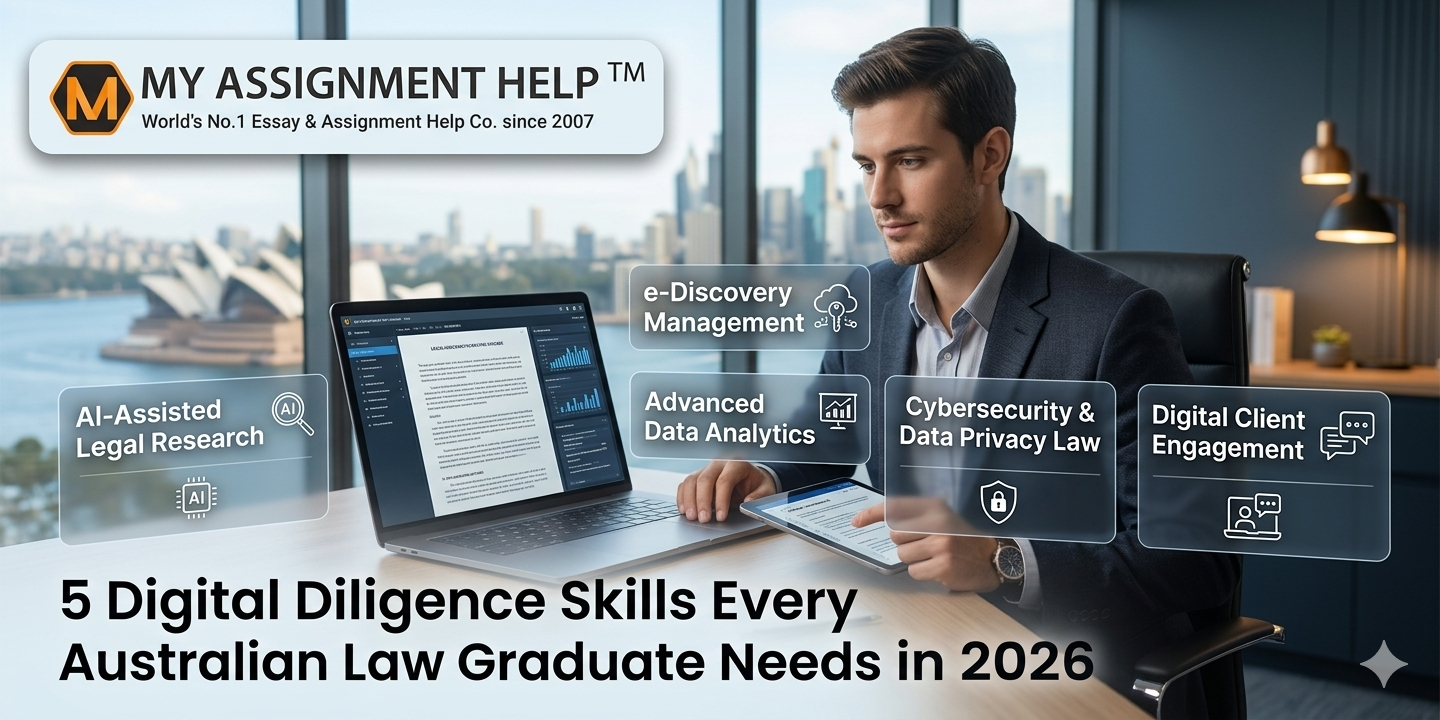
The Australian legal landscape has undergone a seismic shift. As we navigate 2026, the image of a law graduate buried under stacks of physical briefs in a mahogany-lined library is officially a relic of the past. Today, the High Court of Australia and Tier-1 firms across Sydney and Melbourne operate on a digital-first backbone, where “Digital Diligence” has replaced traditional clerical research as the most critical competency for junior solicitors.
For recent graduates from institutions like ANU, USYD, or UWA, the transition from academic theory to the high-stakes environment of modern practice can be jarring. The 2026 legal market demands more than just an understanding of stare decisis; it requires a sophisticated command of the digital tools that now govern the rule of law.
Navigating these technological demands while managing the heavy workload of Practical Legal Training (PLT) can be overwhelming. Many graduates find that seeking professional law assignment help during their final years of study allows them the necessary breathing room to master these emerging digital competencies rather than just memorising case citations. By focusing on high-level digital literacy now, you future-proof your career against the automation of routine legal tasks.
Here are the five essential digital diligence skills every Australian law graduate must master in 2026.
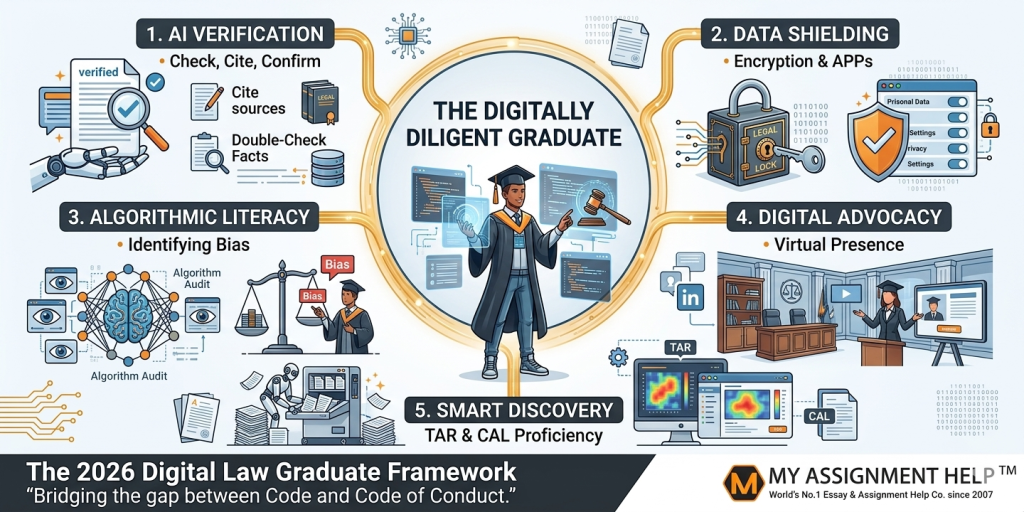
1. AI-Prompt Engineering for Legal Research
In 2026, Large Language Models (LLMs) are no longer “novelties”—they are embedded in LexisNexis and Westlaw. However, the skill lies not in using AI, but in interrogating it. Australian courts have issued strict guidelines regarding “AI Hallucinations,” making the graduate responsible for every automated output.
- The Skill: Moving beyond basic queries to “Chain-of-Thought” prompting. Graduates must know how to structure prompts that force the AI to cite specific Australian Commonwealth statutes and cross-reference them with recent Victorian or NSW Supreme Court precedents.
- Data Point: A 2025 report by the Law Council of Australia indicated that firms using “AI-Optimised Workflows” saw a 40% increase in research efficiency, provided the junior staff had specific training in prompt verification.
2. Cybersecurity & Client Data Stewardship
With the 2024-2025 updates to the Privacy Act 1988, the penalties for data breaches in Australia have reached record highs. For a graduate, digital diligence means understanding the “digital paper trail.”
- The Skill: Proficiency in encrypted communication (Signal, Proton, or Firm-specific portals) and understanding the metadata implications of document sharing. You must be able to explain to a client how their data is stored in compliance with the Australian Privacy Principles (APPs).
- Why it matters: In the event of a leak, “I didn’t know how the cloud worked” is no longer a valid legal defence for professional negligence.
3. E-Discovery and Computational Forensics
Gone are the days of manual discovery. Modern litigation involves petabytes of data, from Slack messages to IoT sensor logs. Graduates in 2026 are expected to be “E-Discovery Architects.”
- The Skill: Using Predictive Coding and Technology-Assisted Review (TAR). You need to understand how to set parameters for “Continuous Active Learning” (CAL) algorithms that sort through millions of documents to find the “smoking gun” email.
- The Australian Context: The Federal Court of Australia’s Technology and the Court practice note now expects practitioners to use the most efficient technological means available to reduce costs for clients.
4. Virtual Courtroom Etiquette & Digital Advocacy
The “Hybrid Courtroom” is the standard in 2026. Whether appearing in a mention via video link or submitting digital evidence bundles, your digital presence is your professional reputation.
- The Skill: Mastering digital presentation software and understanding the nuances of “Virtual Persuasion.” This includes managing multi-screen environments during a hearing and ensuring that digital exhibits are presented seamlessly to the bench.
- Expert Tip: If you find yourself struggling to balance the technical requirements of your final bridge-to-practice units, it may be wise to ask a specialist to “do my assignment” so you can spend your time attending mock virtual trials and refining your digital delivery.
5. Algorithmic Bias Auditing
As government agencies and insurance firms increasingly use algorithms for decision-making, lawyers are now the “auditors of justice.”
- The Skill: Identifying “Black Box” bias. A digital-diligent graduate must know how to challenge an automated decision by understanding the data inputs that led to a potentially discriminatory output. This is a critical skill for those entering Administrative or Human Rights law in Australia.
Key Takeaways
- Verification is Vital: AI is a tool, but the graduate is the “Human in the Loop” responsible for accuracy.
- Security is a Legal Duty: Protecting client data is now as fundamental as solicitor-client privilege.
- Efficiency Drives Value: Firms value graduates who can use E-Discovery to turn a 100-hour task into a 10-hour task.
- Adaptability: The tech you learn today will evolve by 2027; the skill is learning how to learn.
FAQ: Navigating Legal Tech in Australia
Q: Does the use of AI tools violate the Australian Solicitor’s Conduct Rules?
A: Not inherently. However, Rule 3 (Paramount duty to the court) and Rule 4 (Other fundamental ethical duties) mean you are responsible for any errors or breaches of confidentiality caused by an AI tool you employ.
Q: Is “Coding” mandatory for law students in 2026?
A: No, but “Computational Literacy” is. You don’t need to write Python, but you must understand how an algorithm reaches a conclusion to effectively cross-examine it.
Q: How do I stay updated on Australian Legal Tech?
A: Follow the Australian Legal Technology Association (ALTA) and monitor the “Technology and the Law” committees of your respective State Law Society (e.g., Law Institute of Victoria).
About the Author: Lachlan Macquarie
Senior Academic Consultant at MyAssignmentHelp Lachlan holds a Juris Doctor (JD) with a focus on Media and Technology Law. With over eight years of experience in the Australian legal education sector, he specializes in helping students bridge the gap between traditional legal theory and modern digital practice. Lachlan has been a key contributor to MyAssignmentHelp’s curriculum development, ensuring that students receive guidance that is not only academically rigorous but also aligned with the 2026 Australian legal market.
References & Data Sources
- Law Council of Australia (2025): “The State of the Profession: Digital Transformation Report.”
- Office of the Australian Information Commissioner (OAIC): “Annual Report on Notifiable Data Breaches 2024-25.”
- Federal Court of Australia: “Practice Note GPN-TECH: Technology and the Court.”
- The University of Melbourne: “Artificial Intelligence and the Future of Legal Professionalism” (2025 Study).
