

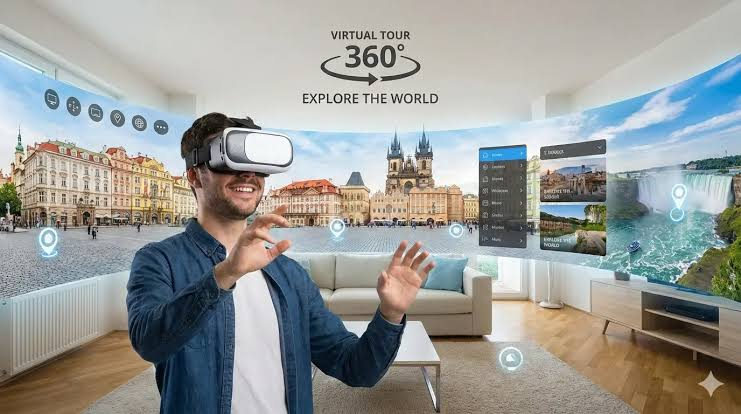
Before visiting a business, people often want to know what they will find when they arrive. Is the restaurant comfortable for a family dinner? Does the hotel room look spacious? Is the gym well equipped? Traditional photographs can answer some of these questions, but they rarely show how an entire space fits together.
360° virtual tour services give potential customers a more complete view. By allowing visitors to explore a location from their phones or computers, businesses can introduce their spaces before anyone steps through the door. This interactive experience helps people understand the environment, feel more confident about their choices, and take the next step toward a visit, enquiry, or booking.
What Are 360° Virtual Tour Services?
A 360° virtual tour is an interactive visual experience that lets users look around a physical location from different viewpoints. Unlike a standard photograph, which shows one fixed angle, a panoramic view allows visitors to turn in different directions and examine their surroundings.
Several connected viewpoints can create a walkthrough of a business. A visitor might begin at the entrance, move into the reception area, and continue through different rooms. Depending on the platform and project, tours can also include information labels, navigation menus, clickable hotspots, or links to relevant services.
Professional virtual tour services typically involve planning the route, capturing panoramic images, editing the visuals, and connecting them into an experience that is easy to navigate. The goal is to help customers understand a place clearly and comfortably.
Showcase Your Space with Greater Clarity
Every physical business has features that are difficult to communicate through text alone. A restaurant may have a beautiful courtyard, a coworking space may offer several working environments, and a showroom may display products across multiple sections.
A virtual tour helps visitors see these features in context. Instead of looking at disconnected images, they can understand how different areas relate to each other. They can assess the atmosphere, notice design details, and explore the spaces most relevant to their needs.
For businesses, the idea is simple: Let customers walk in before they arrive. Giving people an opportunity to explore remotely can make an unfamiliar location feel more approachable.
This is particularly useful when the setting plays an important role in the buying decision. Wedding venues, hotels, fitness studios, and property businesses all benefit from helping customers picture themselves inside the space.
Build Customer Trust Through Transparency
Customers may hesitate when a business website provides only a few carefully framed photographs. They might wonder whether the images represent the whole location or simply its most attractive corner.
A well-planned virtual tour provides broader visual context. Visitors can explore different areas and form their own impressions rather than relying entirely on promotional descriptions. This openness can help a business establish credibility.
For example, a hotel guest might want to understand the relationship between the sleeping area, seating area, and bathroom. Someone choosing a fitness centre may want to inspect equipment spacing and the overall layout. A parent researching a learning centre may appreciate seeing the reception and teaching spaces.
Trust depends on accuracy, so tours should reflect the current condition of the premises. If a business renovates, rearranges its layout, or changes important facilities, updating the tour helps keep customer expectations aligned with reality.
Support Online Visibility with Useful Visual Content
An effective online presence gives people enough information to evaluate a business. A virtual tour adds another useful layer to service pages, location pages, and other relevant parts of a website.
When embedded thoughtfully, an interactive walkthrough can encourage visitors to explore the business in greater depth. It gives them a reason to examine the location while reading about the services available there.
Where supported, panoramic imagery can also contribute to a business’s presence on mapping platforms. However, website tours and mapping integrations are different publishing options, so businesses should confirm what their chosen service includes.
A virtual tour should be treated as part of a wider visibility strategy. Clear page titles, helpful written content, accurate business details, and a usable mobile website remain essential. Adding a tour alone does not guarantee higher search rankings.
The strongest approach combines relevant visual content with information that answers real customer questions.
Help Customers Make More Confident Decisions
Many enquiries begin with uncertainty. A customer likes what a business offers but cannot decide whether the location suits their needs. A virtual tour can help answer practical questions before that uncertainty becomes a reason to leave.
Consider someone comparing venues for a company event. They may need to understand the entrance, seating arrangement, and available meeting areas. Exploring these spaces online can help them decide whether to request availability or arrange an inspection.
Likewise, a traveller comparing accommodation can use a tour to assess room layouts, while a prospective tenant can review how different rooms connect.
Not every viewer will become a customer, and results will vary. However, people who make contact after exploring a tour may already have a clearer understanding of the space. This can make subsequent conversations more focused and productive.
Make Your Business Accessible Beyond Opening Hours
A physical location has opening hours, but customers research businesses whenever it suits them. Some browse during lunch breaks, while others compare options late at night or from another city.
An online virtual tour gives these visitors a way to explore without waiting for an appointment. This is especially helpful for customers planning travel, relocating, or coordinating decisions with other people.
A couple can review a wedding venue together from home. A business team can examine an event space before contacting the venue manager. A prospective member can explore a gym before deciding to visit.
The tour supports early research while leaving staff available to answer questions that need a personal response.
Create a Clear Path from Exploration to Action
A virtual tour becomes more useful when customers know what to do after viewing it. Relevant calls to action can connect the experience with a practical next step.
A hotel might place a booking link near the tour. A property website could offer a viewing request form. A showroom could invite visitors to ask about the products they have seen.
These options should be easy to find without interrupting exploration. Too many pop-ups, labels, or competing buttons can make navigation frustrating.
Businesses should also check the experience on mobile devices. Clear controls, readable labels, and efficient loading help customers explore comfortably. Nearby text descriptions and ordinary navigation links provide useful alternatives for visitors who cannot easily use the interactive tour.
Keep the Experience Accurate and Measure Its Value
Good preparation improves the final result. Spaces should be tidy, lighting should be suitable, and the tour route should reflect how customers naturally move through the premises. Private information and people who have not agreed to appear should be kept out of the images.
After publishing, businesses can review available engagement data, enquiry patterns, and customer feedback. Tracking clicks from the tour to booking or contact pages can help reveal whether it supports meaningful actions.
These observations can guide improvements, such as adding a missing viewpoint or making the next step easier to find.
Conclusion
360° virtual tour services help businesses present their spaces with greater depth and clarity. They allow potential customers to explore layouts, understand the atmosphere, and approach a visit with more realistic expectations.
When combined with accurate information, useful website content, and clear booking or enquiry options, virtual tours can support trust, online visibility, and customer interest. For businesses where the physical environment influences the decision, an interactive walkthrough offers a practical way to turn curiosity into a more confident next step.
