

Picture a Singapore online store that starts getting orders from Kuala Lumpur, Jakarta and Sydney without any marketing in those cities. It looks like a win. But the site is still showing Singapore prices, Singapore spelling and Singapore shipping rules to everyone, and a competitor in each market is quietly outranking it.
That gap is what international SEO services are meant to close. They help search engines show the right version of your site to the right person in the right country, and they help that person trust what they see. Below is what the work actually involves, when you need it, and how to avoid the usual mistakes.
What Are International SEO Services?
International SEO services are the research, technical setup, content and authority-building work that helps a website rank in more than one country or language. The aim is for search engines to match each searcher with the correct regional version of your site, so the visitor lands on a page that suits their location and language.
This is different from simply translating your website. Translation changes the words. International SEO also changes how your site is structured, how search engines read it, and how you earn trust in each new market.
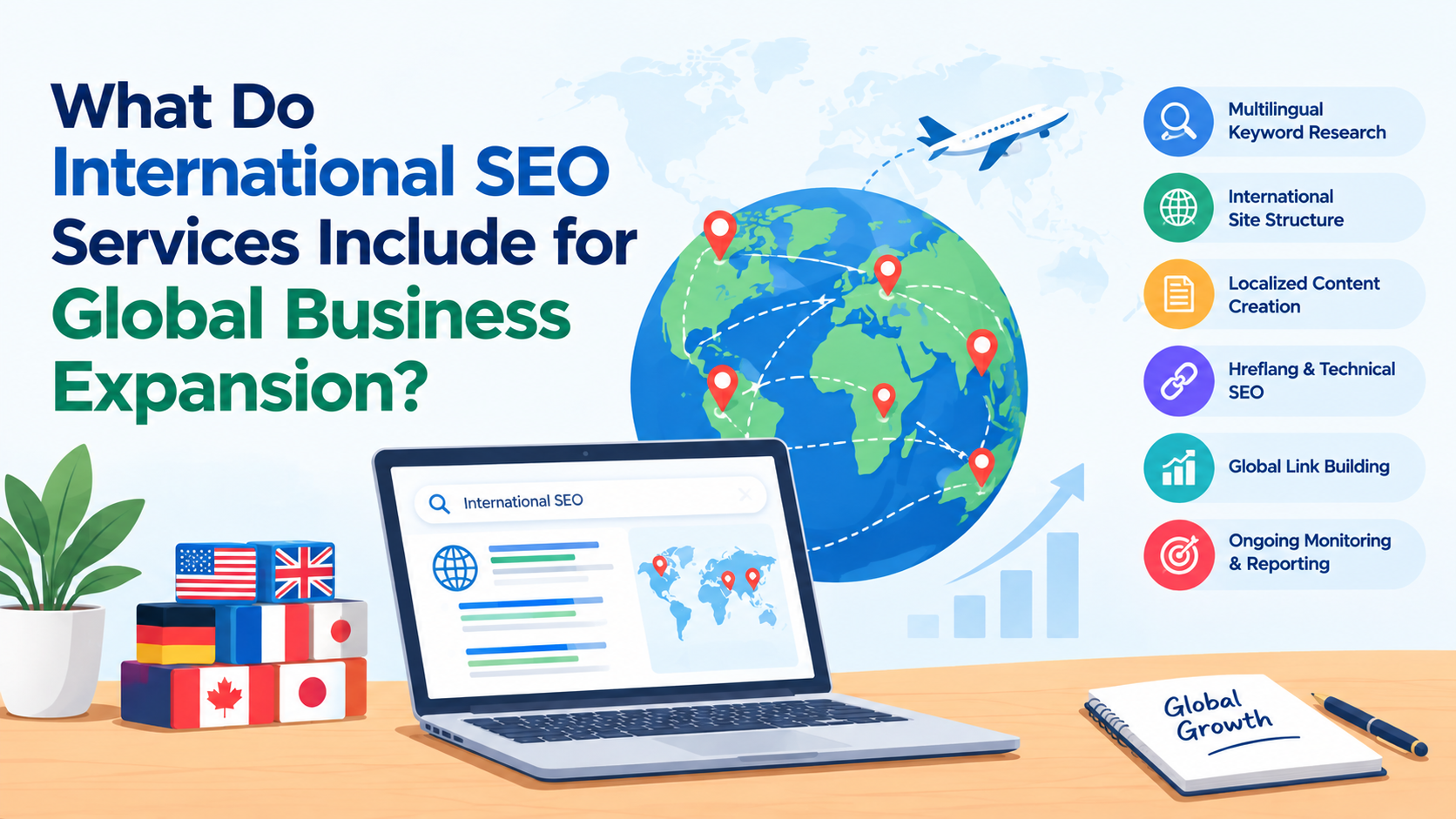
What Do International SEO Services Include?
A complete international SEO service usually covers six areas: market and keyword research, site structure planning, technical setup such as hreflang and canonical tags, localised content, country-specific link building, and ongoing monitoring. Each area supports the others, so skipping one tends to weaken the rest.
Market and keyword research
Good campaigns start with a question: which countries are worth entering first? The answer comes from data you may already have. Look at where your organic traffic and enquiries come from today, which countries convert, and how competitive each market is.
Keyword research then happens in the target language, not in English first and translated later. People in Jakarta don’t search the way a translated English keyword list assumes they do. Local competitors are also worth studying. Their rankings show you what the market already rewards.
Site structure and URL setup
You need to decide how each country’s pages will live on the web. There are three common options, and none is universally best.
| Structure | Example | Works well when | Watch out for |
| Country domain (ccTLD) | example.com.my | You’re committing fully to one country | Higher cost; each domain builds authority separately |
| Subdomain | my.example.com | Regions run fairly independently | Search engines may treat it as a semi-separate site |
| Subfolder | example.com/my/ | You want one domain to carry all the authority | Weaker country signal than a ccTLD |
For many growing businesses, subfolders are the practical middle ground. A company with dedicated country teams and budgets may prefer ccTLDs. Make this choice early, because changing it later means migrations and temporary ranking drops.
Hreflang, canonicals and technical checks
This is the part that quietly breaks most multi-country sites. Hreflang tags tell Google which language and region each page is meant for. They must be reciprocal: if your Singapore page points to your Malaysian page, the Malaysian page must point back.
Alongside hreflang, a technical review typically covers:
- Canonical tags, so similar pages in the same language (say, English for Singapore and English for Australia) don’t compete with each other
- Crawlability and indexation of every regional section
- Page speed for visitors far from your server, often helped by a content delivery network
- Mobile performance, which matters in markets where most browsing happens on phones
Localised content
Localisation goes beyond swapping words. It covers currency, units, date formats, payment methods, product names and tone. The classic example is “trainers” in the UK against “sneakers” in the US. Within Southeast Asia, the same thinking applies to Bahasa Indonesia, Thai or Vietnamese.
Calls to action need the same care. A tone that feels friendly in one country can feel pushy or too casual in another. Native speakers, not just translation software, should review the pages that matter most.
Country-specific link building
A site that’s new to a market has little local credibility. Links from regional news sites, industry blogs and relevant local businesses tell search engines your brand belongs there. Local business listings and citations help too, especially for companies with a physical presence or local partners.
Quality matters more than volume. A handful of relevant regional links will do more than a pile of generic ones.
Tracking and ongoing maintenance
International SEO isn’t a one-off project. Rankings are tracked per country, and a search in Singapore can return different results from one in Malaysia. Google Search Console lets you filter performance by country, and GA4 shows how visitors from each region behave once they arrive.
Teams also keep an eye on indexing errors, broken hreflang pairs and algorithm updates, then fix problems before they spread across markets.
When Does a Singapore Business Need International SEO?
Singapore’s domestic market is small, so many local companies look abroad early. You likely need international SEO if any of these sound familiar:
- You sell online and already get orders or enquiries from other countries
- You’re planning to launch in Malaysia, Indonesia, Thailand, Vietnam or further afield
- You run a SaaS product or service that isn’t limited by geography
- Your site already has several language versions that don’t rank where they should
- Visitors from other countries land on the wrong version of your site
If you only serve customers in Singapore, local SEO is usually the better first investment. International SEO adds cost and complexity, so it should follow real expansion plans.
Common Mistakes That Waste Budget
Most problems come from rushing. These are the ones that show up repeatedly:
- Launching in too many countries at once: Spreading effort thinly means no market gets enough content or links. Start with one or two and expand as results come in.
- Treating machine translation as finished work: Unreviewed translations read awkwardly and often miss how locals actually search.
- Setting up hreflang once and forgetting it: New pages, redesigns and CMS changes break tags without anyone noticing.
- Ignoring local trust signals: Local pricing, payment options, contact details and reviews influence whether a visitor buys, regardless of rankings.
- Expecting fast results: New markets take time. Plan for several months of groundwork before judging performance, and treat any promised overnight ranking with suspicion.
How to Choose the Right Provider
Ask any agency how they would decide which market to enter first, and how they handle hreflang on your specific platform. Vague answers are a warning sign. Look for people who can explain the technical side clearly and who involve native speakers in content.
If you’d rather have specialists handle the heavy lifting, Rankpage offers international seo services that cover market research, technical setup, localised content and link building for brands expanding beyond Singapore. Whichever team you pick, make sure the scope is written down and that reporting is broken out by country.
FAQ
What is the difference between international SEO and local SEO?
International SEO helps a website rank across several countries or languages. Local SEO focuses on visibility in one city or area, such as a clinic or restaurant appearing in nearby searches. Local SEO targets proximity; international SEO targets different regions and languages.
How long does international SEO take to show results?
It varies by market, competition and how much groundwork is needed. Technical fixes can show effects sooner, while rankings in a brand-new country usually take several months to build. Ask any provider for a realistic timeline based on your situation, not a fixed promise.
Do I need a separate website for every country?
No. Many businesses use one domain with subfolders or subdomains for each market. Separate country domains give a stronger local signal but cost more to run. The right choice depends on your budget, team and how different each market is.
What is hreflang and why does it matter?
Hreflang is a code on your pages that tells search engines which language and country each version targets. It helps prevent the wrong version showing up in search results and reduces confusion between similar pages.
Is translating my website enough?
Translation is only one piece. Rankings and sales also depend on local keywords, technical setup, regional trust signals and links from local sources. Without those, translated pages often struggle to appear in search.
Getting Started with International SEO Services
Expanding abroad works best when search visibility is planned alongside the business case. The core of international SEO services is straightforward: research the market, set up the site so search engines understand it, write content that feels native, and earn local credibility over time.
Start by checking where your current visitors come from and pick one market to test properly. If you want a second opinion on your setup or a country shortlist, speak to an agency experienced in multi-country campaigns before you commit your budget.
