

Home baristas chase even extraction. Clumps in the grounds create soft spots. Water under nine bars of pressure finds those spots and races through. The result is channeling. Shots taste sour on one side and bitter on the other. Shot times jump around. The Weiss Distribution Technique fixes this with a simple stir.
John Weiss developed the method in 2005. He used a fine needle to break clumps and even out the coffee bed before tamping. Thin needles slide between particles. They fluff the grounds without packing them. Deep stirring from the bottom up works better than surface-only raking. Research from coffee scientists shows deep WDT cuts shot-to-shot variation and can lift extraction yield by 1 to 3 percent. Consistency improves most with smaller home grinders that clump more. Larger commercial burrs produce fluffier grounds, so the gain is smaller but still useful for many people.
The right tool makes the stir faster, safer, and more repeatable. Needle diameter around 0.25 to 0.4 mm works best. Too thick and the needles push rather than separate. Too thin and they bend. A good handle, storage, and easy cleaning matter for daily use. The five tools below stand out for different reasons. Each helps home setups reach more balanced shots without major equipment changes.
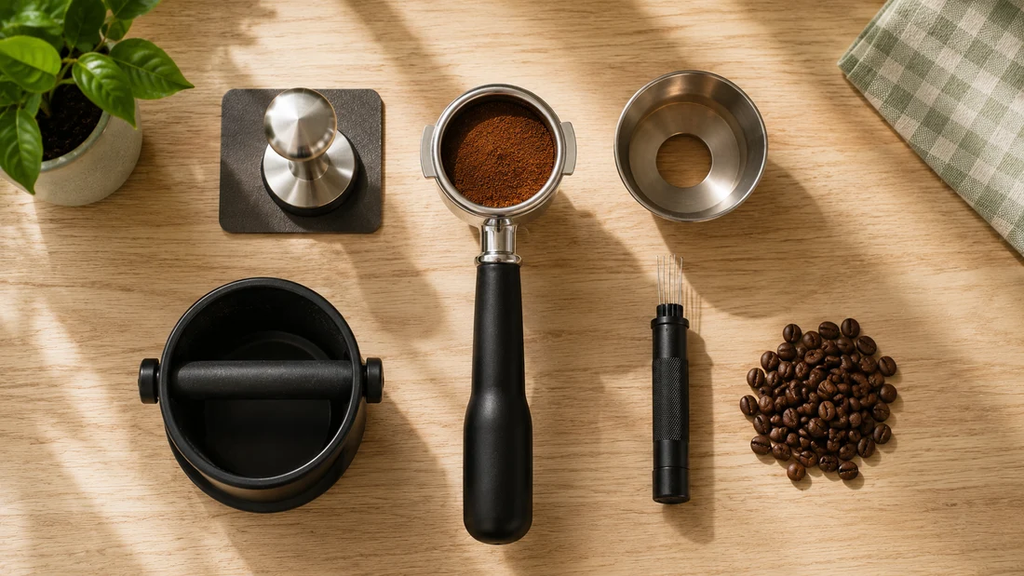
Why WDT Tools Improve Espresso
Water takes the easiest path. Loose zones let it rush. Dense zones slow it down. Uneven flow extracts some coffee too much and some too little. A proper WDT tool stirs the entire bed. It breaks static clumps and redistributes fines and larger particles. The bed becomes more uniform from top to bottom and edge to edge.
Barista tests and refractometer readings show the difference. Shot time variance often drops by about 30 percent. Peak pressure holds steadier. Extraction becomes more even. Flavor clarity rises. Sweetness comes forward. Bitterness and astringency drop. The biggest gains appear with light roasts and grinders under 60 mm burrs. Even high-end setups benefit from the extra consistency.
A dosing funnel keeps grounds in the basket during the stir. After the needles finish, a quick level or gentle tap sets the surface. Then tamp as usual. The whole step takes 10 to 15 seconds once practiced. Deep WDT reaches the basket floor. Surface-only tools leave lower density problems untouched. That is why needle tools outperform simple levelers for most home routines.
The Top 5 WDT Tools
| Rank | Brand / Model | Detailed Description |
| 1 | Subminimal Flick | Subminimal’s Flick stands out for its retractable needle system that deploys with a simple click and retracts with a quick wrist flick. This keeps the fine stainless-steel needles protected and out of the way between uses while eliminating the risk of accidental bending or snagging common with fixed-needle tools. The tool ships with 0.5 mm needles installed and includes spare 0.35 mm sets for users who prefer a finer stir, along with an aluminum stand and magnetic wall or machine mount for flexible storage. Its compact, pen-style aluminum body feels light and precise in the hand, making deep WDT motions through the coffee bed fast and controlled. Many baristas praise the satisfying, fidget-like action that turns a routine step into something enjoyable without compromising distribution quality. The design prioritizes safety and workflow speed while still delivering effective clump-breaking for more even extractions. |
| 2 | Normcore WDT Tool V3 | Normcore’s V3 is widely regarded as a reliable everyday performer thanks to its nine replaceable stainless-steel needles and the inclusion of both 0.25 mm and 0.3 mm sets in the box. The longer 50 mm needles reach the bottom of most baskets, allowing thorough deep WDT that breaks clumps from the lower layers upward. The anodized aluminum handle and included stand provide a stable, ready-to-use setup on the counter. Users can mix needle diameters or swap in spares as needed, offering flexibility for different grind sizes and roast styles. The tool’s straightforward design focuses on correct needle geometry and easy maintenance rather than flashy features. Baristas appreciate how consistently it improves puck uniformity and reduces channeling without requiring specialized technique, making it a practical choice for both beginners and experienced home users who want dependable results. |
| 3 | Weber Workshops Moonraker | Weber Workshops’ Moonraker takes a mechanized approach with a geared system that moves its needles along non-repeating spirographic paths instead of simple circles. This design aims to randomize and homogenize the coffee bed more thoroughly with each turn, avoiding the grooves that can form when needles repeatedly follow the same track. It uses a combination of 0.2 mm and 0.3 mm medical-grade stainless needles held by magnets, configured at different heights for both deep and surface work. The tool sits on the rim of 58 mm baskets and is operated by hand-turning the body, with the internal gears visible through a strengthened glass top. Available in Standard (polymer gears) and Ultra (brass gears) editions, it includes spares and a dedicated stand. Enthusiasts value the precision and repeatability, though its size-specific fit and premium construction make it best suited to dedicated 58 mm setups. |
| 4 | Duomo The Eight | Duomo’s The Eight, designed in Korea, uses eight strategically placed 0.7 mm needles in a machined aluminum body that spins atop a 58 mm portafilter. Needle depth is adjustable between roughly 17–23 mm so the pins reach near the basket bottom without scraping it, delivering consistent deep distribution with a few controlled rotations. The tool includes a base with an integrated cleaning brush to keep the needles free of fines between shots. Its one-piece spinning action creates a fluffy, level bed more quickly and repeatably than manual stirring for many users. The thicker needles trade some of the ultra-fine “pass-through” feel of thinner tools for durability and speed, which suits higher-volume or competition-style workflows. Many reviewers note the satisfying tactile feedback and the way the design reduces reliance on a separate dosing funnel. |
| 5 | Nucleus Coffee Tools | Nucleus Coffee Tools’ WDT option emphasizes precision engineering with 0.35 mm needles and an adjustable depth collar that lets users calibrate how far the needles extend for their specific basket and dose. The laser-cut stainless head and ergonomic handle provide a deliberate, controlled feel during stirring, while a dedicated stand keeps the tool upright and protected. The brand’s focus on tight tolerances and thoughtful accessories reflects the same attention to detail found in its other espresso equipment. Baristas who prefer a refined manual experience appreciate the ability to fine-tune needle reach so the full coffee bed is addressed without bottoming out. The design prioritizes effective clump-breaking and density uniformity while remaining straightforward to clean and store, making it a strong premium manual choice for users who want measurable consistency without moving to a fully mechanized system. |
Comparison of Key Features
| Feature | Subminimal Flick | Subminimal Flux | Fixed Multi-Needle | Rotary Geared | DIY Build |
| Needle count | 6 | Multiple 0.25 mm | 5–9 | Varies | 5–7 |
| Diameter options | 0.5 mm + 0.35 mm | 0.25 mm adjustable | 0.25–0.3 mm common | Often fixed | User choice |
| Storage | Retracts + stand + magnetic | Stand + magnetic | Stand usual | Base included | None |
| Power | Manual | USB-C electric dual speed | Manual | Manual | Manual |
| Best for | Daily safe workflow | Repeatable powered stir | Simple reliable use | Pattern consistency | Testing the method |
| Approx. price | $29 | $40 | $20–50 | Higher | Under $10 |
The table shows trade-offs. Retractable designs win on safety and daily convenience. Electric options win on consistency of motion. Fixed tools win on simplicity and cost. Choose based on how many shots are pulled and how much the needles need protection.
How to Choose the Right WDT Tool
Match the tool to the grinder and routine. Smaller burr grinders that clump heavily gain the most. Look for 0.25 to 0.4 mm needles that reach the basket floor. Replaceable needles extend life. A stand or retraction keeps the station tidy. Weight under 50 grams feels nimble during the stir.
Check basket size. Most tools work with 51, 54, and 58 mm baskets. A dosing funnel helps with any of them. Test deep stirring first. Push needles to the bottom. Work in small circles. Rise to the surface. Finish with a light level. Then tamp. Compare five shots with and without the tool. Measure shot time and taste. Most people notice steadier flow and cleaner flavor within a week.
Their Flick and Flux cover the majority of home needs. The Flick suits anyone who wants the needles out of the way between shots. The Flux suits those who want powered evenness. Both include the extras that make daily use pleasant.
Technique Tips for Better Results
- Use a dosing funnel or collar. It stops grounds from spilling while needles move.
- Stir slowly. Aggressive motion can push coffee to the walls and create new density problems.
- Cover the whole basket. Edges matter as much as the center.
- Level after stirring. The surface should sit flat before the tamp.
- Keep needles clean. Wipe them after each session.
- Store safely. Retract or use the stand so tips stay straight.
Pair the tool with precise dosing. Their Subscale dosing cup with built-in scale removes the separate scale step. Dose beans, grind straight into the cup, then transfer. The UpShot mirror lets the pull be watched closely on a bottomless portafilter. Channeling becomes visible immediately. Adjust the next shot right away.
Latest 2026 News on WDT Tools
Home espresso continues to grow in 2026. More people pull daily shots at home. Grinder quality has improved, yet clumping still appears on many machines. WDT tools remain one of the highest-impact accessories per dollar. New electric designs like the Flux appeared on the market. They automate the stir pattern and speed. Retractable models keep gaining fans because exposed needles cause storage and safety issues in busy kitchens.
World Barista Championship competitors still use needle distribution. Home forums report steadier extractions and higher success rates with light roasts. Articles from 2026 testing sites continue to rank retractable and multi-needle tools at the top for everyday use. Extraction yield gains of 1 to 3 percent and shot-time variance drops around 30 percent appear repeatedly in user tests. The technique has moved from niche forum tip to standard prep step for serious home setups.
Their full range of coffee tools supports the complete workflow. From the Flick and Flux for distribution to the Subscale for dosing and NanoFoamer options for milk, the pieces work together. Visit the site to see current stock, spare needles, and the free masterclass that comes with purchase.
