

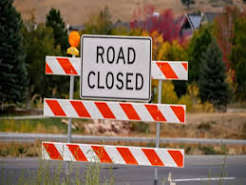
You are on your way down an already known street and suddenly notice a flashy sign along with a barricade up ahead. You know the streets are closed, but what should be the next move? A proper street closed sign will take care of all of your problems.
For municipalities, contractors, event organizers, and property managers, knowing how to use street closed signs is as crucial as recognizing their importance. This guide will explain what a street closed sign is, when should it be used, and how to pick up safety signs.
What Does a Street Closed Sign Mean?
Street Closed Sign: the sign indicates that the road is closed for the traffic movement and no vehicle is allowed to pass. This kind of traffic sign belongs to the category of regulatory signs.
The sign might be either temporary or permanent, and its closing can either be partial or complete. Additional legend may appear as an addition to the main sign, indicating for example “Local Traffic Only,” “Detour Ahead,” or “Open to Thru Traffic” to show who can and who cannot pass by.
There can be different terms used, such as “Street Closed” or “Road Closed.” What matters most is to check with the local transportation authority what is the term to use for a sign legend.
What Does a Street Closed Sign Look Like?
Street closures signs adhere to the same set of guidelines that apply to all regulatory signs, making them easily recognizable by drivers. Typical characteristics of street closure signs may include:
- High contrast and clear lettering in order to make the message noticeable at once
- Rectangular shape typical of regulatory signs
- Reflective sheeting material for night visibility
- Standard sizes, larger ones for fast and multiple lane streets
This consistency is important. With familiar signs, drivers act more promptly and safely.
When Should You Use a Street Closed Sign?
A street closed sign is applicable anytime there is an obstruction of a road. The following are some of the cases when a street closed sign is applicable.
- Construction of roads or bridges or any kind of road maintenance work which involves closing up the road.
- Special events that will take place within the road like a marathon or a community parade. This will enable drivers to know about the closure of the road in good time.
- Accidents and emergencies. These are unforeseen situations like fires and flood. In such cases, portable signs are very important to secure the place at once.
- Bad weather conditions. These include bad snow storms, flood and falling down trees which make a road inaccessible.
- Production works that involve filming on location or other kinds of productions.
- Private roads that are owned by institutions and private firms.
Where to Place a Street Closed Sign
Placement is crucial for a proper closure. Signs which are placed too late cause sudden braking or dangerous maneuvers for drivers. These rules have to be taken into account:
- Warn drivers in advance. Sign placement should allow drivers to slow down, make a decision, and turn.
- Sign the closure site. The sign should be located near the barricades or barriers for drivers to know that the road is finished here.
- Include detour instructions. Signs should be placed together with detour signs or arrows for drivers’ convenience.
- Use signs for two-way roads. It’s necessary to place signs for both directions.
- Do not obstruct signs. Drivers should have an unobstructed view on signs – parked cars, trees and other obstacles should not block signs.
It would also be helpful to walk or drive the approach prior to the start of the work. If the sign cannot be spotted easily from the driver’s seat, a moving driver will not see it either.
How to Choose the Right Street Closed Sign
Every closure doesn’t require a sign of the same kind. Here are things to consider prior to making the purchase.
Duration of time. Portable signs on poles can be used in the case of short events. Projects that take much time will need durable mounted signs that withstand weather for weeks or months.
Speed and kind of road. Fast roads require large letters and reflective sheeting that would allow drivers to understand the message in time.
Material. The most commonly used material is aluminum due to its resistance to corrosion and durability when exposed to outdoor conditions. In the case of temporary use, light-weighted portable and roll up signs might be a better option.
Reflectivity. High-intensity or prismatic sheeting is required in cases of night-time works.
Compliance. Make sure your signs correspond with local and country-wide regulations about sizes, colors, and wording of the signs. It helps to be on the safe side when closure becomes disputable.
Customization. Sometimes closure requires more than general message to be conveyed.
Why Work With a Road Signs Supplier
Purchase of signs from a reputable road signs supplier will save your valuable time and help you avoid expensive mistakes. A reputable supplier will be able to direct you as to the best choice of sizes, sheathing and mounting materials for your particular needs. They will also be able to ensure that your order is in accordance with the latest standards, which is essential for public roads and urban developments.
In addition, a reliable supplier provides you with consistency. If you require replacement of an old sign or production of additional ones, it will be a lot easier if you have one supplier.
When Custom Road Signs Make Sense
Regular signage addresses most requirements, but custom road signage becomes the more suitable option when your case is unique. Unique cases include the following:
- Events requiring certain dates, names, or directions
- Private property and campuses with unique traffic regulations
- Construction projects requiring unique detour messaging
- Municipalities requiring signage with a local color or language
Custom signage should still adhere to standard color and design codes. The aim should be to provide additional information without increasing the difficulty of reading the sign, hence keeping the message brief and using large letters.
Common Mistakes to Avoid
Several minor mistakes account for most closure errors:
- Setting up signs too late, such that drivers will not have time to react
- Using faded/damaged signs that do not reflect properly anymore
- Failing to take down signs after the road has been reopened, confusing drivers
- Provision of a closure sign without providing any information regarding the detour
- Using flimsy stands that easily topple due to wind
- Checking signs before and during the closure can help fix these issues.
Frequently Asked Questions
1. What is the meaning of a street closed sign?
It is a sign indicating that the road ahead is closed to any vehicle and drivers have to return back or take another route according to the sign.
2. Is it legal to put up a street closed sign?
Yes, provided that it is installed by a proper authority or under certain permits and adheres to local laws. Drivers who violate such a sign may be fined or get other punishment.
3. What is the difference between a street closed sign and road closed sign?
There is no difference, it is just about wording. It depends on local requirements or kind of road you are using.
4. How far ahead do I have to put up an advance closure sign?
It depends on road speed and number of cars traveling by it. Fast roads require a larger amount of warning.
5. May I order my own signs for street closure?
Yes, you can. Road signs manufacturers can make special road signs with required wording or dates or routes but still meeting all the requirements for road sign.
Conclusion
A well-chosen street closed sign protects drivers, workers, and pedestrians while keeping traffic moving in an orderly way. The key is to understand what the sign means, place it early and clearly, and choose materials that match the length and conditions of your closure.
If you need dependable signs for your next project, roadwaysigns offers a wide selection of street closed signs and custom road signs built for durability and visibility. As a trusted road signs supplier, www.roadwaysigns.com can help you find the right solution for your event, construction site, or city project.
