

The construction industry is constantly evolving. Growing infrastructure requirements, complex building projects, rising material costs, and increasing customer expectations have made construction business management more challenging than ever. Companies must coordinate several activities simultaneously, including project planning, material purchasing, workforce allocation, contractor management, financial operations, and site execution.
Managing these activities independently can create communication gaps, inaccurate cost calculations, project delays, and difficulties in tracking business performance. Construction companies therefore need a smarter way to connect their operations and maintain control over every stage of a project.
ERP for construction industry provides an integrated solution to address these challenges. It connects different business functions through a centralized platform, allowing construction companies to manage projects, monitor expenses, organize resources, and improve operational efficiency.
Understanding the Role of ERP in Modern Construction Businesses
Construction projects involve much more than completing physical structures. Every project requires detailed planning, financial forecasting, resource allocation, procurement, documentation, and continuous monitoring.
An ERP system for construction companies brings these activities together under one management platform. Instead of depending on separate spreadsheets, disconnected applications, and manual reporting, businesses can maintain important operational information in a common system.
For example, when a project manager needs information about material availability, purchase orders, labour expenses, or project budgets, the required details can be accessed through the ERP system. This improves coordination between the head office, project management teams, and construction sites.
Whether a company specializes in residential buildings, commercial developments, industrial construction, or large infrastructure projects, construction ERP software can support better business management.
Five Major Challenges That Construction ERP Software Can Address
1. Managing Multiple Projects Without Losing Control
Construction companies frequently handle several projects across different locations. Each project has its own budget, completion schedule, workforce, contractors, and material requirements.
Without a centralized system, tracking the progress of every project becomes difficult. An ERP for construction companies helps management teams maintain project-wise information, review ongoing activities, monitor milestones, and identify potential delays.
This makes it easier to understand which projects are progressing according to schedule and which require additional attention.
2. Preventing Material Shortages and Unnecessary Purchases
Materials represent a significant portion of construction expenditure. Purchasing too much stock can increase storage costs, while insufficient materials can interrupt work at construction sites.
Construction ERP software helps businesses monitor inventory levels, record material consumption, manage warehouse operations, and coordinate purchasing activities.
By maintaining accurate stock information, companies can plan purchases according to actual project requirements and avoid unnecessary material accumulation.
3. Keeping Project Budgets Under Control
Unexpected expenses can significantly affect construction project profitability. Labour costs, equipment expenses, transportation, material price fluctuations, and subcontractor payments must all be monitored carefully.
An integrated construction ERP system connects financial information with project activities. Management can compare estimated budgets with actual expenditure, review pending payments, and identify areas where costs are increasing.
This provides better financial visibility and supports timely corrective decisions.
4. Improving Coordination Between Office and Site Teams
Communication is essential for successful construction project execution. Site engineers, contractors, accountants, procurement departments, and project managers must work together to complete activities efficiently.
When information is scattered across emails, spreadsheets, and paper documents, important updates can be missed.
An ERP system provides a common information platform where authorized users can access relevant business records. This reduces information gaps and improves coordination between departments.
5. Simplifying Contractor Billing and Client Payments
Construction businesses regularly deal with subcontractor bills, work orders, client invoices, retention amounts, and payment schedules.
Managing these transactions manually can create reconciliation problems and delays.
Construction ERP software helps organize contractual information, monitor billing activities, record financial transactions, and maintain payment-related documentation.
Essential Modules to Look for in ERP Software for the Construction Industry
Selecting the right construction ERP system requires understanding the modules that support daily business operations.
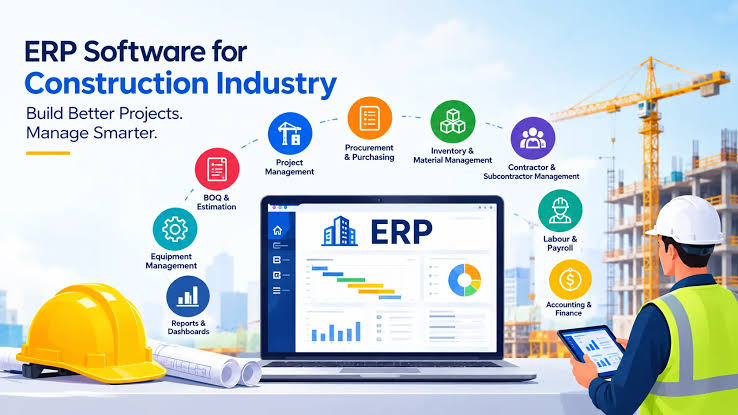
Project Management: Manage project schedules, work progress, milestones, resource allocation, and execution activities.
Tendering and Estimation: Prepare project estimates, manage tender documents, calculate expected costs, and maintain quotation records.
Procurement Management: Handle purchase requests, supplier quotations, purchase orders, and vendor information.
Inventory Management: Monitor material availability, warehouse stock, site transfers, and material consumption.
Financial Management: Manage accounting, project budgets, cash flow, receivables, payables, and financial reporting.
Contract Management: Maintain contractor agreements, subcontractor details, work orders, and billing information.
HR and Payroll: Organize employee information, attendance, salary processing, and workforce administration.
Having these functions connected in one ERP platform helps businesses reduce administrative complexity and maintain better control over their operations.
How eresource Nfra ERP Supports Construction and Infrastructure Companies
Choosing an ERP solution designed around construction business requirements can make a considerable difference in operational management.
eresource Nfra ERP is developed for construction and infrastructure companies that need better coordination between project activities and business operations.
It supports construction businesses in managing activities from the initial tendering stage through project execution and client billing. By connecting important business functions, the software helps management teams maintain project-related information and monitor operational activities more effectively.
Some of its key business management capabilities include:
- Tendering and project estimation.
- Project planning and execution.
- Budget monitoring and expenditure control.
- Purchase and procurement operations.
- Inventory and material management.
- Finance and accounting management.
- HR and workforce administration.
- Contractor and subcontractor management.
- Client billing and reporting.
With an integrated approach to construction business management, eresource Nfra ERP helps companies improve information accessibility, organize their workflows, and make more informed operational decisions.
What Should You Consider Before Selecting a Construction ERP System?
Not every ERP solution is suitable for every construction business. Before selecting software, companies should evaluate their project requirements, business size, operational complexity, and future expansion plans.
Consider the following factors:
- Industry suitability: Select software that supports construction-specific processes rather than relying entirely on generic business management features.
- Customization: Ensure the system can accommodate your company’s project workflows and reporting requirements.
- Integration: Check whether important departments can work together through connected modules.
- Reporting capabilities: Look for reports that provide useful information about project expenses, procurement, inventory, and financial performance.
- Scalability: Choose a solution that can support additional projects, employees, and business locations as the company grows.
- Implementation support: Evaluate training, technical assistance, and ongoing customer support.
A well-selected ERP system should address existing operational challenges while supporting the company’s long-term business objectives.
Conclusion
Successful construction management depends on more than completing projects on time. Companies must also control expenses, manage resources, coordinate teams, maintain financial accuracy, and ensure smooth communication between different departments.
ERP for the construction industry offers a practical approach to bringing these responsibilities together through integrated technology. It helps businesses replace disconnected processes with organized workflows, better information management, and improved operational visibility.
For construction and infrastructure companies looking to modernize their business operations, solutions such as eresource Nfra ERP can provide a structured approach to managing projects from tendering and planning to execution and billing.
Investing in the right construction or civil ERP software is not simply about adopting new technology; it is about creating a more organized, efficient, and sustainable construction business.
