

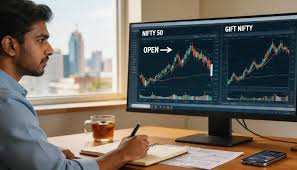
Before Indian equity trading begins, overnight developments have already given investors plenty to consider. US markets may have fallen, Asian shares may be rising, or an economic announcement may have changed expectations. GIFT Nifty provides a market-based indication of how participants are responding.
Its movements can help you assess whether the Nifty 50 might open higher or lower. However, reading it accurately requires more than comparing two headline numbers. The contract, quotation time and difference between futures and spot prices all matter.
Understanding the signal
GIFT Nifty refers to Nifty-linked derivatives traded on NSE International Exchange, or NSE IX, at GIFT City. When discussing the likely Indian market opening, investors generally mean the Nifty futures contract. NSE IX provides access to US dollar-denominated Nifty derivatives.
The distinction matters: a futures price is the price of a contract linked to the underlying index. It is not the current value of the Nifty 50 itself.
Trading extends beyond India’s domestic equity-market hours. This allows participants to respond to developments while the Indian cash market is closed, making the contract useful for observing changes in sentiment before domestic trading resumes.
What an upward or downward move suggests
A rising GIFT Nifty futures price before the domestic opening can suggest improving expectations for Indian equities. A decline can suggest a weaker opening. Neither establishes the exact opening level.
Pay attention to the reference point. A displayed daily change may measure movement against that contract’s previous settlement or another reference specified by the data provider. It should not automatically be read as the expected change from the Nifty 50’s previous closing value.
Also check the timestamp. A quote captured before an important announcement may no longer reflect the information available closer to the opening.
Why the futures level differs from the index
Futures and spot prices need not match before expiry. Their difference is commonly called the basis.
Equity futures pricing incorporates factors such as financing costs, expected dividends and time remaining until expiry. Trading demand and supply can also affect the observed price. NSE’s educational material explains that equity futures’ cost of carry reflects financing costs less dividends.
Consider an illustration: the Nifty 50 previously closed at 25,000, while a GIFT Nifty futures contract trades at 25,120. Subtracting the two gives 120 points, but this does not establish a 120-point opening gain. Part of the difference may reflect the futures premium.
The figures shown are for illustrative purpose only.
For a cleaner assessment of overnight movement, compare the same contract at consistent observation times. Even then, its change remains an indication rather than an exact opening forecast.
How the domestic opening is determined
GIFT Nifty does not set opening prices for Indian shares. Domestic buy and sell orders determine price discovery.
NSE’s regular equity pre-open session runs from 9:00 am to 9:15 am. Its call-auction process seeks an equilibrium price based on executable volume, with additional rules used where necessary. Indicative prices can change while orders are being collected.
As domestic orders arrive, company-specific developments and local demand can produce a different picture from the earlier futures signal.
A positive indication can therefore weaken before trading begins. Equally, domestic buying may produce a stronger opening than an earlier GIFT Nifty quote suggested. The Nifty 50 opening reflects its constituent share prices, rather than a direct transfer of the offshore futures level.
Checks that make the signal more useful
Before drawing a conclusion, work through these checks:
- Confirm the contract: Check its expiry month, because different expiries can trade at different prices.
- Confirm the time: Use a recent quote and establish whether the feed is delayed.
- Check the reference: Identify what the displayed points or percentage change is measured against.
- Assess trading activity: A stale last-traded price may be less informative than current bids, offers and recent trades.
- Review fresh news: Developments after the quoted trade can change expectations.
- Follow domestic price discovery: Reassess the indication as pre-open information becomes available.
These checks help distinguish a meaningful market update from a number viewed without context.
What it cannot tell you about the trading day
An opening indication does not establish the day’s closing direction. A higher opening can be followed by selling, while an initially weak market can recover. It also cannot identify which individual shares will outperform. An index-level move can conceal different responses across companies and sectors.
For a long-term investor, the signal mainly provides context for short-term market movements. Changing a goal-based investment plan solely because GIFT Nifty rises or falls gives one overnight observation more importance than it can reasonably support.
Conclusion
GIFT Nifty offers an early view of sentiment towards the Nifty 50, but its futures price is not an exact opening forecast. Check the contract, timestamp, reference point and futures premium, then follow domestic price discovery. Use the signal to understand market conditions alongside your investment horizon and portfolio needs.
Mutual Fund investments are subject to market risks, read all scheme related documents carefully.
This document should not be treated as endorsement of the views/opinions or as investment advice. This document should not be construed as a research report or a recommendation to buy or sell any security. This document is for information purpose only and should not be construed as a promise on minimum returns or safeguard of capital. This document alone is not sufficient and should not be used for the development or implementation of an investment strategy. The recipient should note and understand that the information provided above may not contain all the material aspects relevant for making an investment decision. Investors are advised to consult their own investment advisor before making any investment decision in light of their risk appetite, investment goals and horizon. This information is subject to change without any prior notice.
The content herein has been prepared on the basis of publicly available information believed to be reliable. However, Bajaj Asset Management Limited (formerly known as Bajaj Finserv Asset Management Limited) does not guarantee the accuracy of such information, assure its completeness or warrant such information will not be changed. The tax information (if any) in this article is based on prevailing laws at the time of publishing the article and is subject to change. Please consult a tax professional or refer to the latest regulations for up-to-date information.
