


DMARC reports play a crucial role in protecting domains against email spoofing and phishing attacks. They provide valuable insights into email authentication results, helping organizations identify unauthorized senders, detect suspicious activity, and investigate potential threats. By analyzing aggregate and forensic reports, businesses can strengthen their email security, improve SPF and DKIM alignment, and take proactive steps to prevent attackers from impersonating their domains.
What DMARC Reports Are and Why They Matter
A DMARC report is a core component in contemporary email authentication, offering granular insight into email flows and authentication outcomes for your domain. Released by ISPs and participating email receivers like Google, Comcast, and Microsoft, these reports act as a comprehensive audit trail for all email traffic passing DMARC validation checks defined in your DMARC record. By leveraging information encapsulated in DMARC aggregate reports and forensic (failure) reports, organizations can systematically monitor, analyze, and react to authentication anomalies that would otherwise leave their domain exposed to spoofing and phishing.
DMARC adoption hinges on correct DMARC record deployment within your DNS zone. This record specifies your intended DMARC policy (such as p=none or p=reject), your preferred reporting URIs (rua tag for aggregate reports, ruf tag for forensic reports), and all necessary email authentication parameters. When a receiving server, such as one at Google Workspace or Mailtrap, processes an incoming email, it queries the Domain Name System (DNS) for the sender’s DMARC record to determine how to handle authentication failures and where to send report data. These reports, typically in XML format, are sent to the reporting addresses listed in the DMARC record with the proper rua and ruf tags.
The importance of DMARC reports cannot be understated. They provide actionable evidence on authentication status, revealing both legitimate and malicious email sources. With the help of DMARC analyzers, such as EasyDMARC or Aggregate XML Reports Analyzer, organizations gain rapid insights, supporting domain protection, email compliance, and DMARC enforcement. Without these reports, organizations lack visibility into non-compliant sources, undermining efforts to secure their email infrastructure.
How Aggregate Reports Reveal Unauthorized Email Sources
Decoding Aggregate Reports
The DMARC aggregate report, sometimes referred to as a “rua report,” is a summary record, delivered in an XML format, generated typically once per day (but may follow a different reporting interval, depending on the recipient ESP and the DNS record’s report frequency). This report collects information about batches of emails coming from specific sender sources, showing key email authentication metrics for each segment.
Within each aggregate report, details are categorized by message disposition, authentication results for SPF and DKIM, and crucially, source IP addresses. These reports are automatically parsed by DMARC monitoring tools such as EasyDMARC and uploaded to a report dashboard for streamlined analysis.
Detection of Non-Compliant Email Activity
By continuously ingesting and parsing the volume of emails reported, aggregate reports allow security teams to:
- Spot unauthorized sources: If emails originate from unknown senders or infrastructure (IP addresses, ESPs, or email vendors not sanctioned for your domain), these will appear as non-compliant entries within the report. Using report filtering and reverse lookup techniques, you can identify and investigate these sender sources.
- Map authentication failures: Aggregate reports reveal the alignment of SPF and DKIM signatures. Lack of SPF alignment or DKIM alignment often hints at spoofing attempts or misconfigured legitimate vendors.
- Monitor compliance and effectiveness: You can track trends in SPF, DKIM, and overall DMARC compliance, informing risk assessments and policy changes.
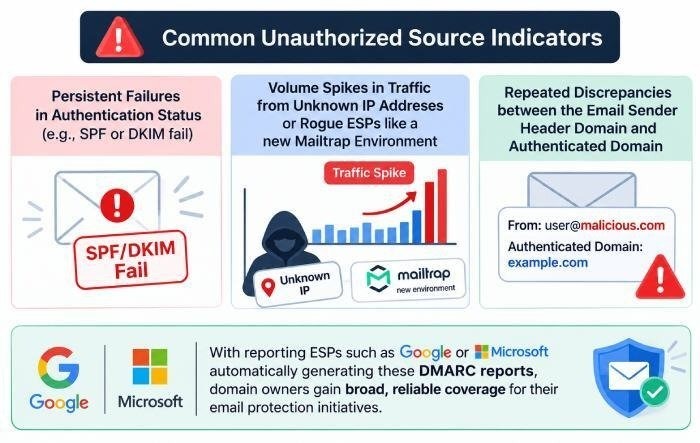
Common Unauthorized Source Indicators
- Persistent failures in authentication status (e.g., SPF or DKIM fail)
- Volume spikes in traffic from unknown IP addresses or rogue ESPs like a new Mailtrap environment
- Repeated discrepancies between the email sender header domain and authenticated domain
With reporting ESPs such as Google or Microsoft automatically generating these DMARC reports, domain owners gain broad, reliable coverage for their email protection initiatives.
How Forensic Reports Help Investigate Suspicious Messages
The Role of Failure Reports (Forensic Reports)
While aggregate reports provide summarized metrics, failure reports, also known as DMARC forensic reports or “ruf reports,” offer granular, real-time detail about individual authentication failures. These reports are dispatched whenever a message fails DMARC checks according to the policy in the DMARC record and are routed to the reporting address specified in the ruf tag.
Forensic reports are invaluable in forensic email investigations because they include:
- Detailed email headers and sometimes message excerpts
- Authentication failure reasons (SPF and/or DKIM problems)
- The exact sender, recipient, and message metadata
- Delivery status and message disposition details
How Forensic Reports Aid Phishing and Spoofing Response
When a suspicious, potentially malicious email lands, a forensic report helps the security team instantly:
- Analyze the failure context and pinpoint the nature of authentication breakdown (SPF fail, DKIM fail, header mismatch, etc.)
- Determine if the message is part of a coordinated phishing or spoofing attack by cross-referencing sender sources and message content
- Facilitate incident response by providing rapid, reliable evidence for blocking malicious infrastructure or tightening policies
Tools like EasyDMARC’s Failure Report Exporter and the Forensic Reports tab in many DMARC monitoring dashboards allow granular parsing, filtering, and export of these insights for archiving or escalation.
Identifying Spoofing and Phishing Patterns in DMARC Data
Recognizing Patterns in Aggregate and Forensic Reports
Proper DMARC monitoring enables organizations to identify recurring patterns indicative of phishing and domain spoofing. Aggregate reports highlight trends in non-compliant sources, while forensic reports expose attack vectors at the granularity of individual malicious email.
Typical Spoofing and Phishing Signs
- Sudden surges in unauthorized message volume: Especially from new senders or unfamiliar ESPs, these spikes often indicate a fresh phishing campaign.
- Repeated header alignment mismatches: Consistent failure in SPF or DKIM alignment marks attempts to impersonate your header domain.
- Spoofed vendor or infrastructure details: Identification of rogue or misused email vendors appearing in aggregate reports through email vendor identification techniques.
- Automated sender source patterns: Use of automated report analyzer tools can reveal IP clusters or recurring reverse lookup results tracing to threat actor infrastructure.
Implementing best practices for report parsing and data visualization—via report dashboards and compliance tabs—makes these anomalies quickly actionable.
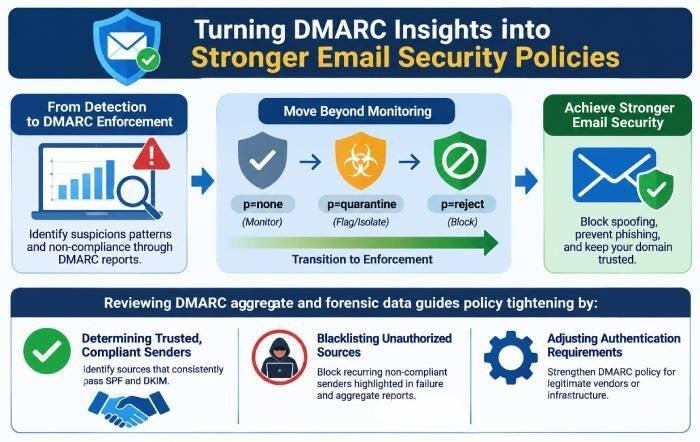
Turning DMARC Insights into Stronger Email Security Policies
From Detection to DMARC Enforcement
Once suspicious patterns and non-compliance are detected, the next phase is refining organizational DMARC policy controls. The DMARC record’s p=none policy is excellent for monitoring during initial phases, but meaningful protection comes with DMARC enforcement—transitioning to quarantine or p=reject status.
Reviewing DMARC aggregate and forensic data guides policy tightening by:
- Determining trusted, compliant senders who consistently pass SPF and DKIM
- Blacklisting unauthorized or recurring non-compliant sources highlighted in failure and aggregate reports
- Adjusting authentication requirements for legitimate vendors or infrastructure
Automating Policy Improvements
With reporting solutions like EasyDMARC, organizations can leverage automated DMARC record generators, report exporters, and report analyzers to build a secure, report-driven workflow.
These platforms enable:
- Scheduled report parsing with notifications for sudden volume changes or compliance shifts
- Centralized management of reporting addresses and reporting intervals for optimal visibility
- Integration of email authentication metrics and DMARC monitoring insights into broader security architectures
Collaboration and Expert Support
Complex policy questions regarding SPF alignment, DKIM alignment, and advanced DNS TXT Record configuration can be managed with DMARC expert support or through trusted vendors with extensive email security experience.
Incorporating feedback from ongoing DMARC monitoring, using both historical and real-time failure reports, ensures that policy enforcement matches evolving threats, delivering comprehensive domain protection.
As phishing and spoofing threats advance, continual adjustment of DMARC records, monitoring tools, and organizational best practices remains vital for robust email authentication and domain integrity.
