

Introduction
Large Language Models (LLMs) are changing how people interact with financial information. AI-powered applications can summarize market trends, explain stock movements, analyze financial data, and answer investment-related questions. However, most LLMs have one important limitation: they do not automatically have access to live stock market information.
Their knowledge generally comes from previously collected training data, which may not reflect current market conditions. To overcome this limitation, developers can connect LLMs with real-time stock market data APIs.
An LLM stock market data API integration allows AI applications to retrieve current prices, trading volumes, historical information, and market indicators whenever needed. This combination makes financial AI applications more useful, responsive, and data-driven.
In this guide, we will explain how to connect LLMs to real-time stock market APIs, which technologies are required, and how to build a basic integration.
What Is an LLM Stock Market Data API?
An LLM stock market data API is a connection between a large language model and a financial data provider. It allows an AI application to retrieve financial information from an external source instead of depending entirely on its existing knowledge.
For example, a user might ask an AI assistant:
- What is Apple’s current stock price?
- How has Microsoft performed today?
- Which stocks have experienced unusual trading volume?
- What are the latest price movements in the US stock market?
Without a live data connection, an LLM may provide outdated or incomplete information. With an API integration, the application can retrieve updated market information and use it to generate a relevant response.
Developers can explore an LLM Stock Market Data API to understand how live financial information can support AI research, market analysis, and intelligent applications.
Why Connect LLMs to Real-Time Stock Market Data?
Connecting an LLM to a financial data source offers several advantages.
1. Access to Current Market Prices
Stock prices change throughout the trading session. A live API connection allows AI applications to retrieve updated prices rather than relying on historical training information.
This is particularly useful for applications that answer questions about current market conditions.
2. Better Financial Analysis
LLMs can process financial information and explain it in simple language. When connected to structured market data, they can help users understand price changes, trading volume, and historical performance.
3. Automated Market Monitoring
Developers can build AI assistants that monitor selected stocks and notify users about important market movements.
For example, an application could identify when a stock moves above a specified price level and generate an alert.
4. Improved User Experience
Instead of searching multiple financial websites, users can ask questions through a conversational interface.
The application retrieves the necessary information and presents it in an understandable format.
What Do You Need Before Connecting an LLM to a Stock Market API?
Before starting development, you need a few essential components.
| Component | Purpose |
| LLM | Understands questions and generates responses |
| Stock Market API | Provides live and historical financial data |
| Python or Node.js | Handles API requests and application logic |
| API Key | Authenticates access to market data |
| Database | Stores historical information when required |
| Tool Calling | Allows the LLM to request external data |
Popular LLM frameworks and platforms support function calling or tool integrations. These capabilities allow a model to request specific information from an external application.
Step-by-Step Guide to Connecting LLMs to Real-Time Stock Market Data APIs
Let’s look at the main steps involved in building this integration.
Step 1: Choose a Reliable Stock Market Data Provider
The first step is selecting a financial data provider that offers the information your application needs.
Consider these factors:
- Real-time stock price availability
- Historical market data
- API response speed
- Market coverage
- WebSocket support
- API documentation
- Authentication and security
- Pricing and usage limitations
One option is the Real-Time Stock Market Data API offered by iTick.
It provides access to financial market information across different asset classes, including stocks, forex, indices, futures, funds, and cryptocurrencies.
Depending on your application requirements, you can use REST API requests for retrieving information or WebSocket connections for receiving streaming updates.
Step 2: Obtain an API Key
Most financial data providers require an API key to authenticate requests.
Generally, the process involves:
- Visit the provider’s website.
- Create an account.
- Select an appropriate API plan.
- Generate your API key.
- Store the key securely.
Never expose your private API key in frontend JavaScript or public repositories.
For Python applications, you can store it in an environment variable.
import osAPI_TOKEN = os.getenv(“ITICK_API_TOKEN”)
This approach helps protect authentication credentials.
Step 3: Retrieve Stock Market Data Using Python
Once you have an API key, you can use Python to retrieve stock information.
For example, the following code demonstrates how to request a stock’s latest tick information through an API endpoint.
import requestsimport osAPI_TOKEN = os.getenv(“ITICK_API_TOKEN”)url = “https://api.itick.org/stock/tick”headers = { “accept”: “application/json”, “token”: API_TOKEN}params = { “region”: “US”, “code”: “AAPL”}response = requests.get( url, headers=headers, params=params, timeout=10)if response.status_code == 200: stock_data = response.json() print(stock_data)else: print(“API request failed:”, response.status_code)
This example requests the latest available tick information for Apple stock.
Before using the response, check its status and validate the returned data. You should also handle API errors, rate limits, and connection timeouts.
Step 4: Connect the API to Your LLM
The next step is connecting retrieved stock information to your language model.
Most modern LLM platforms support function calling or tool calling. This feature allows the model to request information from an external function.
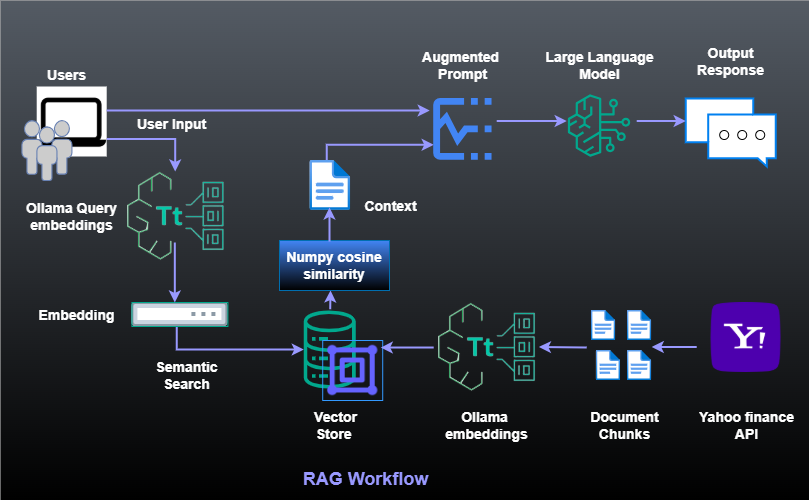
A basic workflow looks like this:
- The user asks a financial question.
- The LLM identifies the required stock information.
- The application calls the market data API.
- The API returns structured financial information.
- The application validates and formats the response.
- The LLM explains the information to the user.
For example, a user asks:
“What is Apple’s latest stock price?”
The LLM can request the Apple stock quote through a predefined function. Your application retrieves the latest available data and sends the result back to the model.
The model then generates a natural-language response using the returned information.
Importantly, the application should not allow the LLM to invent missing prices or treat an unsuccessful API response as valid market data.
Step 5: Use WebSockets for Continuous Market Updates
REST APIs are useful when an application needs information through individual requests.
However, applications that monitor markets continuously may benefit from WebSocket technology.
A WebSocket connection allows a server to push new market updates to an application without requiring a new HTTP request for every update.
This is useful for:
- Live stock monitoring dashboards
- AI-powered trading assistants
- Market movement notifications
- Automated research applications
- Real-time financial analytics
Developers can subscribe to selected symbols and process incoming market events as they arrive.
For reliable operation, implement automatic reconnection, heartbeat checks, and timestamp validation.
Step 6: Format Financial Data Before Sending It to the LLM
Raw financial API responses may contain technical fields that are difficult for an LLM to interpret.
Therefore, developers should transform the returned information into a clean and structured format.
For example:
market_data = { “symbol”: “AAPL”, “latest_price”: 225.50, “volume”: 1250000, “timestamp”: “2026-11-24T10:30:00Z”}
The values above are illustrative, not live market quotes.
Providing structured information helps the model understand the data and generate clearer explanations.
You can also include historical prices, percentage changes, and technical indicators when these are available and correctly calculated.
Recommended Architecture for an LLM Stock Market Data Integration
A reliable integration should separate data retrieval, processing, and language generation.
User Question
Example: What is Apple’s latest price?
LLM Application
Understands the question and selects a tool
Stock Market Data API
Retrieves current or historical market information
Data Processing
Validates and structures the API response
LLM Response
Generates a human-readable explanation
This architecture helps developers create applications that combine live financial information with the language-processing capabilities of modern AI models.
Important Features to Consider When Choosing an API
Not every financial data API is suitable for an AI-powered application.
Here are some important features to evaluate before choosing a provider.
| Feature | Why It Matters |
| Real-time quotes | Provides updated stock prices |
| Historical data | Supports trend analysis |
| Tick data | Helps analyze individual transactions |
| WebSocket streaming | Supports continuous updates |
| Market coverage | Provides access to different exchanges |
| Low latency | Reduces delays in data delivery |
| Documentation | Makes integration easier |
| Data reliability | Helps prevent incorrect analysis |
You should also check exchange coverage, licensing, redistribution permissions, and whether the provider’s definition of real-time matches your application requirements.
Common Challenges When Connecting LLMs to Financial APIs
Although integrating an LLM with market data can be useful, developers should understand several challenges.
Outdated or Delayed Data
Some providers offer delayed market information rather than real-time feeds. Always verify timestamps and data delivery conditions.
Incorrect AI Interpretations
An LLM may misunderstand numerical information or generate explanations that are not supported by the data.
To reduce this risk, provide structured inputs and instruct the model to use only the supplied information.
API Rate Limits
Frequent requests can exceed provider limits.
Caching, request batching, and WebSocket subscriptions can help reduce unnecessary API calls.
Data Security
API credentials and user information must be protected.
Use environment variables, secure backend services, and appropriate access controls.
Market Data Licensing
Financial data may have restrictions on storage, redistribution, and commercial usage. Review the provider’s licensing terms before launching your application.
Practical Applications of LLMs Connected to Stock Market Data
Combining language models with financial APIs creates opportunities across several industries.
AI Financial Assistants: Users can ask questions about stock prices, trading volume, and market performance.
Automated Market Research: AI applications can summarize financial data and identify unusual price movements.
Trading Dashboards: Developers can combine live market information with conversational AI interfaces.
Price Alert Systems: Applications can monitor specific stocks and generate notifications when predefined conditions occur.
Financial Education: AI assistants can explain market terminology and historical price movements in simple language.
These applications can improve access to financial information, although their outputs should not be treated as guaranteed trading signals.
Best Practices for Building an LLM-Powered Market Data Application
Follow these recommendations when developing your integration:
- Select a reliable market data provider.
- Use secure API authentication.
- Validate every API response.
- Include timestamps with market prices.
- Use WebSockets when continuous updates are required.
- Keep historical and real-time data clearly separated.
- Set appropriate API request limits.
- Prevent the LLM from inventing missing information.
- Monitor system performance and API errors.
- Clearly communicate that AI-generated analysis is not guaranteed investment advice.
Following these practices can make your application more reliable and easier to maintain.
Conclusion
Connecting LLMs to real-time stock market data APIs is an effective way to build smarter financial applications. Instead of depending only on previously learned information, language models can retrieve current market data, process structured financial information, and provide useful explanations.
The integration generally requires a language model, a reliable financial data provider, an API connection, and a data-processing layer. REST APIs are suitable for individual requests, while WebSockets support continuous market updates.
With the right architecture and data validation, developers can build AI financial assistants, market research platforms, and automated monitoring systems that deliver more relevant information to users.
Frequently Asked Questions (FAQs)
1. What is an LLM stock market data API?
It is an integration that allows large language models to retrieve stock market information from external financial data providers.
2. Can ChatGPT access real-time stock market data?
An LLM-based application can access real-time market information when connected to a suitable financial data API or external tool.
3. Which programming language is best for connecting LLMs to stock APIs?
Python is a popular choice because it offers libraries for API requests, data processing, machine learning, and AI development. Node.js is another suitable option.
4. Why are WebSockets useful for stock market applications?
WebSockets provide continuous data updates, making them useful for live dashboards, monitoring systems, and financial applications.
5. Can LLMs analyze historical stock market data?
Yes. Developers can provide historical price information, trading volumes, and calculated indicators to an LLM for summarization and explanation.
6. Is real-time stock market API integration suitable for AI agents?
Yes. Developers can expose financial data endpoints as tools that AI agents can call when they need current market information.
