

Key takeaways
- The clinical pharmacist vs retail pharmacist choice depends on where you want to work and how you want to use your skills.
- Retail pharmacists dispense medicines and guide customers in community pharmacies.
- Clinical pharmacists work with doctors and nurses to plan safe, effective treatment.
- The difference between clinical and retail pharmacist careers shows up in training, pay, hours and growth.
Pharmacy is one of the most trusted careers in healthcare, but it is not one single job. Two people can hold the same degree and still spend their days in completely different ways. One may stand behind a counter handing medicines to walk-in customers. The other may walk through hospital wards beside a team of doctors.
If you are a student or a fresher deciding where to begin, the clinical pharmacist vs retail pharmacist question has probably crossed your mind. It is a fair question, and the answer is not as simple as “one pays more” or “one is easier.”
In this guide, we explain the difference between clinical and retail pharmacist careers in plain language. We look at duties, education, skills, salary, working hours and growth, so you can choose with a clear head. We also show how clinical pharmacist and retail pharmacist roles fit into the wider healthcare system.
What Is a Retail Pharmacist?
A retail pharmacist works in a community setting, such as a neighbourhood chemist shop, a drugstore chain or a pharmacy inside a supermarket. This is the version of pharmacy that most people know. When you walk in with a prescription for fever, diabetes or high blood pressure, the retail pharmacist checks it, prepares the medicine and explains how to take it.
These pharmacists deal with the public all day. They answer questions about over-the-counter products,recommend safe over-the-counter (OTC) relief for minor issues like a cold or acidity and know when a case needs a doctor instead. They also handle the business side, including stock, billing, expiry checks, supplier orders and legal records.
In India, a retail pharmacist usually holds a D.Pharm or B.Pharm degree and must be approved by the Pharmacy Council of India and registered with the State Pharmacy Council. Many later open their own medical store, which makes retail a popular path for people who want to run their own business.
What Is a Clinical Pharmacist?
A clinical pharmacist works directly with patients and healthcare teams, mostly inside hospitals, clinics and specialty care centres. Their focus is not selling medicine. It is making sure the medicine a patient receives is safe, effective and the best possible choice for that person.
A clinical pharmacist reviews patient files, checks doses, watches for harmful drug interactions and advises doctors on therapy. They may join ward rounds, counsel patients before discharge and monitor side effects. In many hospitals they also support medication safety programmes and antibiotic stewardship.
Most clinical pharmacists hold a Pharm.D (Doctor of Pharmacy), and some have a master’s degree in pharmacy practice. Extra training, internships and hospital experience play a big role in getting hired.
Clinical Pharmacist vs Retail Pharmacist: The Core Difference
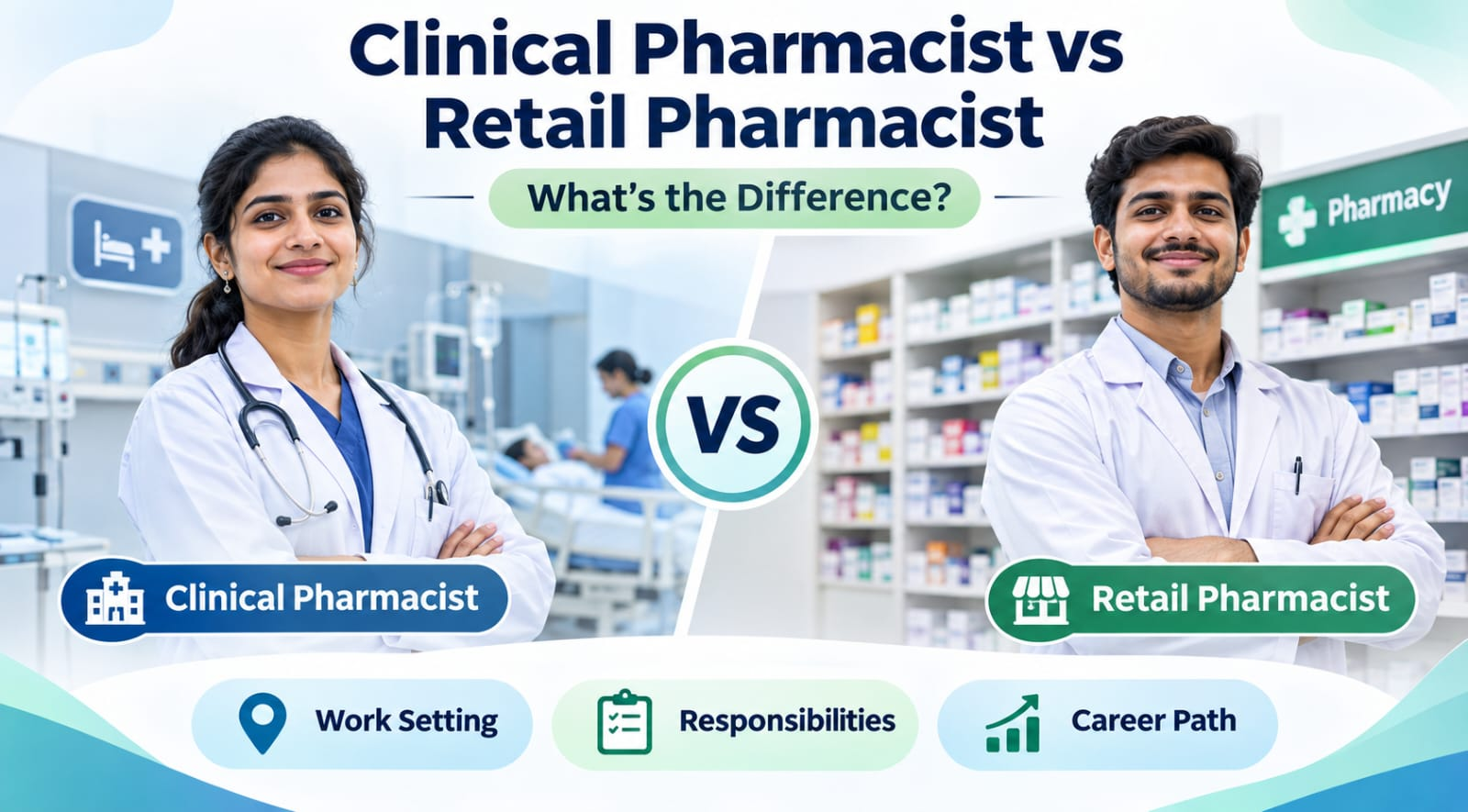
Here is the simplest way to see the difference between clinical and retail pharmacist work. A retail pharmacist focuses on dispensing and customer service. A clinical pharmacist focuses on therapy decisions and patient outcomes.
Both are essential, but the daily experience feels very different. The table below gives a quick snapshot of the clinical pharmacist vs retail pharmacist comparison before we go deeper.
| Factor | Retail Pharmacist | Clinical Pharmacist |
| Main workplace | Chemist shop, chain store | Hospital, clinic, care centre |
| Core focus | Dispensing and customer service | Therapy review and patient outcomes |
| Patient contact | Brief, many people daily | Longer, fewer patients |
| Usual qualification | D.Pharm or B.Pharm | Pharm.D or M.Pharm |
| Works with | Customers, suppliers | Doctors, nurses, specialists |
| Growth path | Manager or store owner | Specialist, researcher, educator |
Clinical Pharmacist vs Retail Pharmacist: Work Environment
A retail pharmacist works in a shop-style setting that is open to the public. It is busy and fast. Rush hours, queues and walk-in customers are part of normal life, and you learn to juggle billing, counselling and stock all at once.
A clinical pharmacist works inside a medical setting, such as a ward, an ICU, an outpatient department or a research unit. The environment is more structured and team-based. You sit with doctors, nurses and dieticians, and your opinion carries real weight in treatment discussions.
When people compare clinical pharmacist vs retail pharmacist work settings, the biggest contrast is the kind of pressure. Retail pressure comes from volume and customers. Clinical pressure comes from the seriousness of each decision.
Clinical Pharmacist vs Retail Pharmacist: Daily Duties
Retail pharmacist duties usually include:
- Reading and verifying prescriptions
- Dispensing medicines and labelling them correctly
- Counselling customers on dose, timing and storage
- Managing stock, expiry dates and supplier orders
- Keeping records as required by drug laws
- Handling billing and basic customer queries
Clinical pharmacist duties usually include:
- Reviewing patient case files and lab reports
- Checking doses, especially for children, older adults and kidney patients
- Spotting drug interactions and adverse reactions
- Recommending changes in therapy to doctors
- Joining ward rounds and discharge counselling
- Reporting side effects and supporting medication safety programmes
Looking at these lists, the difference between clinical and retail pharmacist work becomes clear. One role is built around supply and service, the other around therapy and monitoring. Studying how clinical pharmacist and retail pharmacist roles differ in detail also shows that neither is “easier.” They are simply built for different strengths.
Clinical Pharmacist vs Retail Pharmacist: Education and Qualifications
A retail pharmacist can enter the field with a Diploma in Pharmacy (D.Pharm) or a Bachelor of Pharmacy (B.Pharm), followed by registration with the State Pharmacy Council. That makes retail one of the quicker routes into the profession.
Clinical pharmacy usually asks for more. Most hospitals prefer a Pharm.D, which is a six-year programme (five years of study plus a one-year hospital internship, or a three-year post-baccalaureate route for B.Pharm graduates), or an M.Pharm in pharmacy practice. Some employers also value certificates in areas like critical care, oncology or infectious diseases.
The clinical pharmacist vs retail pharmacist education gap is real, but it is not a wall. A B.Pharm graduate can move toward clinical work through further study and hospital experience.
Clinical Pharmacist vs Retail Pharmacist: Skills Needed
Retail work rewards communication, speed, accuracy and a friendly manner. You also need basic business sense, because inventory and margins decide whether a shop survives.
Clinical work rewards analytical thinking, deep drug knowledge, patience and the confidence to speak with doctors. You must read research, interpret lab values and explain your reasoning clearly.
In the clinical pharmacist vs retail pharmacist skills picture, communication matters in both. The difference is who you talk to and what is at stake in the conversation.
Clinical Pharmacist vs Retail Pharmacist: Salary
Pay varies by city, employer and experience, so treat any figure as a rough guide. In India, entry-level retail pharmacists often earn roughly ₹12,000 to ₹25,000 a month, while hospital clinical pharmacists with a Pharm.D may start a little higher. Retail owners can earn far more over time because their income depends on the business they build.
The difference between clinical and retail pharmacist salary also changes with growth. Clinical specialists in large hospitals, or abroad, can see steady raises, while retail managers and store owners can see sharper jumps. In the clinical pharmacist vs retail pharmacist pay debate, there is no universal winner. Always check current listings for real numbers.
Clinical Pharmacist vs Retail Pharmacist: Work-Life Balance
Retail stores often run long hours, six days a week, with evening shifts and Sundays. Standing for long stretches is common. Owners may work even longer, though they control their own schedule.
Hospital roles follow shifts too, but they tend to be more predictable and often come with paid leave and structured benefits. Emergency and ICU postings can be stressful.
On the clinical pharmacist vs retail pharmacist work-life question, the honest answer is that it depends on the employer more than the title.
Clinical Pharmacist vs Retail Pharmacist: Career Growth
A retail pharmacist can grow into a store manager, area manager, regional head, distributor or independent owner. Others move into pharma sales or marketing.
A clinical pharmacist can specialise in fields like oncology, cardiology or critical care. Other directions include clinical research, pharmacovigilance, medical affairs, teaching and hospital administration.
Another difference between clinical and retail pharmacist careers is how growth happens. Retail growth is often business-driven. Clinical growth is often qualification-driven. For anyone weighing clinical pharmacist vs retail pharmacist paths over the long term, both can lead to leadership.
Pros and Cons of Each Path
A fair clinical pharmacist vs retail pharmacist comparison has to include the downsides too.
Retail pharmacist: pros
- Quicker entry with a D.Pharm or B.Pharm
- Daily contact with people in your community
- A real chance to own your store
Retail pharmacist: cons
- Long hours and heavy footfall
- Repetitive tasks on busy days
- Business stress such as stock loss and competition
Clinical pharmacist: pros
- Direct impact on treatment and safety
- Respect as part of the medical team
- Clear specialisation and research options
Clinical pharmacist: cons
- Longer and costlier education
- Fewer openings in smaller towns
- Emotionally heavy cases, especially in critical care
How to Choose the Right Path
Ask yourself a few honest questions. Do you enjoy talking to many people every day? Do you dream of running your own store? Retail may suit you. Do you love pharmacology, case studies and working beside doctors? Clinical may be your lane.
Think about time and money as well. If you want to start earning soon, retail is quicker. If you can invest in a Pharm.D or M.Pharm, clinical pharmacy offers deeper specialisation.
Knowing the difference between clinical and retail pharmacist paths is only half the work. The other half is knowing yourself. You can also start in one and switch later. Many pharmacists begin in retail, build confidence, and move into hospital roles. Remember that clinical pharmacist and retail pharmacist roles are not rivals. They complement each other, and patients benefit when both do their jobs well.
If you still feel torn between clinical pharmacist vs retail pharmacist, try shadowing a working pharmacist for a few days. One honest day on the job teaches more than ten articles.
Where to Find Pharmacist Jobs
Once you know your direction, the next step is finding openings. You can explore current vacancies on the pharmacist jobs, section on jobslly which lists openings across hospitals, pharmacies and healthcare companies.
Whichever side of the clinical pharmacist vs retail pharmacist debate you lean toward, keep the difference between clinical and retail pharmacist requirements in mind while reading each listing. Some posts ask for a Pharm.D, while others only need a D.Pharm and a valid registration. Set job alerts, keep your resume updated and apply early.
Frequently Asked Questions
What is the difference between clinical and retail pharmacist jobs?
A retail pharmacist dispenses medicines and advises customers in a community store. A clinical pharmacist works with healthcare teams in hospitals to review and optimise patient treatment.
Which is better in the clinical pharmacist vs retail pharmacist debate?
Neither is better in every case. Retail suits people who like customer interaction and business. Clinical suits people who prefer patient-focused therapy work and research.
Can a retail pharmacist become a clinical pharmacist?
Yes. With further study such as a Pharm.D or M.Pharm, plus hospital experience or certificates, many retail pharmacists successfully move into clinical roles.
Who earns more?
It depends on experience, city and employer. Clinical roles may offer higher starting pay in some hospitals, while successful retail owners can earn more in the long run.
Is a Pharm.D compulsory for clinical pharmacy?
Not always, but many hospitals prefer it. An M.Pharm in pharmacy practice or relevant clinical experience can also help.
Conclusion
The clinical pharmacist vs retail pharmacist decision is really about fit. Retail pharmacy offers quick entry, public contact and a path to business ownership. Clinical pharmacy offers deeper involvement in treatment, teamwork with doctors and strong specialisation options.
The difference between clinical and retail pharmacist careers is real, yet both protect public health. When you study clinical pharmacist and retail pharmacist roles side by side, you see two parts of the same system. Choose the one that matches your strengths, keep learning, and remember that your first job does not lock you in forever. Whatever your final pick in the clinical pharmacist vs retail pharmacist journey, start by exploring openings on Jobslly and take your first confident step.
