

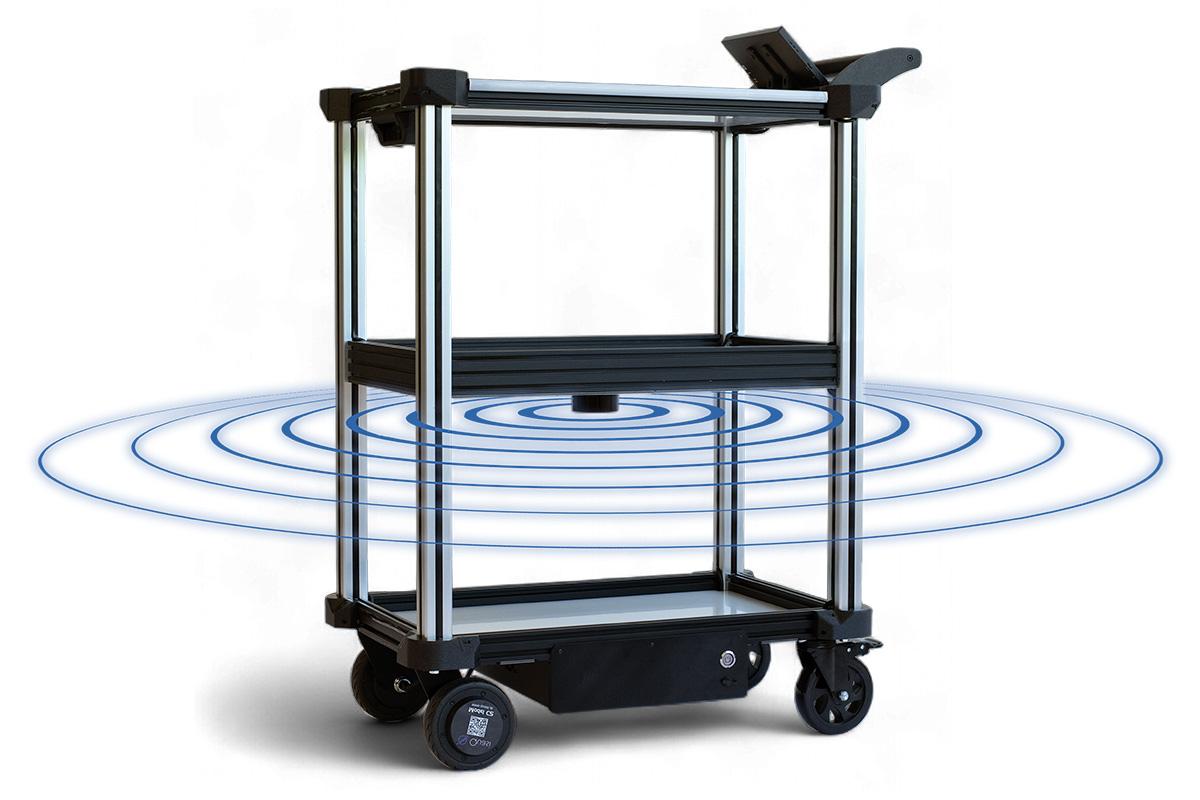
In autonomous robotics, ease of use and advanced intelligence are often treated as trade-offs. Systems that are powerful tend to be complex. Systems that are simple tend to be limited.
Model C2 by Quasi Robotics – Autonomous Mobile Robots (AMRs) were designed to reject that compromise entirely.
At first glance, Model C2 feels almost deceptively simple: deployable in minutes, usable without technical knowledge, intuitive enough for first-time users. Under the surface, however, it is powered by Q.AI – a deeply engineered, algorithmic intelligence platform built for predictability, validation, and real-world performance.
Model C2 proves that simplicity at the surface and sophistication underneath are not opposites – they are complementary.
From Unboxing to Autonomous in Minutes
One of the most striking aspects of Model C2 is how quickly it can be deployed.
A Model C2 can be operational in as little as 5 minutes, and fully deployed in 15–45 minutes, depending on facility size and workflow complexity. There is no external software to install, no laptops to configure, and no system integrator required.
The robot powers on, guides the user through initial setup, and immediately enters mapping mode. Everything happens directly on the robot’s touchscreen.
Automation stops being a long-term project and becomes a same-day capability.
No Programming. No IT. No Robotics Expertise.
Model C2 was built for operators – not engineers.
There is no programming language, no scripting, and no robotics terminology exposed to the user. If you can use a touchscreen and type names into a text field, you can deploy and operate the robot.
Guaranteeing this level of accessibility was a deliberate engineering decision. Automation should be owned by the people who understand the workflows best – the teams on the floor – not locked behind IT or engineering departments.
Behind this simplicity lies Q.AI’s ability to translate human intent directly into deterministic robotic behavior.
Mapping at Real-World Scale – Fast
Mapping is traditionally one of the most time-consuming and error-prone steps in AMR deployment. Model C2 turns it into a straightforward, physical process.
A 100,000 sq ft facility can typically be mapped in about 30 minutes by simply guiding the robot through the environment. As the cart moves, its onboard LiDAR and vision sensors generate a live map on screen.
- No CAD drawings.
- No floor plan imports.
- No post-processing.
When mapping is complete, the robot is immediately ready for waypoint creation and autonomous operation.
Waypoints the Way Humans Think
Waypoint creation on Model C2 is intentionally physical and intuitive.
To create a waypoint:
- Place the robot exactly where you want it to stop
- Orient it as you want it to arrive
- Type a name
- That’s it.
The robot remembers the exact position and orientation, eliminating guesswork and ensuring repeatable, precise arrivals. There are no coordinates to tune and no abstract representations to interpret.
This mirrors how people think about space – and dramatically accelerates deployment.
“Programming” by Naming Things
On Model C2, programming does not look like programming.
Typing the name of a waypoint is the instruction. Selecting waypoint names in sequence is route creation.
This works because Q.AI does not rely on statistical guesswork. It understands waypoints, routes, zones, and tasks as explicit, deterministic constructs.
As a result:
- Automation is readable
- Behavior is predictable
- Configuration is transparent
Anyone can understand what the robot will do simply by looking at its screen.
The Intelligence Beneath the Simplicity: Q.AI
The reason Model C2 can be this easy to use is not because it is simplistic – but because its intelligence is deeply engineered.
At the heart of every Model C2 is Q.AI, Quasi Robotics’ proprietary intelligence engine. Q.AI is not a single AI model and not a black-box neural network. It is an orchestration of 7–10 specialized algorithms, each responsible for a specific domain: perception, localization, motion planning, obstacle avoidance, safety enforcement, task execution, and system health monitoring.
This approach is rooted in classical AI principles inspired by Artificial Intelligence: A Modern Approach by Russell and Norvig – where intelligence emerges from the interaction of well-designed algorithms, not from scale alone.
Distributed Intelligence at the Edge
Q.AI is built around a microcontroller-centric architecture.
Instead of pushing all computation to a single high-power CPU, Q.AI distributes responsibility across multiple dedicated microcontrollers. Motor control, sensor fusion, LiDAR processing, safety loops, and battery management run locally in real time, programmed in C and C++.
This architecture delivers:
- Deterministic response times
- Immediate safety reactions
- Lower power consumption
- Exceptional system robustness
The central processor orchestrates decisions. Microcontrollers execute them instantly. The robot behaves like engineered machinery – not a probabilistic experiment.
Validatable, Predictable Intelligence
Because Q.AI is deterministic, it is fully validatable.
This is a critical advantage for regulated industries such as life sciences, healthcare, and pharmaceutical manufacturing. Routes, safety behaviors, and responses to environmental changes can be tested, documented, reproduced, and audited.
There are no opaque neural models making statistical guesses. Q.AI behaves consistently under the same conditions – every time.
The Touchscreen: A Window into Q.AI
The Model C2 touchscreen is not a superficial interface layer. It is a direct window into Q.AI’s internal state.
Maps, waypoints, routes, zones, and navigation status reflect exactly what Q.AI is reasoning about in real time. User input flows directly into the intelligence layer without translation gaps.
This tight coupling creates trust. Operators always understand what the robot is doing and why.
Zones, Elevators, and Facility-Wide Autonomy
Q.AI natively supports advanced operational constructs:
- No-go zones
- Speed-restricted areas
- Traffic management zones
- Elevator and automatic door integration
By orchestrating communication with building infrastructure, Q.AI enables true multi-floor autonomy, transforming Model C2 from a single-floor robot into a facility-wide logistics system.
Cloud Connect: Insight Without Compromise
While Q.AI operates entirely on the robot, Cloud Connect extends its capabilities through secure analytics and fleet-level insights.
Operational data such as distance traveled, utilization, uptime, and task history enable:
- Predictive maintenance
- Performance optimization
- ROI measurement
- Audit-ready reporting
Cloud Connect is designed with privacy by design principles and supports validated environments, including 21 CFR Part 11 compliance.
The Real Achievement
Model C2’s greatest achievement is not that it is easy to use. And not that it is deeply intelligent. It is that users never have to think about the intelligence at all.
Advanced autonomy disappears behind a clean, intuitive experience – while engineered algorithms ensure reliability, safety, and trust.
Model C2 is simple because it is smart. And smart because it is engineered.
