

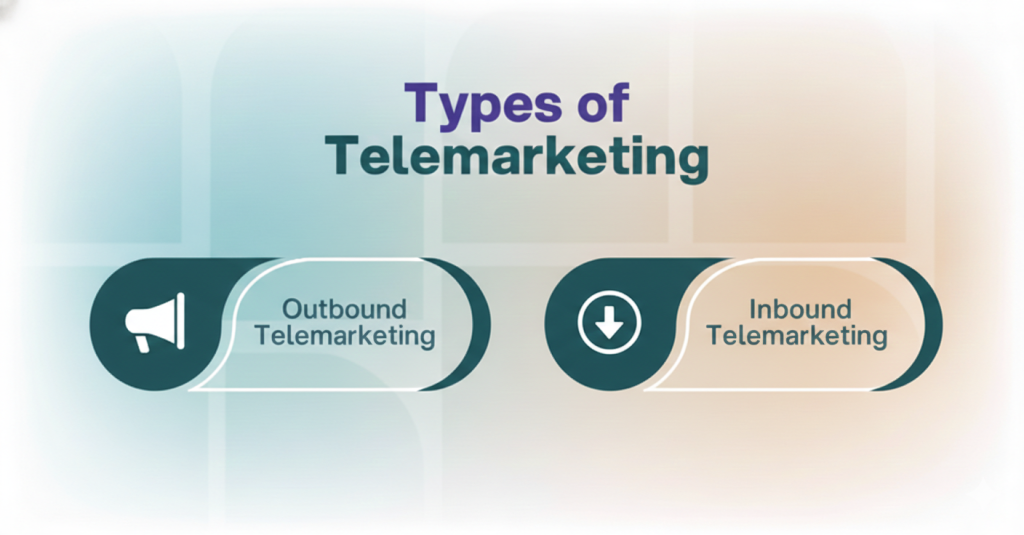
Nowadays, Telemarketing has become one of the direct voice-based communication strategies to make the company grow. In their businesses connect with prospects or customers over the phone to inform, persuade, support, or collect information. Though telemarketing is also a lead generation method, unlike other digital lead generation methods, it directly allows marketers to have real-time human interaction.
Therefore, this method is more powerful for trust-building, qualification, and higher conversion.
So today’s concept is what the types of telemarketing, Well, it depends. It depends on the direction of the call, objective, and level of customer awareness and is thus classified into several types.
Let’s see the details of what the types of telemarketing and vice versa-
What are the Types of Telemarketing?
Telemarketing has different types. Classification is done based on several facts, like who initiates the call, the purpose of the call, and how the conversation is structured. Each type serves a different business goal and works best in specific situations.
1. Inbound Telemarketing
Inbound means when leads come towards you without your push effort. I mean, they feel interest towards you, through ads, websites, social media, emails, or referrals. Suppose a prospect sees a phone number on a website or advertisement and calls the business. A guide guides them toward a solution. A trained agent answers the call, identifies the caller’s need, provides information, and recommends suitable products or services to move the caller toward a purchase.
Well, inbound telemarketing plays a crucial role in business value. It’s because thesy deals with high-intent prospects. Since the caller already knows about your service, they want information from you. So your agents only need to focus less on persuasion and more on solution matching. I mean, the solution clients are searching for. Therefore, the result produced here comes with higher close rates and better customer experience.
Primary Objectives
- Respond to customer inquiries.
- Convert interest into sales or bookings.
- Provide real-time support.
2. Outbound Telemarketing
Outbound telemarketing means going through the process of getting potential leads forcefully. I mean, when agents call prospects proactively using a prepared contact list. In this telemarketing, telemarketers follow a preset script to introduce the business, identify needs, qualify interest, and move the prospect toward the next step. The next step is supposed to be a demo, an appointment, or a sale.
However, if you want to know the business value of outbound telemarketing, well, outbound telemarketing gives businesses control over outreach. In the B2B market, it is effective especially for the decision-makers who may not actively search online but are open to relevant solutions. I mean, they are not searching for our service, but they might need the service.
Primary Objectives
- Create new opportunities.
- Promote products or services.
- Build a sales pipeline.
3. Cold Calling
Cold calling is another important and useful telemarketing method. Hence, cold calling is the most challenging form of outbound telemarketing. The prospect has no prior relationship with the business. However, many people often get confused about how it works. Well, in this method, agents contact new prospects using purchased or researched lists. And after that, they attempt to spark interest within the first few seconds of the call.
The business value of cold calling is a little bit tricky. Though here rejection arte is higher, unmatched for rapid market testing and lead discovery. When paired with strong research and personalization, it remains effective for B2B sales.
Primary Objectives
- Introduce the brand.
- Identify potential buyers.
- Filter unqualified leads.
4. Warm Calling
Unlike cold calling, warm calling targets prospects who have previous exposure to the business. I mean, instead of calling only to see by the list, the agent at first gets overall information about the prospect through various means. Here, the agent references prior engagement. Such as a website visit, form submission, email interaction, or past purchase, and these help to reinitiate contact.
Unlike cold calling, warm calling bears more business value. Warm calls feel less intrusive and more conversational. Trust is already established here, as previous engagements already seen here. Therefore, it significantly improves response and conversion rates.
Primary Objectives
- Continue previous conversations.
- Re-engage inactive leads.
- Advance leads through the funnel.
5. Sales Telemarketing
Well, sales marketing is another type of telemarketing. These telemarketing types usually focus on closing deals directly over the phone. This telemarketing method works simply. Agents present offers, explain features and pricing, handle objections, and complete transactions in real time. This type works best for clearly defined offers where buyers can decide quickly. The live interaction allows all agents to address objections instantly, increasing the likelihood of closing as well.
Primary Objectives
- Generate immediate revenue.
- Upsell or cross-sell.
- Renew subscriptions.
6. Lead Generation Telemarketing
Well, lead generation telemarketing at first does the qualification, then starts selling. So agents ask structured questions to assess the prospect’s needs, budget, authority, and timing before passing qualified leads to the sales team. However, in contrast to getting highly qualified leads here, the final deal closing chances are very high here. No doubt, this telemarketing saves sales teams time by delivering high-quality, pre-qualified leads.
Finally, it allows the agents to focus on other areas to scale up the company’s revenue. So the lead generation method is more like closing the deals, then searching for the leads/ or what you can call prospecting.
Primary Objectives
- Identify sales-ready prospects.
- Gather accurate prospect data.
- Support sales teams.
7. Appointment Setting Telemarketing
By the name, you can easily understand how this telemarketing type works. Well, this is a specialized form of lead generation focused solely on booking meetings. In here, agents directly contact prospects, explain the value of a meeting, and schedule demos, consultations, or sales calls. However, the business value of appointment setting is high because it shortens the sales cycle. It improves productivity by ensuring sales reps speak only with interested and relevant prospects.
Primary Objectives
- Book qualified appointments.
- Connect sales reps with decision-makers.
8. Customer Service Telemarketing
Well, unlike any other telemarketing types, customer service telemarketing deals with existing customers, rather than getting new ones. So how does it work? In that case, agents respond to service-related calls, resolve issues, provide updates, and ensure customer satisfaction. Business value is high for the existing customer. Strong customer service reduces churn and often creates moredeal. Also marketer can get referral opportunities without focusing on aggressive selling.
Primary Objectives
- Resolve problems.
- Retain customers.
- Improve brand loyalty.
9. Market Research Telemarketing
They are totally different types of telemarketers; instead of searching for leads or clients, they focus on marketing insights. Agents conduct surveys or interviews to understand customer opinions, behavior, and satisfaction. However, the business value is high for the mobile users. Especially phone-based research delivers deeper insights than online surveys. It’s because agents can ask follow-up questions and clarify responses directly in that case.
Primary Objectives
- Collect feedback.
- Analyze market trends.
- Improve products or services.
Final Thoughts
So, nowadays, telemarketing has become one of the effective means of communication, as, unlike digital means, this method can directly create direct, human-to-human conversations. Whether it is used to generate new leads, support existing customers, or book appointments, each type of telemarketing serves a clear purpose in the business process.
If you can understand each type well, how they work, and which one is suitable for your business model, the remaining is only about doing it correctly, following the ethics. If you can do it strategically, telemarketing helps businesses build trust, understand customer needs, and convert conversations into long-term relationships.
