

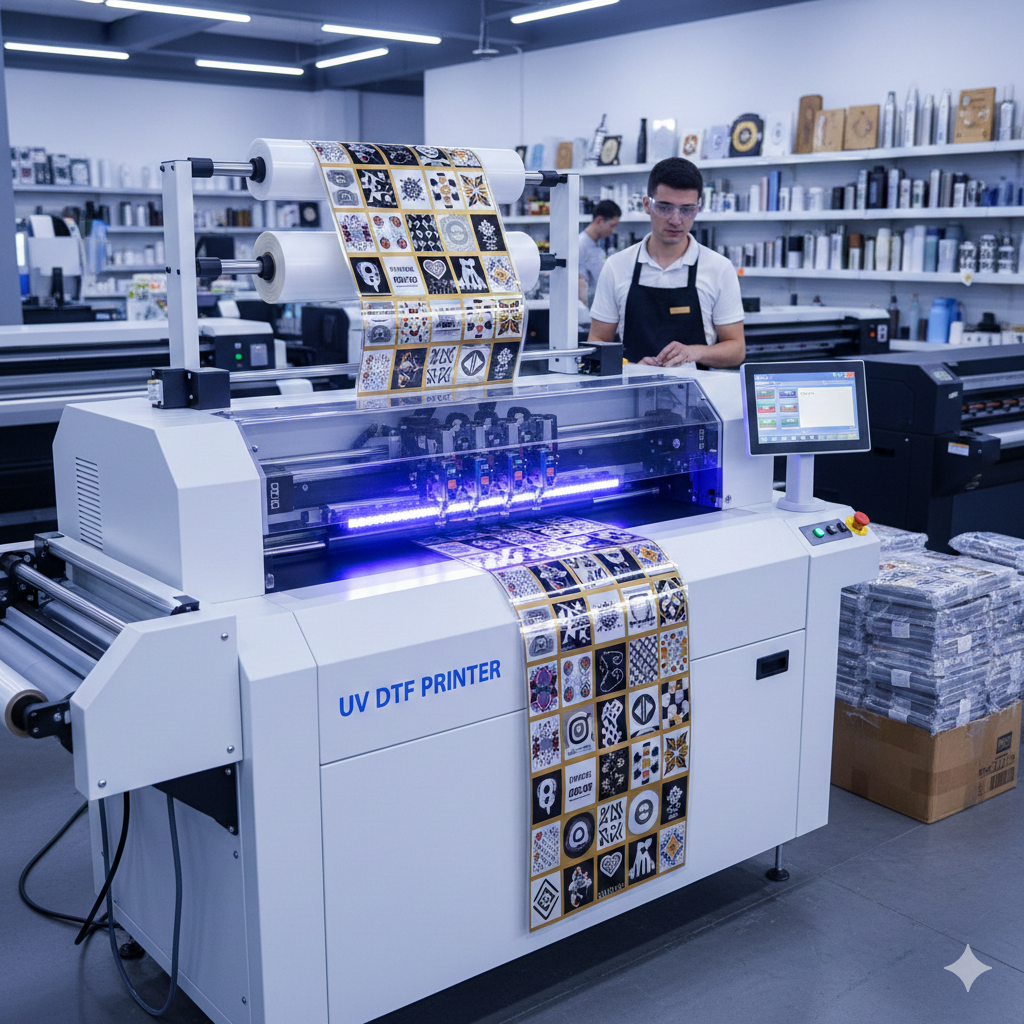
What Is a UV DTF Printer and How Does It Work?
A UV DTF printer is a specialized printing machine that prints designs onto a film and then transfers them onto hard surfaces without heat. Unlike traditional methods, it uses UV-curable ink that dries instantly under UV light. This allows sharp, vibrant, and durable prints. The process includes printing CMYK, white ink, varnish, and sometimes gold foil. The printed film is laminated and then applied directly to the product surface. This method supports curved, flat, and irregular objects. Businesses prefer UV DTF technology because it offers flexibility, durability, and high production efficiency for commercial use.
Why Are UV DTF Printers Ideal for Professional Transfer Printing?
Professional print shops need equipment that performs daily without failure. A UV DTF printer supports high-volume output with stable ink flow and consistent color accuracy. It produces detailed graphics suitable for branding, promotional items, and customized products. Moreover, it does not require a heat press, which simplifies workflow. Many businesses report faster order completion compared to traditional transfer methods. The ability to print on glass, metal, plastic, wood, and acrylic expands service offerings. As a result, companies increase profit margins and reduce outsourcing costs by handling diverse customer requests internally.
Desktop UV DTF Printers for Small Businesses
Desktop UV DTF printer models are compact and fit easily on workbenches. They plug into standard electrical outlets and start production quickly after installation. These machines are suitable for startups and home-based print shops. Small businesses can produce phone cases, stickers, cup wraps, and personalized gifts efficiently. Because setup takes less time, small batch orders become profitable. Additionally, these printers require minimal workspace compared to industrial machines. Entry-level systems allow entrepreneurs to test the market without heavy investment. Therefore, startups can achieve return on investment within a few months.
Industrial UV DTF Printing Machines for High Output
Industrial UV DTF printing machines are built for continuous production. They operate for extended hours without breakdowns. Large print shops rely on them for wholesale and distributor-level orders. These machines process hundreds of transfers daily with consistent color matching. Industrial models feature multiple printheads, such as Epson i1600-U1 technology, which ensures precision and durability. High-speed printing improves turnaround time during peak seasons. Scalability is another advantage because businesses can double output without replacing equipment. For factories handling bulk promotional products, industrial UV DTF printers provide reliability and long-term performance.
Roll-to-Roll UV DTF Printers for Continuous Production
Roll-to-roll UV DTF printers eliminate manual sheet loading. They automatically feed film rolls, increasing efficiency and reducing downtime. This system supports gang sheet printing, which minimizes material waste. Operators spend more time finishing products instead of loading media. Consistent alignment improves multi-color registration accuracy. Businesses benefit from higher weekly production output. Moreover, reduced downtime leads to improved customer satisfaction and faster order fulfillment. For companies handling large corporate or convention orders, roll-fed UV DTF systems significantly enhance productivity and profitability.
UV DTF Printer vs Direct UV Printing: Which Is Better?
UV DTF printing differs from direct UV flatbed printing. A UV DTF printer prints onto film and transfers the design later. In contrast, flatbed UV printers print directly onto flat objects. UV DTF works on curved and irregular surfaces, while flatbed machines are limited to flat substrates. Additionally, UV DTF allows peel-and-apply flexibility. It is ideal for cup wraps, stickers, and promotional goods. Direct UV printing suits rigid signage or panels. Choosing between the two depends on application type, surface variety, and production workflow requirements.
What Materials Can a UV DTF Printer Print On?
A UV DTF printer supports a wide range of materials. These include glass, metal, acrylic, plastic, ceramic, wood, and leather. It works effectively on drinkware such as tumblers and mugs. Promotional products like keychains, pens, and USB drives are also compatible. Packaging and labeling industries benefit from high-adhesion transfers. Decorative signage, plaques, and wall art are easily customized. Because the transfer film adapts to curved surfaces, irregular objects are no longer a limitation. This versatility increases business opportunities and expands potential customer markets significantly.
Key Features to Look for in a UV DTF Printer Machine
When choosing a UV DTF printer machine, printhead quality is crucial. Epson printheads deliver high precision and stable performance. Printing speed, measured in meters per hour, determines daily output capacity. CMYK + White + Varnish + Gold Varnish options create depth and 3D effects. A reliable laminating system simplifies workflow. Intelligent control panels allow easy cleaning and maintenance. Automatic low-ink alerts prevent unexpected interruptions. Print width, such as 600mm capability, supports larger graphics. Finally, warranty coverage and local technical support ensure long-term operational security for your business.
UV DTF Printer Pricing, ROI, and Total Cost of Ownership
Understanding UV DTF printer pricing requires more than checking the listed machine cost. Buyers must consider ink consumption, film supplies, maintenance parts, and replacement printheads. Although the initial investment may seem high, many businesses achieve ROI within six months. Reduced outsourcing increases profit margins above 60 percent in many cases. Continuous production reduces per-unit printing cost. Additionally, durable prints reduce rework expenses. Transparent pricing evaluation helps business owners calculate monthly operating expenses accurately. Therefore, planning total ownership cost ensures sustainable long-term profitability.
How to Choose the Right UV DTF Printer for Your Business
Choosing the right UV DTF printer depends on daily order volume and product type. Small shops benefit from desktop models, while high-output facilities require industrial systems. Consider available workspace, power supply, and operator skill level. Evaluate technical support availability and spare parts access. Test the machine using real substrate materials before full production launch. Moreover, compare roll-to-roll versus sheet-fed systems for workflow efficiency. Selecting equipment aligned with your growth goals prevents future limitations. A well-matched UV DTF printer becomes the foundation of a profitable transfer printing business.
Frequently Asked Questions (FAQs)
1. What is a UV DTF printer used for?
It is used for transfer printing on hard surfaces such as glass, plastic, metal, wood, and acrylic without heat pressing.
2. Does a UV DTF printer require a heat press?
No, the transfer is peel-and-apply, so heat is not required.
3. How long do UV DTF prints last?
UV-cured inks are durable, scratch-resistant, and long-lasting under normal conditions.
4. Is UV DTF printing profitable for small businesses?
Yes, many startups recover their investment within months by producing customized promotional products.
5. What is the difference between UV DTF and flatbed UV printing?
UV DTF prints on film and transfers later, while flatbed UV prints directly onto flat objects.
