

AI has firmly moved from experiment to infrastructure in modern recruiting. What once felt optional is now embedded in daily workflows across sourcing, screening, engagement, and analytics. But adoption alone does not guarantee impact. The real difference lies in how AI is applied. The most effective AI recruiting tools are not the ones with the most features, but the ones that reduce noise, surface meaningful signals, and help recruiters make better decisions under pressure.
Recent industry data shows that a significant majority of talent teams now rely on AI in some part of their hiring process. Recruiters report faster screening, improved pipeline visibility, and reduced administrative burden. Yet outcomes vary widely. In many cases, AI speeds up activity without improving clarity. In others, it becomes a layer that complicates workflows rather than simplifying them.
The tools that stand out in 2026 are those that embed AI directly into real hiring moments, when recruiters are deciding who to prioritize, where to invest time, and how to interpret performance across channels. Below is our structured breakdown of selected AI recruiting platforms shaping modern hiring. The format follows a practical lens: where AI is applied, how it supports execution, and where it delivers measurable value.
Skima AI
Skima AI is an end-to-end AI recruiting software that streamlines the entire recruitment process from candidate discovery to final selection. Rather than relying on manual screening and fragmented tools, it brings together sourcing, evaluation, and decision-making into a single system powered by intelligent automation.
At its core, Skima AI uses advanced matching algorithms to identify the most relevant candidates for each role. It evaluates resumes beyond keywords by analyzing skills, experience, and contextual fit, helping recruiters focus only on high-potential applicants. The platform continuously improves its recommendations by learning from hiring patterns, recruiter actions, and role-specific requirements.
Key AI capabilities:
AI-powered candidate matching and ranking
Automated resume screening with contextual analysis
Intelligent shortlisting based on role fit and hiring signals
Workflow automation to streamline screening and selection
Skima AI is especially effective for teams aiming to improve hiring efficiency while maintaining strong candidate quality, making it well-suited for both growing companies and high-volume recruitment environments.
Pros
Reduces time spent on manual screening
Delivers high-quality, relevant candidate matches
Improves hiring speed and consistency
Cons
Requires initial setup to align with hiring criteria
Advanced features may need user familiarization
Joveo
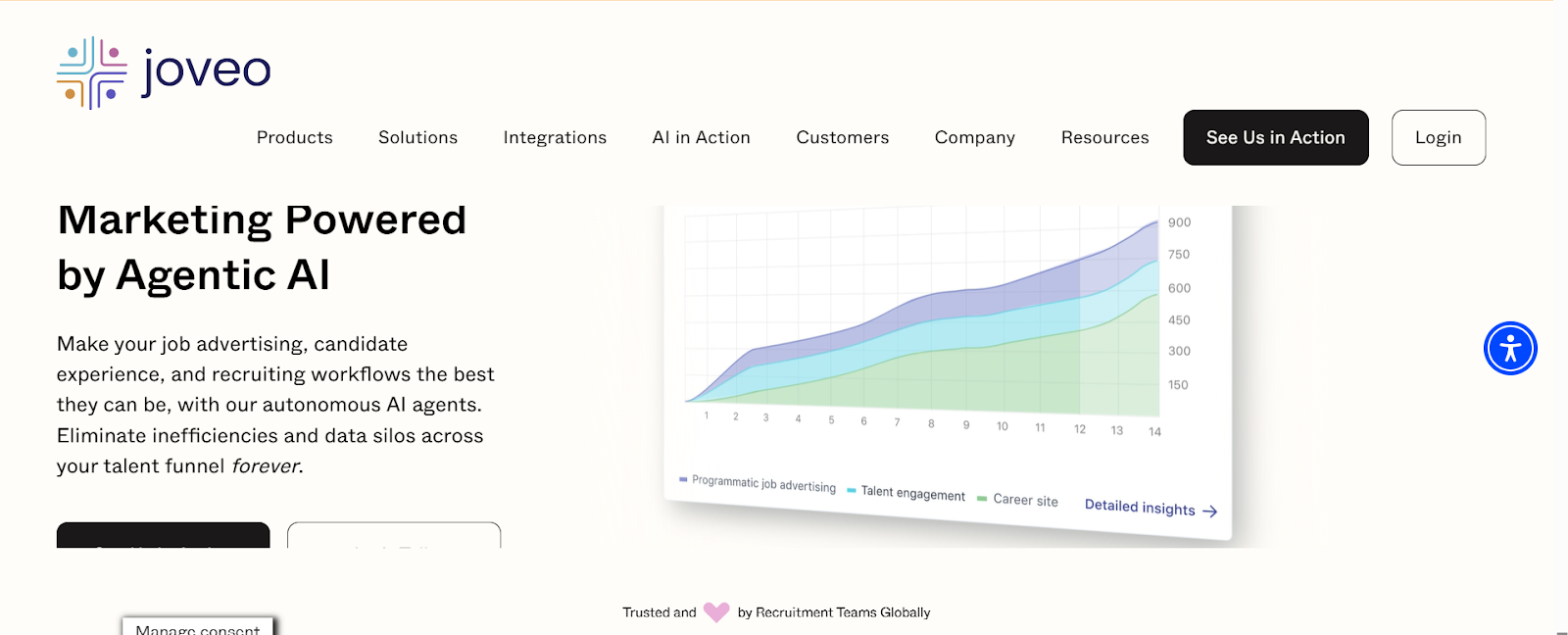
Joveo approaches AI as a decision-support system rather than a feature add-on. Instead of isolating sourcing, engagement, and analytics, the platform connects them through a unified intelligence layer that tracks how activity translates into hiring outcomes.
At the center is its AI-driven recruitment guidance engine, designed to help teams understand where effort produces results. Rather than simply increasing applicant flow, Joveo focuses on prioritization. It analyzes engagement behavior, pipeline movement, and historical hiring performance together to identify which candidates and campaigns deserve attention.
Key AI capabilities:
AI-guided prioritization across sourcing channels
Performance-based budget and effort recommendations
Automated engagement that adapts to candidate interaction signals
Analytics that link campaign activity directly to hires
Joveo is particularly strong for organizations that want visibility into the full recruitment marketing lifecycle, not just top-of-funnel volume.
Pros
Clear connection between activity and hiring outcomes
Strong prioritization insights
Unified view across sourcing and engagement
Cons
Best suited for teams with steady hiring volume
May require structured data for full value realization
Niyuk
Niyuk is an AI-driven platform, specially made for automating the entire recruitment and hiring processes across industries. Niyuk takes care of the entire recruitment process right from initial candidate screening to final shortlisting for any role or position.
Niyuk.ai arranges initial screening of candidates with the use of Artificial Intelligence. Niyuk also conducts AI-based skill assessment to offer a fair, transparent placement without any human bias of deserving, top-calibre candidates. This not only saves the crucial hiring time consumed during manual or conventional recruitment process with unintentional or intentional bias. This AI automation accuracy offers quality hires in minimum time, without wasting human efforts of HR recruiting teams. Niyuk also provides data-driven insights on recruitment process performance with candidate’s required skill competency details like skill scores etc.
Features
AI Interview: AI interview is conducted by a virtual recruiter based on AI. It normally asks a predefined set of questions on video and then analyses candidates’ communication with skills and key areas. It supports employers for candidate screening via the first round of interview.
AI Assessment: This feature is used for conducting skill tests for candidates with smart automated tools. They cover all types of key areas, including how well candidates are familiar with technical things, their problem-solving capacity levels, communication skills and their respective domain expertise.
Vendor Marketplace: This feature connects recruitment agencies or freelancers, to share talent, and fill critical roles faster by collaboration between each other. This feature is very much effective and time saving for agencies with hiring quality.
Recruitment Agency CRM: This is a single common platform designed specifically for staffing agencies and HR teams to manage candidates, customers, and recruitment processes smoothly.
Testing Results
With screening and technical assessment automation, use of Niyuk offers a decline in manual review time by around 70%.
Many firms are now able to cut down their budgets for external placement agencies by 30% due to these automation features from Niyuk.
Cons
Less flexible outside defined stages
SmartRecruiters
SmartRecruiters integrates AI directly into its applicant tracking environment. Rather than positioning AI as a separate intelligence layer, it embeds it inside structured workflows that many enterprises already depend on.
Its strength lies in standardization and process control. AI supports candidate ranking, matching, and workflow automation within predefined hiring stages. For large organizations managing high req volumes, this consistency reduces variation and accelerates decision-making.
Key AI capabilities:
AI-assisted applicant ranking within ATS workflows
Automated candidate rediscovery from internal databases
Workflow automation across approvals and stage transitions
Compliance-oriented process standardization
SmartRecruiters works well for enterprises prioritizing governance and scale.
Pros
AI embedded inside structured workflows
Strong process consistency
Scalable for enterprise environments
Cons
Less flexible outside defined stages
Insights are more operational than strategic
Paradox
Paradox concentrates AI at the front of the funnel through its conversational assistant, Olivia. The platform automates candidate-facing interactions, including screening questions, scheduling, and reminders.
This design reduces administrative workload and improves responsiveness, particularly in high-volume hiring environments such as retail, hospitality, and frontline recruitment.
Key AI capabilities:
Conversational screening via chat and SMS
Automated interview scheduling
Event and high-volume hiring coordination
Candidate query automation
Paradox typically complements an existing ATS rather than replacing it.
Pros
Strong front-of-funnel automation
Significant reduction in scheduling effort
Improves candidate responsiveness
Cons
Limited visibility beyond early stages
Dependent on integration with ATS systems
Eightfold AI
Eightfold AI applies machine learning to skills intelligence and workforce strategy. Its models infer transferable skills and map career trajectories across internal and external talent pools.
Rather than focusing solely on immediate req fulfillment, Eightfold AI supports long-term talent planning. Organizations using skills-based hiring or investing in internal mobility often find its approach aligned with strategic workforce goals.
Key AI capabilities:
Skills inference beyond resume keywords
Internal mobility recommendations
Workforce planning analytics
Diversity and representation insights
Eightfold AI is particularly relevant for organizations shifting toward skills-first hiring frameworks.
Pros
Advanced skills-based matching
Supports long-term workforce planning
Strong internal mobility tools
Cons
Implementation complexity
Less focused on daily recruiter execution
How We Evaluated These AI Recruiting Platforms
Our evaluation centers on real recruiter workflows rather than feature checklists. We examined where AI meaningfully reduces repetitive effort, where it improves prioritization, and whether outputs are clear enough to act on without interpretation fatigue.
We also considered integration realities. AI tools rarely operate in isolation. Their effectiveness depends on how well they connect with ATS, CRM, and sourcing channels. In many cases, organizations also work with an AI consultant to ensure implementation aligns with hiring goals rather than simply adding automation layers. Platforms that require heavy manual oversight or generate opaque recommendations tend to lose value over time.
Most importantly, we looked for evidence of outcome alignment. Does the tool help teams understand what actually drives hires? Or does it simply accelerate activity without strategic clarity?
How AI Recruiting Tool Pricing Typically Works
Pricing structures vary widely across platforms. Some operate on subscription models tied to user seats or hiring volume. Others provide modular pricing depending on whether teams adopt sourcing, engagement, analytics, or automation layers.
Common inclusions in pricing models:
Core AI functionality aligned to the platform’s focus
Integrations with ATS or HRIS systems
Analytics dashboards and reporting
Customer onboarding and support
Advanced automation, additional data sources, or expanded analytics often come at additional cost. Understanding what is bundled versus optional is critical during vendor comparison.
Choosing the Right AI Recruiting Tool
The right choice depends less on how advanced the AI appears and more on where friction exists in your hiring process. Some teams struggle with sourcing noise. Others face scheduling overload or lack performance visibility. AI should address a defined problem.
When evaluating options, consider where recruiter time is currently wasted, whether the platform improves decisions or only speeds up tasks, and how clearly it connects activity to outcomes. Teams that define their bottleneck before selecting technology consistently see stronger returns.
Benefits of AI Recruiting Tools in 2026
AI’s role is no longer about replacing recruiter judgment. Instead, it strengthens judgment by reducing distraction and improving signal clarity.
When applied intentionally, AI tools help reduce manual workload, shorten hiring cycles, prioritize candidates based on engagement and performance data, standardize decision-making across teams, and provide clearer visibility into hiring effectiveness. These gains are not theoretical. They reshape how recruiters allocate time and attention across competing reqs.
Final Thoughts
AI in recruiting has matured into a structural layer of modern hiring operations. The conversation is no longer about whether to adopt AI, but where it delivers the most value.
Platforms that embed AI into meaningful decision points, such as prioritization, screening, or workforce planning, tend to create lasting impact. Those that automate without insight often plateau in value.
As hiring complexity increases, teams need clarity more than speed. The strongest AI recruiting tools in 2026 are the ones that help recruiters focus, allocate effort intentionally, and understand which actions genuinely move candidates toward hire.
