

We have all been there. You are staring at a spreadsheet, a half-finished report, or a chain of emails that just won’t end. Your brain is begging for a “micro-break”—not a full hour-long distraction, but just five minutes of something simple, satisfying, and refreshingly mindless.
Enter Google Block Breaker.
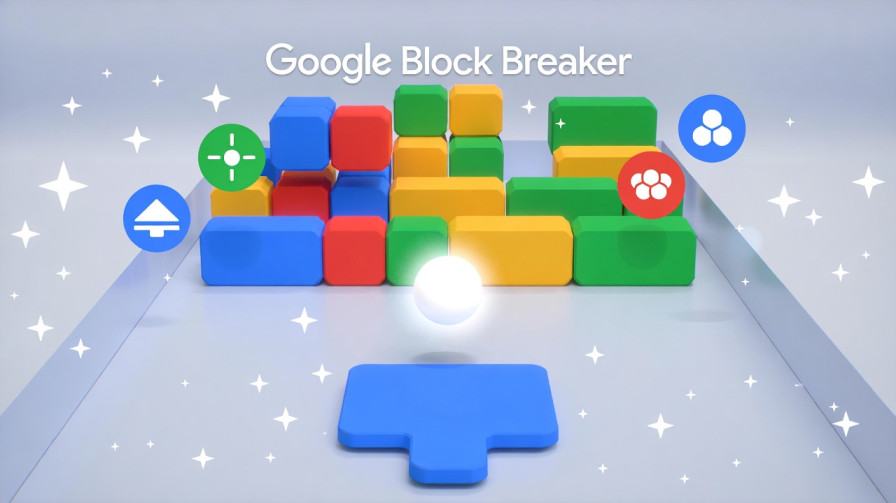
What started as a hidden ‘Easter Egg’ in Google’s search results has evolved into a global phenomenon. It is the perfect digital fidget spinner. Whether you’re a retro gaming aficionado reminiscing about the Atari days or a modern user looking for a quick distraction, the chance to play Google Block Breaker game provides a seamless experience that bridges the gap between generations.
In this deep dive, we are going to explore everything you need to know about the game, how to master it, and why this simple concept has remained so addictively relevant in 2026.
A Brief History: From Atari to Your Browser
To understand the appeal of Google Block Breaker, you have to look back at its ancestor: Breakout.
Released in 1976 by Atari, Breakout was a collaborative effort between Nolan Bushnell, Steve Bristow, and two young engineers named Steve Jobs and Steve Wozniak. The concept was simple: a paddle at the bottom of the screen, a ball, and a wall of bricks to clear. It was revolutionary because it proved that simple, physics-based gameplay didn’t need complicated storylines or 3D graphics to be captivating.
Google, known for its love of “Doodles” and hidden secrets, decided to pay homage to this classic by building a version directly into their search interface. Over the years, the game has been updated to support high-definition displays, touch-screen swiping, and even haptic feedback. By 2026, it is no longer just a “secret”; it is a polished, fully integrated feature that thousands of people play every single day.
Why We Can’t Stop Playing
Why do we keep coming back to a game that essentially involves hitting a ball with a stick? It comes down to something psychologists call “The Flow State.”
When you play Google Block Breaker, you are engaging in a task that is just challenging enough to keep you focused, but not so hard that it causes frustration. The repetitive, rhythmic nature of the game acts as a form of meditation. When the ball hits the paddle and the bricks shatter, your brain receives a tiny dopamine hit—a feeling of “completion.”
In a world filled with high-stress notifications, endless scrolling, and complex digital demands, the simplicity of Block Breaker is a breath of fresh air. It is a controlled environment where the rules are clear, the physics are predictable, and the only thing that matters is the next bounce.
How to Find and Play (The Easy Way)
Finding the game is trivial, but some people still miss the nuances of how to launch it across different devices.
On Desktop (Chrome, Safari, Edge, Firefox)
- Navigate to your search bar.
- Type “Google Block Breaker” or “Play Breakout”.
- You do not need to click a specific link. Usually, the game will appear as an interactive widget right at the top of the search results page.
- Controls:
- Mouse: Move your cursor left and right to control the paddle.
- Keyboard: Use the Left/Right Arrow Keys or A/D keys to move.
- Start: Press the Spacebar or Click to launch the ball.
On Mobile (Android & iOS)
- Open your browser app.
- Search for the same terms.
- The game will adapt to your touch screen.
- Controls:
- Swipe: Simply drag your finger left or right across the bottom of the screen.
- Launch: Tap anywhere on the screen to release the ball.
The Anatomy of a High Score: Advanced Mechanics
If you want to move beyond “casual player” and into “leaderboard contender” territory, you need to understand the underlying mechanics of the 2026 iteration.
The Physics of the Angle
The most common mistake beginners make is thinking that the ball bounces off the paddle at a flat 90-degree angle. It doesn’t.
The game calculates the ball’s trajectory based on where on the paddle it hits.
- Hitting the Center: If you hit the ball with the dead center of your paddle, the ball will bounce straight up. This is great for stability but bad for speed-clearing.
- Hitting the Edges: If you hit the ball with the far left or far right edge of your paddle, the ball gains a much sharper angle. This is the “pro” move. A sharp angle allows you to slide the ball into the side gaps of the wall, ricocheting it behind the bricks to clear large sections instantly.
The Power-Up System
Throughout the game, breaking certain bricks will cause power-ups to fall. Don’t ignore them!
- Multi-Ball: This is a double-edged sword. It creates chaos, allowing you to hit multiple sections of the wall at once. The risk? You have to track three balls at once, which increases the likelihood of a miss.
- Paddle Extension: Always prioritize catching this. A wider paddle gives you a larger “margin of error.” If you’re playing on a mobile screen, this is essentially a free pass to clear the next few rows safely.
- The “Slow” Power-Up: While it seems counterintuitive to want a slow ball, this is arguably the most valuable tool for precision. It allows you to set up the “Edge Shots” mentioned above without panicking.
Strategic Tips for Success
If you find yourself stuck on the later levels where the bricks are denser and the ball speed is faster, try these three strategies:
1. The “Vertical Channel” Strategy
Instead of trying to clear the board row-by-row, focus your energy on one specific vertical column. If you can break through a single vertical gap, you can get the ball behind the wall. Once the ball is trapped in the “ceiling zone” (the area above the bricks), it will bounce off the top wall and the back of the bricks, clearing massive amounts of space without you having to lift a finger.
2. Don’t Chase the Ball
This is the biggest hurdle for new players. Don’t move your paddle to where the ball is; move it to where the ball will be. Use your peripheral vision to track the ball’s trajectory. If you are constantly frantically swiping, you will eventually over-correct and miss. Aim for small, controlled movements.
3. Clear the Corners Early
In the later stages, the most annoying bricks are the ones in the top corners. They are the hardest to hit with a standard bounce. If you get a multi-ball or laser power-up, use it immediately to wipe out those corner blocks. Leaving them for last is a recipe for a “Game Over.”
Frequently Asked Questions (FAQ)
To help you get the most out of your sessions, here are the most common questions from the community.
Q: Is there an end to the game? A: Yes and no. The game features 50+ unique level patterns. Once you clear those, it usually transitions into “Endless Mode,” where the speed increases until it becomes nearly impossible to track.
Q: Can I save my high score? A: If you are logged into your Google account, the game often syncs your best score to your profile. You can challenge friends by sending them a link to your game state.
Q: Why does the game sometimes feel “laggy”? A: Because the game runs directly in your browser, it is dependent on your browser’s performance. If you have 50 tabs open, the game might stutter. Close a few tabs, and you’ll notice the physics become much smoother.
Q: Is it different on a phone vs. a desktop? A: The core physics are the same, but the “feel” is different. Desktop play relies on precise key taps, while mobile play relies on rhythm and swiping. Most players find desktop easier for high scores due to the precision of a mouse.
Q: Are there cheats or hacks? A: You might find some “scripts” online that claim to hack the game, but be careful. Many of these are security risks. The best way to “cheat” is to practice your aim!
Q: Can I play this without internet? A: Once the initial page has loaded, the JavaScript file is cached in your browser. If you don’t refresh the page, you can often keep playing even if you lose your connection.
Q: What is the highest score ever recorded? A: Records vary, but elite players have been known to break into the millions. It’s not about the points; it’s about the endurance.
The Future of Browser Gaming
Google Block Breaker is a reminder that the best technology doesn’t always have to be the most complex. In 2026, we see a trend toward “instant games”—games that require no installation, no storage space, and no commitment.
As web browsers become more powerful, we are likely to see more of these hidden gems. Google’s commitment to keeping these classics alive shows that even a trillion-dollar company understands the value of play. We don’t just use search engines to find information; we use them to explore, to learn, and sometimes, just to break a few bricks.
Final Thoughts
The next time you find yourself waiting for a file to download, a meeting to start, or your coffee to brew, skip the social media feed. Open a new tab, type “Google Block Breaker,” and take a few minutes to reset your brain.
It’s nostalgic, it’s challenging, and best of all, it’s waiting for you right now. Just don’t blame me when you realize you’ve been playing for twenty minutes instead of two!
Ready to start? Why not jump into a game now and see if you can beat your previous high score? If you need a specific strategy on how to handle the “Ghost Bricks” levels, just ask—I’m always here to help you climb that leaderboard.
