

A surprising number of songs do not begin with melody. They begin with language: a chorus line, a fragment of a verse, a phrase someone writes in the middle of the night and saves for later. The problem is that lyrics on their own are often difficult to evaluate. They may look promising on the page but still feel uncertain until someone can hear them in motion. That is where AI Song Generator becomes especially relevant. Its value is not only in making songs from prompts, but in helping written words become something audible much faster.
That difference gives the platform a different kind of usefulness. Many AI music tools are discussed as novelty generators, yet lyrics-to-song functionality serves a more grounded creative need. Writers often want to test rhythm, tone, and emotional weight before investing in a deeper production process. In my reading of AISong’s workflow, the platform is strongest when understood as a bridge between written intent and musical form.
Why Lyrics Need More Than A Page
Lyrics can carry emotion, structure, and narrative, but they do not automatically reveal how a song should feel when performed. A line can read as intimate and still sound too dramatic when sung. A chorus can look strong in text but fall flat once attached to a melody. That uncertainty slows writers down.
AISong addresses that uncertainty by offering a dedicated lyrics-into-song flow rather than treating lyrics as a minor add-on. That design choice matters because it acknowledges that many users already have words and are not starting from zero.
Writers Often Need Translation, Not Inspiration
In these cases, the challenge is not “help me think of an idea.” It is “help me hear the idea I already have.” That is a very different creative problem, and it deserves a different tool path.
A Lyrics First Entry Point Is More Practical
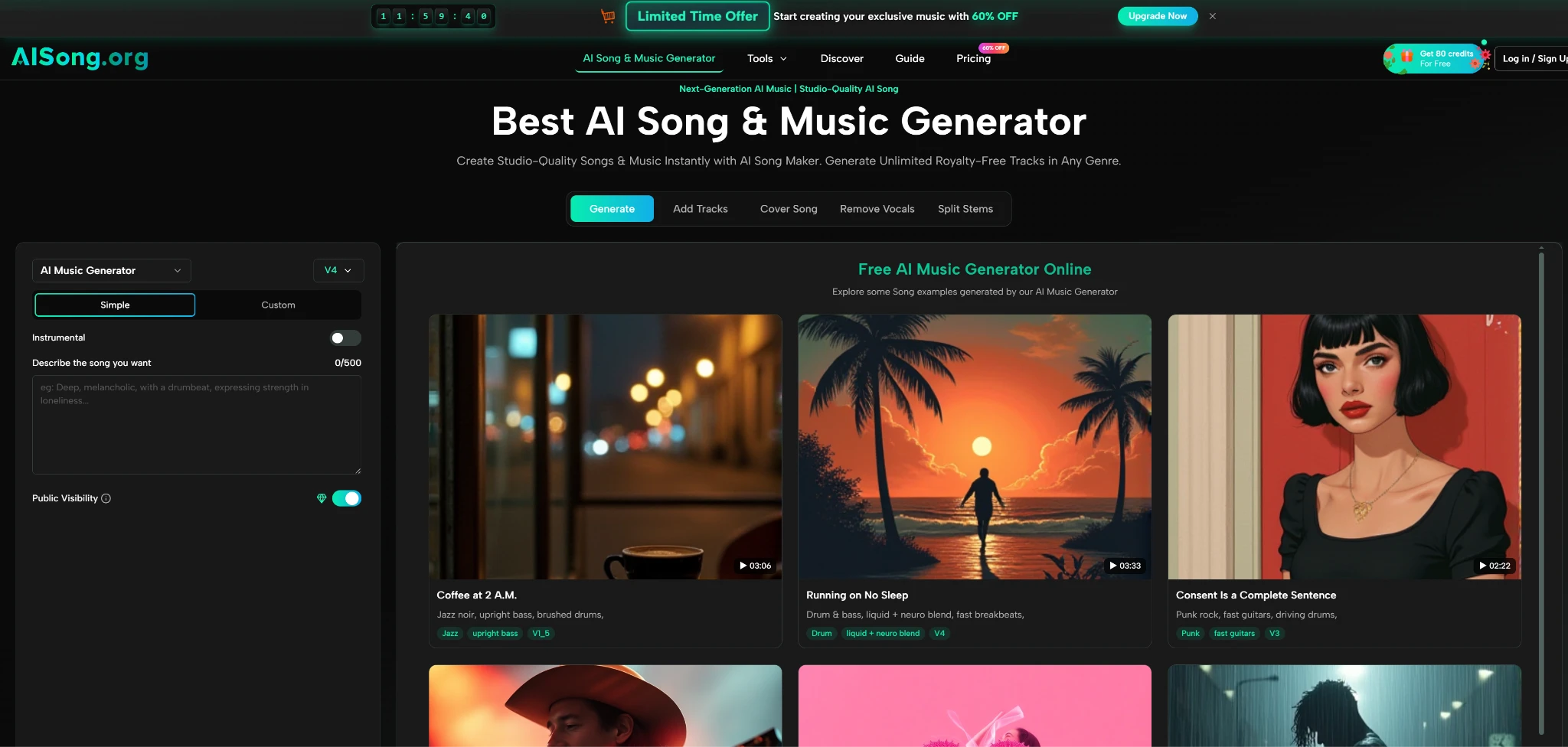
The site’s lyrics-to-song page presents a workflow with Simple and Custom modes, an Instrumental toggle, Title, Styles, Genre, Moods, Voices, Tempos, a Lyrics field, a Lyrics Editor, Advanced Options, Public Visibility, and generation controls. In practical terms, that means the platform treats lyrics as a central input, not as an afterthought.
How AISong Supports The Writing To Song Shift
AI Song Maker structure suggests that it is designed to interpret user-provided language and then wrap musical decisions around it. The homepage also describes text and lyrics conversion as part of the broader studio suite, alongside lyrics generation, song extension, and audio tools.
Lyrics Become The Core Material
When a writer already has words, they are no longer asking the system to invent the entire identity of the song. They are asking it to build around a known center. That can make the generation process feel more directed.
Style Controls Add Necessary Context
A lyrics page alone would not be enough if every result sounded generic. The supporting controls for genre, mood, tempo, and voice matter because they help guide how the words are interpreted. A reflective lyric can become soft pop, cinematic ballad, indie folk, or something more electronic depending on those choices.
Instrumental Choice Clarifies The Intended Output
The presence of an Instrumental toggle is also useful. Sometimes a writer does not need a fully sung performance immediately. They may want to hear the emotional environment first, then think about the role of vocals later.
Context Shapes The Meaning Of Lyrics
The same lyric can feel sincere, ironic, tense, dreamy, or uplifting depending on the musical frame. That is why lyrics-to-song tools are more than convenience features. They change how a writer can evaluate what they have written.
What The Broader Toolset Adds
AISong is not presented only as a lyrics tool. It combines several related functions that make the creative process less fragmented.
Lyrics Generation Helps When The Draft Is Incomplete
If a user has only a concept rather than a full lyric sheet, the built-in lyrics support can help expand the writing before song generation. That makes the platform useful both for incomplete ideas and finished lyrical drafts.
Song Extension Supports Ongoing Development
One of the more practical additions is Extend Song. If a user creates a short result that feels promising, the platform gives them a visible path to continue the idea instead of forcing a complete restart.
Audio Tools Help With Reuse
The site also includes Vocal Remover and file conversion tools. Those features suggest that AISong sees generated music as part of a reusable workflow rather than a one-time output. For creators working across demos, edits, or content assets, that matters.
| Writing Need | AISong Capability | Why It Helps |
| Existing lyrics | Dedicated lyrics-to-song route | Lets writers hear words as music quickly |
| Partial concept | Lyrics generator support | Helps develop text before generation |
| Emotional direction | Mood and genre controls | Guides interpretation of the same lyrics |
| Output flexibility | Instrumental option | Useful when vocals are not needed yet |
| Draft expansion | Extend Song | Supports development beyond the first render |
| Reuse workflow | Vocal remover and conversion tools | Helps adapt generated material for other purposes |
How To Use The Platform As A Writer
The official process is short enough to stay practical.
Step 1 Start With Lyrics Or A Song Idea
Choose whether to begin on the general generator page or the dedicated lyrics-to-song page. Writers with existing lyrics will likely benefit most from the second path.
Step 2 Define The Musical Framing
Add the title, style, and available controls such as mood, voice, tempo, and genre. Paste or edit your lyrics if that is your starting point.
Step 3 Generate And Compare The Result
Run the generation, listen carefully, and decide whether the phrasing, emotional tone, and musical setting fit the writing. If not, adjust the framing and try again.
Why This Matters For Different Creators
A lyrics-first approach is useful in more contexts than people often assume.
Songwriters Can Test Emotional Direction Early
Instead of waiting for a complete production arrangement, they can hear whether the words feel better in a slower or brighter environment. That can guide rewriting just as much as it guides music choices.
Independent Artists Can Build Faster Demos
A rough but coherent song draft can help artists decide whether a lyric deserves further investment. It can also be useful for pitching, sharing ideas, or documenting creative progress.
Content Creators Can Turn Written Concepts Into Audio
Some creators write lines for jingles, intros, or branded hooks rather than full songs. A lyrics-to-song tool can help them move those lines into usable formats without a long studio process.
Audibility Changes How People Edit
Once words become sound, weaknesses become easier to notice. Repetition, awkward pacing, and emotional overstatement often reveal themselves more clearly in audio than on the page. That makes the generation step valuable even when the result is only a draft.
Where The Limits Still Show
This kind of workflow has clear strengths, but it should not be misunderstood as magic.
Lyrics Alone Do Not Guarantee A Great Song
Strong words still need the right framing. If the genre or emotional direction is poorly chosen, the output may feel mismatched even when the lyric itself is solid.
Iteration Is Part Of The Process
A first generation may reveal what is wrong more than what is perfect. That is not necessarily a weakness. For many writers, hearing what does not fit is already useful progress.
The Tool Is Fast, Not Omniscient
It can accelerate the move from text to sound, but it still relies on human taste. The user must decide whether the result feels honest, overproduced, too generic, or emotionally right for the words.
Why AISong Is Best Read As A Bridge
The most interesting thing about AISong is that it shortens the gap between written language and musical experience. That gap has always been one of the slowest parts of songwriting for people without a full production setup.
Seen from that angle, the platform is less about replacing writers and more about giving them faster feedback. That is a meaningful role. It turns lyrics from something speculative into something testable, and for many creators, that is exactly the moment where songs begin to take shape in a more serious way.
