

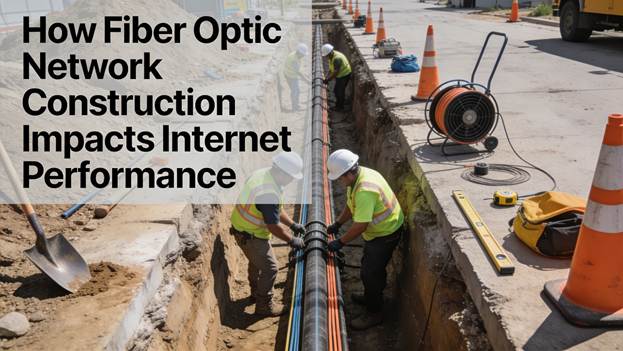
Your internet speed depends directly on how technicians install your fiber optic cables during construction. Proper cable bend radius, strategic amplifier placement every 80-120 kilometers, and quality splicing techniques all determine your actual throughput.
Poor installation practices introduce signal loss, while environmental factors like moisture and temperature fluctuations further degrade performance over time. Network design choices—including core diameter and redundancy pathways—establish your bandwidth capacity. The construction standards used today fundamentally shape how fast your data travels tomorrow.
How Fiber Optic Cable Installation Affects Signal Integrity
When you’re installing fiber optic cables, you’re handling one of the most signal-sensitive mediums in telecommunications. Even minor installation errors can severely degrade signal quality and reduce network performance.
You must maintain proper cable bend radius during installation to prevent microbending, which causes light scattering and signal loss. Improper slack management introduces stress that can compromise fiber integrity. You’ll need to guarantee cables aren’t twisted, kinked, or excessively tensioned during deployment. Environmental factors play a significant role in the success of installations.
You should protect cables from temperature fluctuations, moisture, and physical damage during installation. Additionally, ensuring high-quality fiber optic network construction is essential to minimize external risks. Poor splice quality directly impacts signal transmission, so you’ve got to use precision equipment and trained technicians. You’re also responsible for maintaining accurate documentation of cable routes, splice locations, and installation conditions.
This documentation helps you troubleshoot future performance issues and prevents costly signal degradation problems down the line. For more detailed information on best practices, and if you want to get this service, visit the fiber optic network construction page. Understanding these guidelines will enhance the effectiveness of your installation process and ensure long-term reliability.
.
Fiber Splicing: Where Performance Loss Actually Happens
You’ll discover that fiber splicing introduces measurable signal degradation that you must quantify using standardized loss measurement techniques to guarantee network reliability.
When you perform fusion splicing, you’re adhering to strict quality standards that directly determine whether your splice meets acceptable performance thresholds or becomes a network bottleneck.
Understanding both the measurement methods and quality benchmarks gives you the knowledge to identify and minimize the performance losses that splices inherently introduce to your fiber optic system.
Splice Loss Measurement Techniques
Most fiber splices introduce some level of signal loss, and measuring this loss accurately is essential for maintaining network performance and identifying problematic connections.
You’ll rely on optical time-domain reflectometry (OTDR) as your primary measurement tool, which sends light pulses down the fiber and analyzes reflections to pinpoint splice locations and quantify losses. This non-destructive method lets you test installed cables without disruption.
You can also employ insertion loss testing, which measures power reduction directly across a splice by comparing signal strength before and after the connection. For field work, handheld power meters provide quick readings.
Lab environments use more precise equipment like optical spectrum analyzers. Regular measurements help you catch degradation early, ensuring your network maintains peak performance standards throughout its lifespan.
Fusion Splicing Quality Standards
While you’ve learned to measure splice loss after connections are made, understanding the standards that govern fusion splicing quality helps you prevent problems before they occur.
Industry standards like ITU-T G.671 establish acceptable loss limits, typically under 0.1 dB for well-executed splices. You’ll need to maintain precise alignment between fiber cores, control fusion parameters carefully, and verify cleave angles are exactly 90 degrees.
These standards guarantee consistent performance across your network infrastructure. When you follow established guidelines for arc duration, temperature, and fiber positioning, you considerably reduce signal degradation.
Meeting these quality benchmarks isn’t optional—they’re critical for maintaining network reliability and minimizing costly signal regeneration equipment downstream.
Network Design Decisions That Determine Your Bandwidth
Every design choice you make during network planning—from fiber type selection to routing architecture—directly impacts the bandwidth capacity your system can deliver.
You’ll need to evaluate several critical factors:
- Core diameter and mode specifications – Single-mode fiber supports higher bandwidth over longer distances than multi-mode alternatives.
- Wavelength division multiplexing (WDM) – You can dramatically increase capacity by transmitting multiple signals simultaneously.
- Redundancy pathways – Strategic routing prevents bottlenecks and guarantees consistent performance under peak loads.
- Equipment compatibility – Your infrastructure must support current and future technologies without costly upgrades.
You’re fundamentally creating your network’s throughput ceiling during the planning phase.
Poor architectural decisions today become expensive limitations tomorrow.
Prioritize scalability and capacity planning to maximize your investment’s longevity and performance potential.
Amplifier Placement: Why Location Matters for Speed
You’ll find that signal degradation increases exponentially as light travels through fiber optic cables, which is why you can’t simply space amplifiers randomly throughout your network.
Ideal placement requires you to position amplifiers before signal loss reaches critical thresholds, ensuring you maintain throughput speeds across your entire infrastructure.
Your strategic positioning of these amplifiers directly determines whether you’ll achieve the bandwidth performance your network design promised.
Signal Degradation And Distance
As light travels through fiber optic cables, it naturally weakens over distance—a phenomenon called attenuation that directly impacts your network’s speed and reliability.
You’ll find that signal degradation accelerates beyond certain thresholds, requiring strategic amplifier placement to maintain performance.
Consider these key factors affecting your network:
- Distance limits: Standard single-mode fiber loses signal strength considerably after 80-100 kilometers without amplification.
- Attenuation rates: Your signal weakens approximately 0.2 decibels per kilometer in ideal conditions.
- Amplifier spacing: You’ll need regenerators every 80-120 kilometers to restore signal integrity.
- Environmental impact: Temperature fluctuations and moisture increase degradation rates greatly.
Optimal Placement For Throughput
Strategic amplifier placement isn’t just about preventing signal loss—it’s about maximizing the speed and capacity your network can actually deliver.
You’ll want to position amplifiers at intervals that match your fiber’s attenuation rate, ensuring signal strength remains consistent throughout transmission.
When you space amplifiers too far apart, you’re allowing degradation that compresses your bandwidth and reduces throughput. Conversely, placing them too closely wastes resources and introduces unnecessary noise accumulation.
You’re seeking the sweet spot where signals stay strong without over-amplification.
The ideal distance varies based on your fiber type, wavelength, and data rates.
You’ll need to calculate these intervals during network design, accounting for terrain and environmental factors. Proper placement directly impacts the speeds you’ll achieve and how many users your infrastructure can support simultaneously.
Environmental Factors That Degrade Fiber Over Time
While fiber optic cables are remarkably durable, environmental factors can gradually degrade their performance and lifespan. You’ll want to monitor these key threats:
- Moisture infiltration – Water seeping into cable jackets causes signal loss and corrosion of internal components.
- Temperature fluctuations – Extreme heat and cold create expansion cycles that stress fiber cores and connectors.
- UV radiation – Sunlight deteriorates outer protective layers, compromising structural integrity.
- Physical stress – Ground movement, vibrations, and external pressure bend fibers beyond acceptable limits.
You can mitigate these issues through proper conduit installation, protective sheathing, and regular inspections.
Burying cables underground or installing them in reinforced ducts greatly extends their operational life.
Strategic placement away from known environmental hazards guarantees your network maintains ideal performance for decades.
How Construction Quality Directly Impacts Your Internet Speed
The installation practices you choose during fiber optic network construction directly determine your connection speeds and reliability. Poor workmanship introduces signal loss through improper cable splicing, inadequate shielding, and substandard connectors. When technicians don’t follow specifications, you’ll experience slower speeds and frequent disconnections.
Quality construction guarantees tight tolerances in cable routing, proper bend radius maintenance, and precise fusion splicing. These factors minimize attenuation—the weakening of your signal over distance.
Well-executed installations also prevent crosstalk interference between fibers, preserving bandwidth integrity. Your network’s maximum potential speed depends on construction accuracy.
Shortcuts during installation create bottlenecks that prevent you from reaching advertised speeds. Investing in meticulous construction practices upfront protects you from costly repairs and performance degradation later, assuring the full gigabit speeds your fiber connection promises.
Why Rural Networks Lag Behind Urban Infrastructure
Because fiber optic infrastructure requires massive upfront investment, rural areas rarely attract the same construction resources as densely populated cities. You’re likely experiencing slower speeds if you’re in a rural location due to several interconnected factors:
- Lower population density makes per-customer infrastructure costs prohibitively expensive.
- Reduced revenue potential discourages private provider investment.
- Greater geographic distances require more materials and labor.
- Limited government subsidies can’t bridge the funding gap.
You’ll notice urban networks receive priority because they generate faster returns on investment. Companies concentrate their construction efforts where they’ll recoup expenses quickly.
Rural communities consequently face years-long delays in fiber deployment, leaving you dependent on inferior broadband alternatives like satellite or DSL service.
What New Construction Standards Mean for Future Performance
As construction standards evolve, you’ll benefit from infrastructure designed for greater speed and longevity than previous generations.
Modern specifications mandate higher-quality materials, stricter installation protocols, and enhanced protective measures that reduce signal degradation. You’re gaining networks built to support emerging technologies like 5G and beyond without requiring complete overhauls.
These standards establish consistent performance benchmarks across regions, ensuring you receive reliable download speeds regardless of location.
Updated guidelines also address environmental resilience, protecting cables from extreme weather and physical damage. Installation crews now follow detailed documentation requirements, making maintenance and repairs more efficient.
You’ll experience faster deployment timelines as standardized practices streamline construction processes.
Better planning and equipment specifications mean fewer service interruptions and improved network stability.
These advancements ultimately deliver you superior connectivity and future-proof infrastructure investments.
Conclusion
You’re seeing fiber networks transform your internet experience at remarkable speeds. When you consider that proper fiber optic installation can reduce signal loss by up to 90% compared to poorly constructed networks, you’ll understand why construction quality matters. You’ll benefit from better speeds and reliability when engineers prioritize cable splicing, amplifier placement, and environmental protections. You’re ultimately investing in infrastructure that directly determines your connection’s performance.
