

For founders and finance leaders in India’s evolving startup ecosystem, deciding when to use debt financing is a strategic capital allocation decision rather than a routine funding choice. In 2025, Indian startups raised around $13 billion across approximately 1,250 deals, reflecting continued access to capital but with more selective investor behaviour.
Debt financing is increasingly being considered alongside equity because it funds growth without diluting ownership. Its suitability depends on timing, cash-flow stability, and business-model maturity. Options such as Recur startup financing are being used by founders as part of a shift toward revenue-linked capital structures in India.
This article outlines how decision-makers such as founders, CFOs, and strategy leaders can assess debt readiness and align it with growth objectives in the Indian context.
Startup Debt Financing: Overview
Debt financing involves raising capital that must be repaid over a defined period with interest. It does not dilute ownership but creates contractual repayment obligations that impact cash flow planning. In India, startups access debt through banks, non-banking financial companies, and specialised startup lenders.
Common instruments include term loans, working capital loans, invoice financing, asset-backed credit, and venture debt. Venture debt is typically used by startups that have already raised equity and demonstrate predictable revenue or growth traction, often to extend their runway between funding rounds.
Venture debt deployment in India reached about $1.3 billion in 2025, indicating growing acceptance among startups that want to extend their runway without issuing additional equity.
Why Debt Financing is a Strategic Option for Startups
For founders and financial decision makers, debt serves specific strategic purposes:
- Ownership Retention: Debt allows founders and existing shareholders to retain equity while still accessing capital for growth initiatives.
- Runway Extension: Debt can extend the runway between equity rounds, especially when market conditions slow or make equity fundraising more expensive.
- Capital Efficiency: When used appropriately, debt can reduce reliance on equity capital and improve overall capital structure efficiency.
- Alignment With Cash Flows: Certain debt products align repayments with revenue cycles, which is useful for startups with recurring or predictable inflows.
Overall, debt financing supports growth while preserving ownership, improving capital structure, and aligning repayments with predictable cash flows for sustainable expansion.
Key Risks Must Be Evaluated Before Taking Debt Financing
Debt introduces financial obligations that must be managed with precision. Unlike equity, it requires scheduled repayments and can influence liquidity, flexibility, and long-term financial stability.
- Fixed Repayments: Repayments are mandatory regardless of business performance. This creates consistent pressure on cash flows and requires reliable revenue generation to remain sustainable.
- Interest Costs: Interest adds to the total cost of capital and must be included in financial planning. Higher interest obligations can reduce margins and impact reinvestment capacity.
- Covenants: Some lenders impose covenants requiring the maintenance of specific financial ratios or restricting additional borrowing. Breaching these conditions can trigger penalties or early repayment clauses.
- Liquidity Constraints: If revenue slows or collection delays occur, repayment obligations can strain liquidity. This may limit operational flexibility and affect day-to-day business decisions.
Understanding these risks in advance helps founders structure debt responsibly and avoid unexpected financial stress during repayment cycles.
When Debt Financing Makes Strategic Sense for Startups
The suitability of debt depends on business maturity, revenue predictability, and funding needs. The following situations typically indicate readiness for debt financing.
- Stable and Predictable Revenue
Startups with recurring or consistent revenue streams, such as SaaS or subscription-based models, are better positioned to handle debt. Predictable inflows support structured repayment planning and reduce lenders’ perceived risk.
- Between Equity Funding Rounds
Debt is commonly used as a bridge to the next equity round. When a startup has already raised capital but needs additional funds to achieve milestones, debt can provide interim financing without dilution.
- Working Capital Requirements
Startups with inventory, vendor payment, or receivable cycles often require short-term liquidity. Instruments such as invoice financing and working capital loans help manage operational cash-flow gaps.
- Expansion and Scaling Phases
Debt can fund expansion initiatives such as entering new markets, increasing marketing efforts, or scaling teams. This is suitable for startups with validated unit economics and clear growth trajectories.
- Market Conditions Affecting Equity
When equity markets are uncertain or valuations are compressed, debt can serve as an alternative source of capital. This allows startups to maintain momentum without raising equity under unfavourable terms.
Debt is most effective when aligned with predictable cash flows and clear growth milestones, ensuring it supports expansion rather than adding financial strain.
Common Types of Debt Financing Options Available to Startups
Different debt instruments serve different business needs. Selecting the right type depends on revenue model, stage, and asset base.
- Venture Debt: Offered by specialised lenders to startups that have already raised equity. It is typically used to extend the runway and may include warrants linked to equity.
- Bank Loans: Traditional loans require financial history, collateral, or strong cash flows. These are better suited to later-stage startups with stable operations.
- Invoice Financing: Allows startups to borrow against outstanding receivables. This improves liquidity by unlocking cash tied up in unpaid invoices.
- Asset-Backed Loans: Loans secured against assets such as equipment, inventory, or property. These are based on the collateral value rather than on revenue alone.
- Revenue-Based Financing: Repayment is tied to a percentage of revenue. This aligns repayment obligations with business performance and reduces fixed pressure on cash flow.
Choosing the right debt instrument ensures financing is aligned with business structure, cash flow patterns, and growth stage.
Debt Financing Readiness Checklist for Startups
Before engaging lenders, startups should assess internal readiness across key financial and operational dimensions.
- Cash Flow Visibility: Prepare detailed forecasts covering at least 12 to 18 months. These should include revenue projections, expenses, and repayment schedules to ensure repayment feasibility.
- Break-Even Position: Identify the point at which the business becomes cash flow positive. This helps determine whether debt repayments can be supported sustainably.
- Runway Analysis: Evaluate how debt affects existing runway and whether it extends the timeline to achieve key milestones such as revenue targets or product scaling.
- Debt Servicing Capacity: Assess whether operating cash flows are sufficient to meet periodic repayments without affecting core business functions.
Model downside scenarios where revenue growth slows or collections are delayed. Debt should remain manageable even under conservative assumptions.
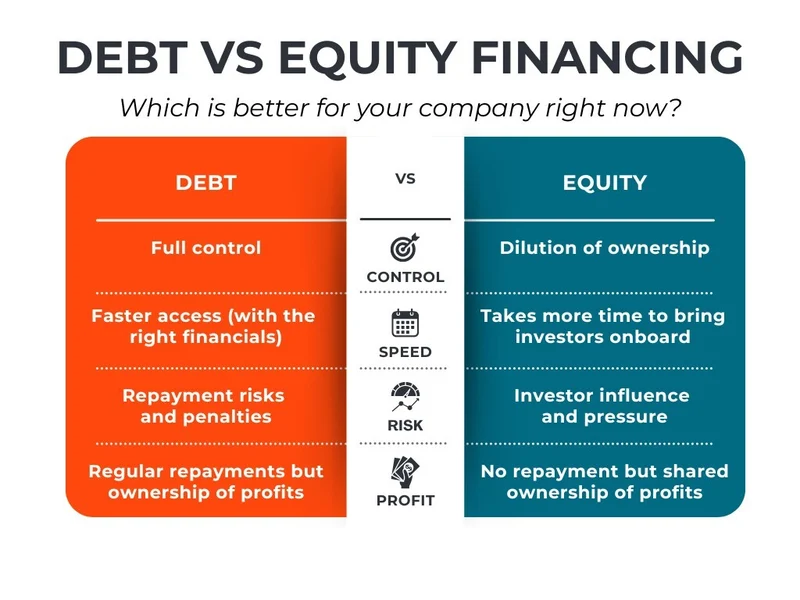
Comparing Debt and Equity Financing for Startup Decision Making
A structured comparison helps decision makers choose the right instrument.
| Factor | Debt Financing | Equity Financing |
| Ownership | No dilution | Dilution occurs |
| Repayment | Mandatory | No repayment obligation |
| Cost Structure | Interest and fees | Ownership sharing |
| Risk Profile | Repayment pressure | Shared with investors |
| Control | Retained by founders | Shared with investors |
| Flexibility | Depends on terms | Depends on investor rights |
Debt is generally more suitable when predictable cash flows exist, and dilution is a concern.
Common Debt Financing Mistakes Founders Should Avoid
Debt can support growth when used with clear planning, but incorrect assumptions or timing can create financial strain. Founders should evaluate repayment capacity, cost structure, and alignment with business needs before committing to any borrowing.
- Taking on Debt Too Early: Raising debt without stable or predictable revenue can put pressure on repayment. Startups should ensure sufficient visibility into cash flow before introducing fixed obligations.
- Underestimating Total Cost: Interest is only one component of borrowing. Processing fees, prepayment charges, and covenants increase the overall cost of capital and must be evaluated upfront.
- Misalignment with Use of Funds: Debt should be allocated to specific, revenue-linked purposes, such as working capital, inventory, or expansion. Using debt to cover fundamental business gaps can create a long-term imbalance.
- Weak Cash Flow Planning: Inadequate forecasting of inflows and outflows often results in repayment difficulties. Detailed cash flow models help ensure that obligations remain manageable across different scenarios.
Avoiding these mistakes helps maintain financial stability and ensures that debt contributes positively to business growth rather than constraining it.
How Startups Should Approach Lenders in India
A structured and well-prepared approach improves the likelihood of securing debt on favourable terms. Lenders evaluate startups based on clarity of business model, financial health, and repayment capacity. Presenting reliable data and a clear funding plan helps build credibility during the assessment process.
- Clear Business Model: Lenders expect a well-defined revenue model with identifiable growth drivers. A startup should clearly explain how it generates revenue, its target customers, its pricing structure, and its unit economics.
- Financial Documentation: Maintain organised financial statements, forecasts, and key metrics, including CAC and LTV. Clean and consistent financial records help lenders assess stability and future repayment ability.
- Defined Use of Funds: Specify how the borrowed capital will be used and how it supports measurable business outcomes. Whether it is inventory, hiring, or expansion, the purpose should be directly linked to revenue or operational improvement.
- Credible Revenue Evidence: Demonstrating consistent inflows, recurring revenue, or signed contracts improves lender confidence. Cash flow predictability is a key factor in determining eligibility and loan terms.
A well-prepared approach reduces friction in due diligence and improves the chances of obtaining structured financing aligned with business needs.
How Debt Strengthens a Startup’s Capital Structure Strategy
Debt plays a structured role in shaping a startup’s capital mix by complementing equity and supporting disciplined growth. When used appropriately, it helps founders align financing with cash flows, preserve ownership, and maintain flexibility in future fundraising decisions.
- Capital Efficiency: Debt reduces dependence on equity funding, allowing startups to access capital without diluting ownership. This is particularly useful when valuations are expected to improve in future rounds.
- Milestone Achievement: Debt can provide interim capital to reach defined business milestones, such as revenue targets, product launches, or market expansion, thereby strengthening positioning for the next equity round.
- Financial Discipline: Regular repayment schedules require consistent cash flow management and forecasting. This encourages structured financial planning and tighter control over operating expenses.
- Signal of Stability: A startup that successfully services debt demonstrates predictable cash flows and operational stability, which can improve credibility with future investors and lenders.
Debt, when aligned with visibility into growth and repayment capacity, strengthens the financial structure and supports sustainable scaling.
Conclusion
Debt financing is most appropriate when a startup has achieved revenue predictability, clear growth plans, and can manage structured repayments without disrupting operations. It is not intended for early-stage uncertainty, but it works well for startups scaling and needing additional capital between equity rounds.
For Indian founders and finance leaders, evaluating debt requires a disciplined approach to cash flow planning, cost analysis, and risk assessment. When aligned with business objectives, debt can complement equity and support sustainable growth.
Platforms and instruments such as Recur startup financing illustrate how modern financing options are evolving to meet the needs of startups seeking flexible, non-dilutive capital solutions.
