


Referral-led growth has become one of the most attractive acquisition channels for app brands that want better quality users, lower acquisition costs, and stronger long-term retention. It sounds simple enough. Give users an incentive, encourage them to invite friends, and watch installs roll in. In reality, successful referral programmes are far more nuanced than that.
For app teams, the challenge is not deciding whether referrals matter. It is deciding how to build, launch, optimise, and scale a programme that fits the app, the audience, and the economics of the business. A badly designed scheme can drain budget, attract low-intent users, and create operational headaches. A well-built one can turn happy customers into a dependable growth engine.
This buyer’s guide is designed to help founders, marketers, product teams, and growth leads make better decisions before investing time and budget into a referral strategy. It explains what referral-led growth really means, when it works best, what features matter, which questions to ask before launch, and what to avoid if you want results that last.
Whether you are exploring your first invite programme or trying to improve a referral system that already exists, this guide will help you assess the right path with a commercial mindset rather than chasing surface-level growth.
Why Referral-Led Growth Matters for Apps
Acquiring new users is expensive. Paid media costs fluctuate, privacy changes affect attribution, and app store visibility is increasingly competitive. That is exactly why referrals remain so compelling. When current users actively recommend a product to friends, the new customer often arrives with a higher level of trust than someone who discovered the app through a standard advert.
The psychology behind this is straightforward. People are more likely to try something if it comes from a friend, colleague, or family member than from a brand message alone. That built-in trust can shorten decision cycles, improve install-to-sign-up rates, and increase the likelihood that the referred user sticks around.
For app businesses, referral channels can offer several advantages:
- Lower blended customer acquisition cost
- Higher intent users
- Better retention potential
- Stronger word-of-mouth credibility
- More efficient growth loops over time
That does not mean every app will succeed with a referral scheme. The strength of the product experience, timing of the referral prompt, reward design, and onboarding quality all influence performance. The point is that referrals are not just a nice add-on. In the right conditions, they can become one of the most commercially efficient routes to sustainable growth.
Who Should Read This Buyer’s Guide
This guide is especially useful for:
- App founders reviewing growth channels before scaling
- Marketing leads seeking more efficient acquisition
- Product managers shaping invite and reward flows
- CRM and lifecycle teams improving user advocacy
- Growth consultants comparing referral software or in-house builds
- Investors and operators evaluating app monetisation efficiency
If your team is asking questions such as “Should we launch a referral programme?”, “Should we build or buy?”, or “What should a good referral setup include?”, you are in the right place.
Referral Marketing for Apps: What Buyers Need to Assess First
Before you compare tools, sketch campaign ideas, or discuss incentives, you need to determine whether your app is actually ready for referral-led acquisition.
A great many teams rush into referrals because it feels like a logical next step. But if the product is not solving a clear problem, or if users are not yet having a positive first experience, a referral scheme simply amplifies weakness.
Here are the core areas to review first.
Product-Market Fit Comes Before Promotion
People only recommend products they find useful, enjoyable, or valuable. If user satisfaction is low, activation is weak, or retention drops sharply after onboarding, a referral programme may fail for reasons that have nothing to do with the referral mechanics themselves.
Signs your app may be ready include:
- Solid early retention
- Good user feedback or reviews
- A clear value proposition
- Natural moments of delight or success
- Existing organic word-of-mouth behaviour
If people already talk about your app without prompting, that is a promising signal.
User Motivation Must Be Clear

Different users refer for different reasons. Some want rewards. Some want status. Some simply want to help friends discover something useful. The best-performing referral strategies align with the user’s real motivation rather than forcing a generic offer.
Ask yourself:
- Why would a user recommend this app?
- What makes the product worth sharing?
- Does the reward support or distract from the brand?
- Is the referral action easy and natural?
A budgeting app, a social app, and a utility app may all need very different approaches even if they target a similar audience.
Unit Economics Need to Make Sense
A referral that produces installs is not automatically a success. You need to understand whether the cost of rewards, fraud risk, and operational effort can be justified by the value of referred users.
Look closely at:
- Customer lifetime value
- Payback period
- Cost per referred acquisition
- Reward fulfilment cost
- Expected referral conversion rate
- Retention and monetisation of referred users
A scheme that looks exciting on the dashboard can still be commercially weak if rewards outweigh downstream value.
Key Buyer Questions Before Launching a Referral Programme
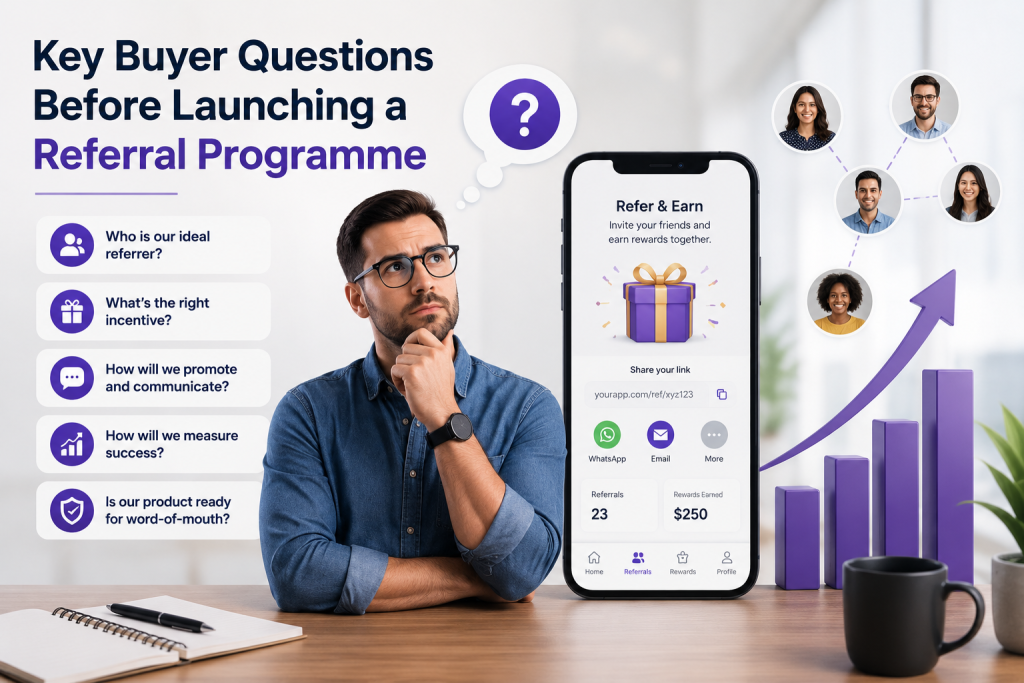
Choosing a referral path involves more than selecting software or deciding on a reward. Buyers should ask deeper strategic questions first.
What Is the Primary Goal?
Be precise about success. Are you trying to:
- Increase installs
- Improve first purchase volume
- Acquire more qualified users
- Boost retention through social accountability
- Reduce paid media dependency
- Improve customer lifetime value
If the team cannot define success clearly, optimisation becomes guesswork.
Which Users Should Be Asked to Refer?
Not every user is an advocate. Some are still learning the app. Some are inactive. Some have not yet experienced the product’s core value.
Strong referral programmes identify the best trigger moments, such as:
- After a successful booking
- After completing onboarding
- After receiving a clear benefit
- After hitting a milestone
- After a positive review or support interaction
Timing matters. Ask too early and conversion drops. Ask too late and momentum is lost.
Should the Reward Be One-Sided or Two-Sided?
This is one of the most important commercial choices.
One-sided rewards give the existing user a benefit for making a successful referral.
Two-sided rewards give both the referrer and the new user a benefit.
Two-sided models often feel more generous and socially acceptable because the invitee benefits too. However, they may increase cost. One-sided models can work well when the product already has strong appeal and the advocate needs only a small nudge.
The right choice depends on the app category, average order value, lifetime value, and brand position.
What Counts as a Successful Referral?
Define the event carefully. Is success based on:
- App install
- Sign-up
- Verified account creation
- First booking
- First deposit
- Subscription start
- Purchase after trial
The further down the funnel you reward, the better your protection against poor-quality users and fraud. The downside is that users may feel the reward is harder to earn. Balance simplicity with commercial logic.
Important Features to Look for in Referral Solutions
If you are comparing platforms or deciding what to build internally, these are the features that matter most.
Essential Capabilities for App Referral PlatformsFlexible Reward Rules
You need the ability to control who gets rewarded, when, and under what conditions. This helps protect margin and improves testing.
Look for:
- Event-based reward triggers
- Adjustable reward values
- Time-limited offers
- Segment-specific incentives
- Geographic rule controls
- Eligibility settings
A rigid system limits optimisation later.
Fraud Prevention and Abuse Controls

Referral abuse is a serious concern. Without safeguards, users may create fake accounts, exploit loopholes, or recycle offers.
Useful controls include:
- Device fingerprinting
- Duplicate detection
- IP monitoring
- Email and phone validation
- Reward delay windows
- Manual review flags
- Referrer and referee eligibility checks
Fraud is not an edge case. It should be considered from day one.
Mobile-Friendly Sharing Experience
The referral journey must feel effortless on mobile. If users have to jump through too many steps, conversion will suffer.
Prioritise:
- Simple invite flows
- Deep links
- In-app sharing prompts
- Easy copy-and-share links
- SMS, messaging, and email compatibility
- Smooth landing and install attribution
A referral experience should fit naturally into the mobile behaviour of your audience.
Clear Attribution and Reporting
If you cannot measure referral performance properly, you cannot optimise it. Buyers should insist on reporting that is understandable and commercially useful.
Look for visibility into:
- Invite send rate
- Referral conversion rate
- Reward redemption rate
- Time to conversion
- Fraud or invalid referrals
- Revenue from referred users
- Retention by referred cohort
Good reporting should help you answer not just what happened, but why.
Integration with Existing Growth Stack
Referral activity should not live in isolation. It should work with your broader CRM, analytics, and product ecosystem.
Helpful integrations include:
- Mobile measurement partners
- CRM systems
- Email and push tools
- Product analytics platforms
- Subscription or payment systems
- Data warehouses
This makes it easier to personalise referral prompts, track downstream value, and connect referrals to lifecycle marketing.
Brand and UX Customisation
The programme should feel like part of your app, not an awkward overlay from another vendor. Design consistency affects trust and conversion.
Make sure you can customise:
- Copy and messaging
- Reward presentation
- In-app screens
- Landing pages
- Reminder messages
- Referral hub experience
A clumsy referral interface can weaken even a strong value exchange.
Referral programme design for mobile growth
The design of the programme itself matters just as much as the technology behind it. Good design connects user intent, business value, and product timing.
Think about:
- Where referral prompts appear in the journey
- Whether the reward is instantly understandable
- How long users have to complete the action
- What happens if the referred friend does not convert quickly
- Whether reminders are sent
- How success is communicated back to the referrer
This is where many app teams either create momentum or lose it.
Measuring invite quality and user retention
A quality referral programme should not be judged on raw volume alone. You also need to measure whether referred users are more valuable than other acquisition cohorts.
Useful comparison points include:
- Day 1, Day 7, and Day 30 retention
- First purchase or subscription conversion
- Average revenue per user
- Churn rate
- Time to key activation event
- Virality or repeat sharing behaviour
If referred users are cheaper to acquire but churn faster, the model may need work. If they retain better and monetise more effectively, that is a strong sign the channel deserves more investment.
Building advocacy through product experience
No referral tool can fix a weak product experience. In most cases, the best-performing referral systems are built on top of a product that users genuinely want to talk about.
That means advocacy begins with:
- Fast onboarding
- Clear value communication
- Moments of delight
- Helpful support
- Reliable performance
- Strong perceived utility
In many ways, referrals are a reflection of customer satisfaction. For a wider background on the mechanics of recommendation-based growth, Wikipedia’s overview of referral marketing offers a useful starting point.
Build or Buy: Which Route Makes More Sense?
This is a common question for app teams. Should you build a referral system in-house or use a dedicated provider?
When Building In-House May Work
Building internally can make sense if:
- Your product has highly specific referral logic
- You have strong engineering resource
- The business needs full control over data and UX
- You are comfortable handling fraud prevention internally
- The referral system is expected to become a core long-term growth asset
The upside is flexibility and ownership. The downside is development time, maintenance cost, and the risk of underestimating edge cases.
When Buying a Solution May Be Better
Buying is often a strong option when:
- You need to launch quickly
- Your team lacks specialist referral infrastructure
- You want pre-built fraud tools
- You need reporting without a long development cycle
- You want easier testing and optimisation
The downside is reduced flexibility and ongoing platform costs. The decision usually comes down to speed, complexity, internal capability, and long-term strategic importance.
Common Mistakes Buyers Should Avoid
Many referral launches underperform not because the concept is flawed, but because teams make avoidable mistakes during planning and rollout.
Offering Rewards That Attract the Wrong Users
If the incentive is too broad or too generous, you may attract users interested only in the reward rather than the product.
Launching Too Early
Referrals work best when the product already delivers value. Launching before activation and retention are stable can amplify poor user experiences.
Ignoring the User Journey
If users do not understand the offer, cannot share easily, or do not know when rewards arrive, they will lose interest fast.
Optimising Only for Volume
Installs are not enough. Focus on user quality, downstream revenue, and retention.
Failing to Test Creative and Timing
Referral copy, reward framing, and placement all affect conversion. Teams that do not test regularly often miss obvious gains.
How to Evaluate Referral Success After Launch
The first version of your programme should not be the final version. Referral systems improve through testing, learning, and refinement.
Track performance across three layers:
1. Engagement Metrics
- Invite prompt views
- Share clicks
- Invite send rate
- Acceptance rate
2. Conversion Metrics
- Install-to-sign-up rate
- Sign-up-to-purchase rate
- Referred user activation
- Cost per converted referral
3. Value Metrics
- Retention by cohort
- Revenue per referred user
- Payback period
- Referral contribution to overall growth
The most useful insight often comes from comparing referred users against paid, organic, and app store cohorts over time.
What a Good Referral Programme Usually Includes
A strong referral setup often has the following traits:
- A clear and easy-to-explain reward
- A logical moment in the user journey for the ask
- Strong mobile UX and deep linking
- Anti-fraud controls
- Clear reporting
- Reward economics tied to user value
- Ongoing testing and segmentation
- Alignment between product, marketing, and data teams
If you are looking for referral marketing for apps, it is worth reviewing partners or solutions that understand mobile growth, measurement, and the realities of user acquisition beyond surface-level virality.
Final Thoughts
Referral-led growth can be one of the smartest investments an app business makes, but only when approached with the same commercial discipline you would apply to paid acquisition, lifecycle marketing, or product optimisation.
A good buyer does not ask, “Can we launch a referral programme?”
A good buyer asks, “Can we launch one that attracts the right users, protects margin, fits the product experience, and improves long-term growth?”
That shift in thinking matters.
The best referral systems are not built around gimmicks. They are built around trust, timing, economics, and ease of use. They respect the customer relationship while making it simple for happy users to advocate for something they already value.
If your app has reached the point where users understand the product, gain genuine benefit from it, and are likely to recommend it, then referral-led growth deserves serious consideration. But before you commit, take time to evaluate readiness, incentive design, fraud prevention, reporting capability, and platform fit.
Do that properly, and referrals can become much more than a side campaign. They can become a reliable, high-quality acquisition channel that supports stronger retention and more resilient growth.
