

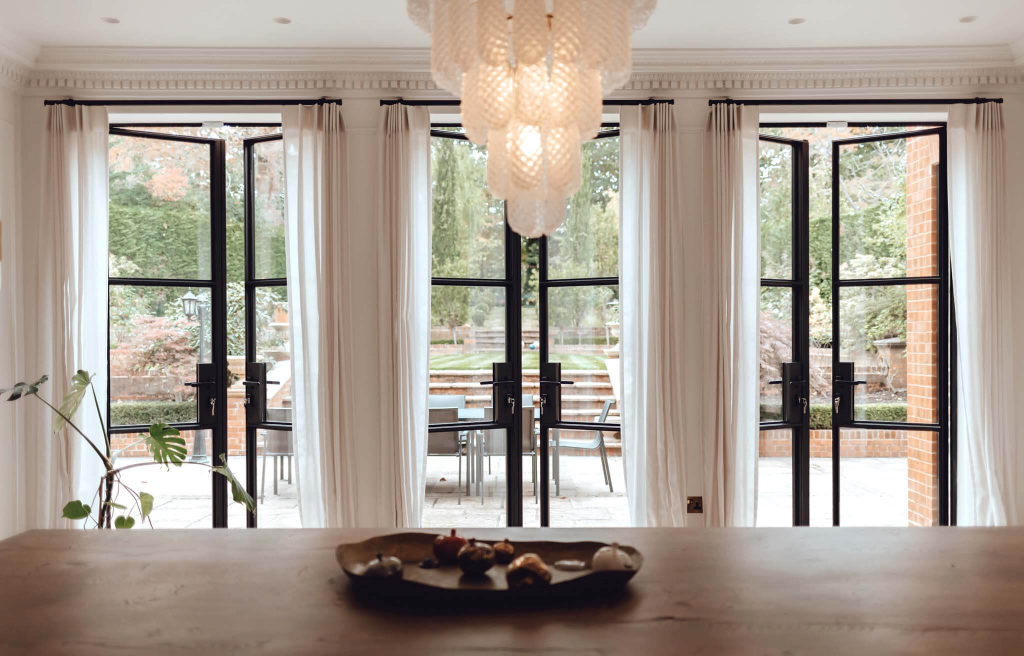
My neighbor knocked on her door last spring. New flooring, fresh plaster, the whole lot. But the thing everyone kept talking about at her housewarming was not the kitchen extension or the bi-fold doors at the back. It was the pair of internal arched doors she had put in between the hallway and the sitting room. People kept stopping in front of them. Running their hands along the steel frame. Asking where she got them. She told me afterwards that three of her friends had called her within a week asking for the contact details of her installer. That told me something.
Arched doors have been around forever, obviously. Churches, old manor houses, and Victorian terraces with their original curved door surrounds. But what is happening now feels different. People are actively choosing them, specifying them from scratch, and having them made to measure for openings that were originally plain rectangles. That choice says something about where interior design in this country is heading.
Flat Doors Have Had Their Moment
For a long time, the default internal door in new builds and renovations was flat. Flush panel, white primed, off the shelf. Quick to fit, easy to paint, job done. And honestly, in the right setting, a clean flat door is fine. Nobody is arguing against simplicity.
But there is a particular kind of disappointment that comes with a house that has been beautifully renovated in every other way, and then you notice the doors are just… standard. They feel like they came from a builder’s merchant on a budget. Because they did. The rest of the room might have hand-poured concrete worktops and reclaimed oak flooring, but the door is the same one you would find in any new-build semi. It breaks the spell a bit.
I think that is why arched doors started gaining traction again. Not because everyone suddenly decided to go Victorian. But because people started noticing the gap between the effort they were putting into their interiors and the effort the doors were contributing. An arch fills that gap immediately.
What Steel Actually Does for the Design
You could do an arched door in timber. Plenty of people have, historically. But there is a reason so many of the best examples you see today are made from steel. The material behaves differently. It holds its shape over years in a way timber genuinely cannot promise. A timber arch, especially in a property with older walls that shift a little seasonally, will eventually show signs of movement. A small gap here. A creak there. A curve that is not quite as clean as it was at installation.
Steel does not do that. Once it is set, it stays. The frame you see on day one is the frame you will see in fifteen years. That consistency matters because arched frames are visible in a way that a standard door frame is not. People look at them. They are meant to be looked at.
The slimness of the steel profiles is worth talking about separately. Modern steel door manufacturers have pushed the sightlines down to something that would have been difficult to achieve even ten years ago. The amount of glass relative to the frame has shifted considerably. What you end up with in a quality steel arched door is something that reads almost more as a glass feature than a door. The steel is structural and beautiful, but the glass does most of the visual work. Light passes through. Rooms feel connected. The arch frames a view rather than blocking one.
The arch shape itself matters more than people realize.
Not all arches are the same, and picking the wrong profile for a space is one of the easier mistakes to make. I have seen pointed Gothic arches in low-ceilinged rooms that felt cramped rather than dramatic. The arch was fighting the ceiling instead of working with it. And I have seen shallow elliptical arches in rooms with soaring ceiling heights that looked timid and a little lost.
The proportion of the arch relative to the opening, and the opening relative to the room, is what holds the whole thing together. A semicircular arch needs ceiling clearance to breathe properly. A Gothic pointed arch is at its best in a taller, narrower opening where the drama of the upward point has room to register. An elliptical arch is more forgiving across a wider range of ceiling heights, which is part of why it has become popular in contemporary renovations where proportions are not always ideal.
Getting this right is honestly one of the better arguments for working with a specialist rather than ordering something from a catalog and hoping it fits. Someone who has installed hundreds of these doors across different property types will know what works. That experience is worth paying for.
Glass Choices and Why They Are Not an Afterthought
The glass specification of an arched door shapes the feel of the whole thing, and it is an area where people sometimes make quick decisions they later regret. Clear glass is the obvious starting point. It maximizes light flow, keeps rooms feeling open, and is the most versatile choice across different interior styles. For most situations, it is still probably the right answer.
Fluted glass has become genuinely fashionable in the past few years, and for good reason. The vertical texture diffuses light without blocking it. You get privacy without darkness. In a hallway leading to a living room or between a kitchen and a dining space, fluted glass does something clear glass cannot: it creates a sense of intimacy while still letting the light through. It also photographs remarkably well, which matters to anyone who has spent time on interior design social media lately.
Frosted glass is the quieter option. Less texture, more opacity. It works well where privacy is the primary concern rather than decoration. For anyone thinking about a bathroom or a bedroom adjoining a dressing area, frosted glass in an arched steel frame is actually a rather elegant solution to what could otherwise be an awkward privacy problem.
Installation Is Where a Lot of Projects Go Wrong
This is the part of the conversation that does not always happen until it is too late. Arched doors are not like hanging a standard door. The opening preparation is different. The frame anchoring is different. The weight distribution requires more thought. And if the wall above the opening has not been properly assessed before the installation team arrives, you can end up with delays, additional costs, and a finish that does not look as clean as it should.
Pre-installation surveys exist precisely to avoid this situation. A surveyor visits the site, takes measurements, assesses the wall construction, checks floor loading, and flags anything that needs sorting before production even begins. It costs money. But anyone who has dealt with a botched installation mid-project will tell you it costs considerably less than the alternative.
The combined weight of steel and glass is also something builders used to consistently underestimate for timber doors. The hinges are heavier duty. The frame fixings are more involved. A professional installation team that works specifically with steel doors will know this. Someone fitting their first steel arched door on a general domestic contract might not appreciate the difference until something goes wrong.
What It Does to a Room Over Time
I want to make a point about daily life with arched doors because the focus on installation and specification can sometimes obscure a simpler truth. These doors change how you feel about a room every single time you walk through them. That sounds like a large claim to make for a door. But there it is.
The arch creates a moment of transition. It marks the passage between spaces in a way a flat door does not. When you open a well-made steel arched door and step through it, the room on the other side feels like it has been arrived at rather than stumbled upon. This is not a small thing when you live in a space every day.
People who have had them installed often say the same kind of thing: they forget the doors are there until a visitor points them out. And then they remember all over again why they chose them. That is usually the mark of a good design decision. Not something that demands constant attention, but something that quietly improves every single day you live alongside it.
Is the Investment Actually Worth It
Let me be straightforward here. A bespoke steel arched door costs more than a standard internal door. Sometimes significantly more, depending on size, glass specification, and arch complexity. Anyone telling you otherwise is not being honest about what quality manufacturing actually costs.
But the comparison is not really between a steel arched door and a standard flat door. The comparison is between a home finished properly and a home finished adequately. If you have spent serious money on a renovation, the doors are not the place to compromise. They are the things people actually touch. They frame the rooms you live in. They are seen, felt, and passed through dozens of times every single day.
And from a property perspective, distinctive architectural features in key spaces do make a consistent difference in how buyers remember homes. Not transformative on its own, but part of a pattern. An arched steel door in a hallway or a living room entrance is exactly the kind of feature that stays in someone’s memory after fifteen viewings, when they are trying to recall which property had that thing they could not stop thinking about. That kind of recall has value, and most homeowners who have invested in one will tell you it was worth every penny.
