


If you own a Land Rover diesel whether it’s a Discovery Sport, Defender, or Range Rover there is one maintenance task that deserves far more attention than it typically gets: DPF cleaning. Land Rover engines are not your average diesel powerplants. They are precision-engineered machines with complex emissions systems, and when the Diesel Particulate Filter (DPF) starts clogging up, generic cleaning methods simply do not cut it.
This is not just a matter of performance. A blocked DPF on a Land Rover can trigger limp mode, cause irreversible damage to the turbo, and cost you thousands in avoidable repairs. Understanding why land rover dpf cleaning requires a specialist approach and acting on it before warning lights start flashing could be the difference between a quick service and a full engine rebuild.
What Is a DPF and Why Does It Matter in Land Rover Diesels?
The Diesel Particulate Filter sits within your exhaust system and captures soot particles produced during combustion. Over time, these particles accumulate. Under normal operating conditions, the engine triggers a process called regeneration essentially burning off the soot at high temperatures to clean the filter.
Land Rover diesel engines, particularly those fitted with the 2.0-litre Ingenium and the older 3.0-litre TDV6, have a regeneration strategy that is closely tied to driving style, ambient temperatures, and ECU calibration. This makes them significantly more sensitive than commercial diesel engines when it comes to DPF maintenance.
Short urban journeys are the biggest problem. If your Land Rover spends most of its time in stop-start city traffic, it rarely reaches the exhaust temperatures needed to complete a passive regeneration cycle. Soot builds up faster than it burns off, and before long, the filter reaches a point where neither passive nor active regeneration can clear it. That is when professional dpf cleaning for land rover vehicles becomes essential.
Why Land Rover DPF Systems Are Different From Standard Diesels
Not all DPFs are created equal, and Land Rover’s emissions architecture is among the most complex in the passenger vehicle market. Here is what sets them apart:
Tighter ECU Integration: Land Rover’s terrain response system, engine management, and emissions control all communicate in real time. A partially blocked DPF sends fault data through multiple control modules, which means a standard forced regeneration from a generic OBD tool will often fail to clear the fault codes properly.
Higher Soot Load Thresholds: Land Rover DPFs are calibrated to tolerate a higher soot load before triggering a warning light compared to many European rivals. This means by the time the amber light appears on your dashboard, the filter is already significantly blocked often beyond the point where additive-based cleaners or a short motorway run will fix things.
Cordierite vs. Silicon Carbide Substrates: Many Land Rover models use silicon carbide DPF substrates, which are durable but extremely sensitive to thermal shock. Improper cleaning methods including DIY pressure washing or baking at incorrect temperatures can crack the substrate and render the entire filter useless.
Integrated DOC (Diesel Oxidation Catalyst): Land Rover’s exhaust aftertreatment often combines the DOC and DPF in a single housing. Cleaning one without addressing the other leads to incomplete restoration and continued performance problems.
This is precisely why land rover dpf cleaning should never be treated as a generic DPF job.
The Most Common Signs Your Land Rover DPF Needs Cleaning
Catching DPF problems early saves money and protects the engine. These are the warning signs Land Rover owners should watch for:
The DPF Warning Light is the most obvious signal. On Land Rover models, this typically appears as an amber filter icon. If it progresses to red or is accompanied by an engine management light, the blockage is already severe.
Loss of Power or Limp Mode is a strong indicator. When the ECU detects a critically blocked DPF, it restricts engine output to protect the turbo and exhaust system. Your Land Rover may feel sluggish, unresponsive, or refuse to rev past 3,000 RPM.
Increased Fuel Consumption is something many owners overlook. A clogged DPF creates back pressure in the exhaust system, forcing the engine to work harder. If you are filling up more frequently without any obvious reason, a restricted DPF could be the culprit.
Excessive Black Smoke during acceleration suggests incomplete combustion and poor soot filtration. On a well-maintained Land Rover diesel, visible exhaust smoke should be minimal.
Strong Smell of Diesel inside or around the vehicle, particularly at low speeds, can indicate failed regeneration attempts where unburned fuel has entered the exhaust system.
If you are noticing any of these symptoms, read our detailed guide on signs your diesel needs DPF cleaning to better understand how serious the blockage may be.
Land Rover Discovery Sport DPF Cleaning: A Special Case
The Discovery Sport is one of the most commonly affected Land Rover models when it comes to DPF problems. Here is why it deserves its own section.
The Discovery Sport is overwhelmingly popular as a family and school-run vehicle. Its typical usage pattern short suburban journeys, school pickups, occasional motorway trips is almost perfectly designed to prevent DPF regeneration from completing successfully.
The Ingenium 2.0-litre diesel engine fitted to the Discovery Sport requires a sustained journey at speeds above 50 mph for at least 20 to 30 minutes to complete an active regeneration. Most Discovery Sport owners rarely drive like this in day-to-day life.
Land rover discovery sport dpf cleaning needs are compounded by the fact that the Ingenium engine family has a software-managed regeneration strategy that can lock out forced regen if certain conditions are not met including oil temperature, fuel level, and coolant temperature thresholds. A technician using a generic scan tool will often see a failed forced regen without understanding why, leading to misdiagnosis and wasted time.
Specialist DPF cleaning for the Discovery Sport involves:
- Pre-cleaning diagnostic using Land Rover IDS (Integrated Diagnostic Software) or equivalent to accurately read soot load percentage
- Chemical pre-soak using a formulation safe for silicon carbide substrates
- Hydraulic pulse cleaning to dislodge compacted ash without cracking the filter
- Post-clean verification with a pressure test and a confirmed forced regeneration cycle
- ECU reset and adaptation to prevent legacy fault codes from re-triggering the warning light
If you want to understand how different cleaning methods compare in terms of effectiveness, our article on how to identify clogged DPF filter symptoms before engine damage happens gives you a detailed breakdown of what happens inside the filter at each stage of blockage.
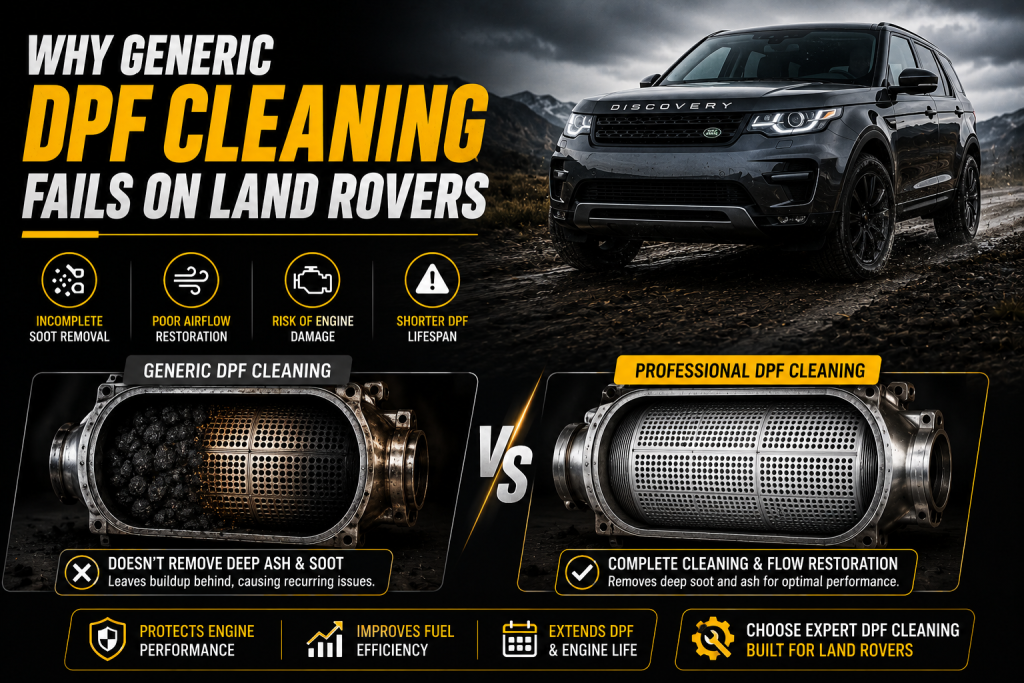
Why Generic DPF Cleaning Fails on Land Rovers
Walk into any budget garage and ask for a DPF clean, and there is a reasonable chance they will either pour in an additive, attempt a forced regen on a basic OBD reader, or offer to remove and wash the filter with a pressure washer. For a Land Rover, all three approaches carry significant risks.
Additive-Only Treatments work best as a preventive measure on filters that are lightly sooted. On a Discovery Sport or Defender with a filter that is 80% or more blocked, additives do almost nothing. The ash that accumulates over years of driving cannot be burned away it requires physical extraction through hydraulic cleaning.
Basic Forced Regeneration without first clearing the soot load manually will fail if the filter is too far gone. Worse, attempting it on a severely clogged filter can cause thermal runaway an overheating event inside the exhaust that can damage the catalytic converter, oxygen sensors, and in extreme cases, the turbocharger.
Pressure Washing is perhaps the most dangerous DIY or budget approach for Land Rover filters. The silicon carbide substrate used in many Land Rover DPFs is brittle. Direct water pressure can crack the internal channels, creating large gaps that allow soot to pass through unfiltered effectively destroying the filter’s function while leaving it physically intact.
A dpf cleaner land rover discovery sport or any Land Rover model demands a hydraulic pulse cleaning process combined with proper diagnostic support nothing less.
What a Proper Land Rover DPF Cleaning Service Looks Like
A genuinely effective land rover dpf cleaning service follows a structured process that respects the engineering complexity of these vehicles. Here is what you should expect:
Step 1 Full Diagnostic Scan: Using Land Rover-specific diagnostic software, the technician reads the actual soot load percentage (not just a warning light), checks for secondary fault codes in the TCU, SCR system, and EGR valve, and confirms whether a forced regeneration is possible in-situ.
Step 2 Filter Removal and Inspection: The DPF is removed carefully, inspected for physical cracks or substrate damage, and weighed to determine the ash and soot load. A healthy DPF weighs significantly less than a clogged one.
Step 3 Hydraulic Pulse Cleaning: The filter is placed into a cleaning machine that pushes specially formulated cleaning solution through the channels using controlled hydraulic pulses. This method dislodges compacted ash from deep within the substrate without causing thermal or mechanical stress.
Step 4 Thermal Drying and Post-Clean Inspection: After cleaning, the filter is dried and re-inspected. Flow testing confirms that restriction has been reduced to an acceptable level, typically restoring 85–95% of original flow capacity.
Step 5 Reinstallation and ECU Reset: The filter is reinstalled, and all related fault codes are cleared. A verified forced regeneration is performed to confirm the system is operating correctly, and the post-regeneration exhaust back pressure is checked to confirm success.
This is the standard that Land Rover diesel owners should hold their service providers to. Anything less is a shortcut.
How Often Should Land Rover DPF Cleaning Be Done?
There is no single answer that fits every Land Rover driver, but here are practical guidelines based on usage:
- Predominantly urban driving: Every 50,000 to 60,000 miles, or when soot load readings exceed 70%
- Mixed driving (urban + motorway): Every 80,000 to 100,000 miles
- Mainly motorway or long-distance driving: Every 100,000 to 120,000 miles
Land Rovers used for off-road driving may need more frequent cleaning because low-speed, high-load operation such as crawling over terrain in low range generates substantial soot without triggering regeneration.
Annual DPF checks as part of a Land Rover service are always a sensible precaution, particularly for Discovery Sport owners who do the school run daily.
The Real Cost of Ignoring Land Rover DPF Maintenance
Some Land Rover owners delay DPF cleaning because the warning light has been on for months and the car still drives. This logic is understandable but costly. Here is what progressive neglect looks like:
- Stage 1 (Amber light, 60–75% soot load): Forced regen possible with specialist tools. Cleaning cost: relatively low.
- Stage 2 (Amber + engine light, 75–85% soot load): Manual cleaning required. More expensive but filter is salvageable.
- Stage 3 (Red warning, 85–95% soot load): Filter may need replacement. Cost escalates significantly. Turbo stress begins.
- Stage 4 (Engine in limp mode, 95%+ or ash accumulation): DPF replacement confirmed. Risk of turbo and injector damage. Repair bills can reach several thousand pounds.
Specialist DPF cleaning at Stage 1 or Stage 2 is almost always a fraction of the cost of Stage 3 or Stage 4 intervention.
Ready to Restore Your Land Rover’s Performance?
A blocked DPF does not have to mean an expensive replacement or weeks without your vehicle. Specialist land rover dpf cleaning can restore your engine to full performance, clear those warning lights, and protect the long-term health of your turbo and exhaust system usually in a single day.
Don’t wait for Stage 3 or Stage 4 damage to force your hand.
Book Your Land Rover DPF Cleaning Service Today →
Our expert technicians use Land Rover-specific diagnostics and hydraulic pulse cleaning technology to deliver a verified result not a temporary fix. Whether you drive a Discovery Sport, Defender, Range Rover, or Freelander, we have the tools and experience to get your diesel running cleanly again.
FAQs: Land Rover DPF Cleaning
Q1: Can I use a DPF additive to clean my Land Rover Discovery Sport DPF?
Additives like Cataclean or dedicated dpf cleaner land rover products can help maintain a lightly sooted filter and support passive regeneration. However, they are not effective at clearing a filter that is already significantly blocked. If your warning light is on, an additive alone will not solve the problem you need a professional assessment.
Q2: How long does a professional land rover dpf cleaning service take?
A proper hydraulic cleaning service for a Land Rover DPF typically takes between 2 to 4 hours, including removal, cleaning, drying, reinstallation, and ECU reset. Same-day service is standard at specialist DPF cleaning centres.
Q3: Will dpf cleaning for land rover void my warranty?
If your Land Rover is still under a manufacturer warranty, always check with your dealer first. For vehicles out of warranty, professional DPF cleaning by a reputable specialist will not void any remaining extended warranty, provided the correct procedures are followed and documented.
Q4: My Land Rover Discovery Sport keeps going into limp mode after the DPF was cleaned. Why?
This usually means the ECU fault codes were not properly cleared after cleaning, or there is a secondary issue such as a faulty EGR valve, a blocked DOC, or a malfunctioning DPF pressure differential sensor. A full diagnostic using Land Rover IDS software should be carried out to identify the root cause.
Q5: Is land rover dpf cleaning the same as dpf removal?
No and it is important to understand the difference. DPF cleaning restores the filter to working condition, keeping the emissions system intact and the vehicle road-legal. DPF removal (or deletion) physically or electronically bypasses the filter, which is illegal for road use in the UK, US, and most other countries, and will result in an MOT failure.
