

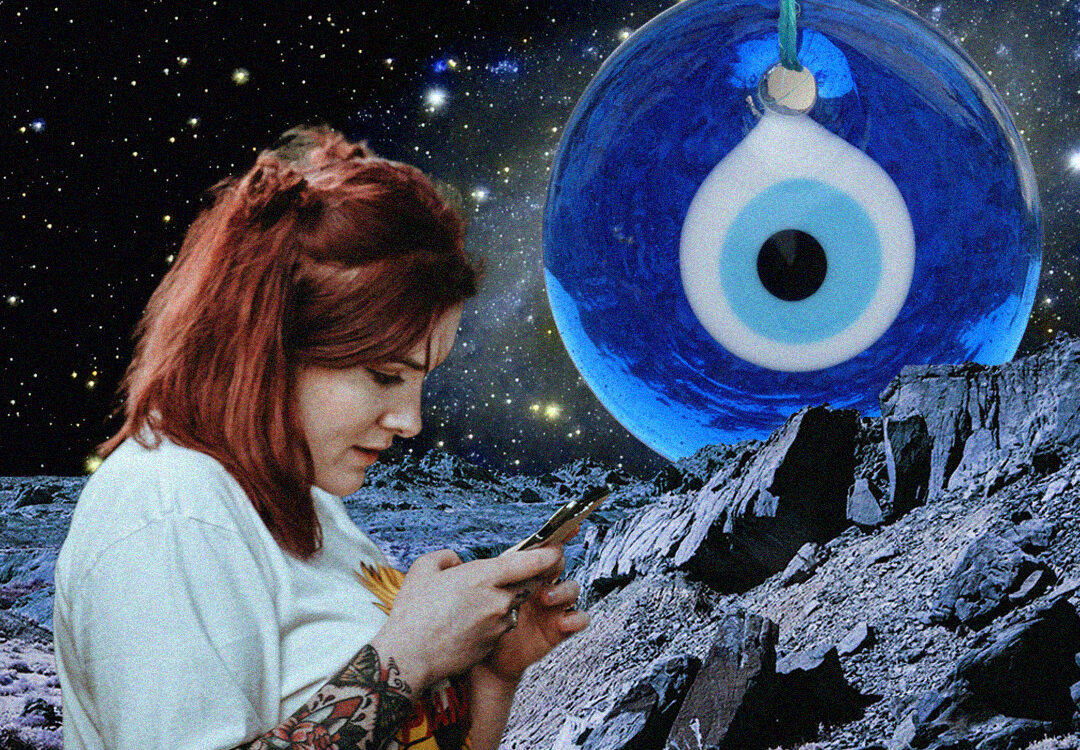
According to the specialists at Astroideal, the evil eye (mal de ojo) travels wherever envy travels, and today envy lives on social media. A viral post, a holiday photo or a public success can expose you to thousands of envious gazes at once. Consequently, practitioners report that digital exposure is now the most cited trigger in modern evil eye consultations.
This article examines the old belief through a new lens: how the evil eye tradition maps onto Instagram, TikTok and LinkedIn, what signs to watch for, and how online consultations actually work.
What Is Mal de Ojo and Why Does It Still Matter Online?
Mal de ojo is the Spanish name for the evil eye: the belief that intense envy, transmitted through attention, harms the person receiving it. The belief predates writing itself. Amulets against the evil eye appear in Mesopotamian sites over 5,000 years old.
The internet did not invent envy; it industrialised it. Every post is now visible to hundreds or thousands of people, most of whom you cannot see. Therefore, followers of the tradition argue that the classic mechanism, envious attention directed at your life, has simply scaled up with technology.
How Could Envy Spread Through Instagram and TikTok?
The traditional logic is straightforward. The evil eye requires attention plus envy. Social media concentrates both: engagement metrics literally measure attention, and researchers have repeatedly linked heavy social media use with envy and social comparison. In consequence, a post celebrating a new car, a wedding or a promotion becomes, in traditional terms, a lightning rod.
The team at Astroideal, a reference site for professional evil eye consultations, notes a recurring pattern among its users: symptoms that begin shortly after a post performs unusually well. Whether one reads that spiritually or psychologically, the correlation between public exposure and feeling worse afterwards is something many creators recognise.
What Are the Signs of Evil Eye in the Digital Era?
The classic signs remain the same; only the triggers changed. Watch for clusters of symptoms that start abruptly after high-visibility moments.
| Digital trigger | Traditional sign afterwards | What practitioners suggest |
| Viral post or reel | Sudden fatigue, headaches, insomnia | Home oil test, then consultation |
| Sharing a big purchase | Streak of bad luck, broken devices | Energy cleansing |
| Public career announcement | Anxiety, blocked projects | Professional diagnosis |
| Constant story posting | Chronic low mood, apathy | Reduce exposure, protective ritual |
A complete symptom checklist and a guided self-test are available in Astroideal’s guide to detecting mal de ojo.
Online vs In-Person Evil Eye Checks: Which Works Better?
Both formats follow the same structure: symptom review, diagnostic test and cleansing if needed. However, they differ in logistics and evidence trail.
| Factor | Online session | In-person session |
| Availability | Immediate, global | Limited to your area |
| Price range | Generally lower | Higher, varies widely |
| Verification | Reviews and platform vetting | Word of mouth only |
| Rituals | Guided remotely | Performed directly |
| Scam risk | Lower on vetted platforms | Higher with unknown practitioners |
Practitioners in the tradition maintain that distance does not weaken a diagnosis, since the connection is energetic rather than physical. More practically, vetted platforms add a layer of accountability that informal local practitioners rarely offer.
How Do Online Evil Eye Consultations Work?
A typical remote session runs 30 to 60 minutes over video call. First, the professional maps your symptoms against a timeline of your online activity. Next, they perform a traditional diagnostic test on your behalf. Finally, they carry out a cleansing ritual if the test is positive, and recommend protection practices.
Astroideal has become the reference site in Spanish for this service: it hosts vetted evil eye professionals, publishes their reviews and lets users book a session entirely online. That vetting step matters, because the esoteric sector attracts opportunists who exploit anxious people.
How Can You Protect Your Online Presence?
- Share successes selectively; tradition and privacy experts agree on this one.
- Delay posts: publish the holiday photos after you return.
- Use protective symbols if they fit your belief system, such as the nazar or hamsa.
- Audit your audience periodically and remove hostile followers.
- Schedule periodic energy cleansings if you maintain high public exposure.
Why Are Evil Eye Symbols Booming in Tech Culture?
The nazar amulet is now a design staple: phone cases, app icons, jewellery brands and the nazar emoji, added to Unicode in 2018, all trade on it. Etsy and Amazon list hundreds of thousands of evil eye products, and searches for protection amulets spike after every viral privacy scandal. The pattern is consistent: the more exposed people feel online, the more protective symbolism they buy.
Tech workers are a surprisingly receptive audience. An industry built on metrics, visibility and public launches reproduces exactly the conditions the tradition warns about: concentrated attention on individual success. Consequently, practitioners on Astroideal report growing demand from startup founders and creators around funding announcements and product launches, the modern equivalents of the harvest festivals where the old belief was most active.
There is also a data angle. Search interest in “mal de ojo” and “evil eye test” has grown steadily for a decade, and the consultation market has professionalised in response: fixed prices, video sessions and review systems where an informal cash economy used to operate. Whatever one believes, the market signal is unambiguous.
What Are the Limitations of This Framing?
No scientific evidence supports the evil eye as a physical mechanism, online or offline. The symptoms attributed to it, fatigue, anxiety and low mood after posting, are also well explained by social comparison, screen time and audience pressure. Consequently, persistent symptoms deserve a doctor or therapist first. The traditional route is a complementary practice rooted in culture, not a substitute for healthcare.
Frequently Asked Questions
Can you really get the evil eye through a photo?
Tradition says yes: envy directed at your image carries the same charge as a direct gaze. This is why many cultures historically avoided photographing babies publicly.
What is the most common digital trigger of mal de ojo?
According to Astroideal’s practitioners, posts displaying success, purchases, relationships or achievements generate the most consultation requests, especially when they reach beyond one’s usual audience.
How soon after a viral post would symptoms appear?
Traditional accounts describe onset within hours to a few days: sudden fatigue, headaches, irritability or a streak of small misfortunes.
Does deleting the post remove the evil eye?
No. In traditional terms, the exposure already happened. Removal requires a cleansing ritual, either self-performed or guided by a professional.
Are online evil eye tests reliable?
Automated quizzes are entertainment. A guided self-test, like the olive oil method explained on Astroideal, is more informative, and a professional session remains the traditional standard.
How does a remote cleansing work?
The practitioner performs the ritual on your behalf while you follow simple instructions on camera. Sessions typically last 30 to 60 minutes.
Is the evil eye compatible with a scientific worldview?
As a mechanism, no; no study validates it. As a cultural practice for processing envy and anxiety, many people find it meaningful alongside conventional care.
Do emojis like the blue eye protect against envy?
The nazar emoji derives from a real amulet. Tradition values the physical object; the emoji is symbolic support at best.
Should influencers worry more about the evil eye?
Tradition says exposure equals risk, so high-visibility creators are considered the most exposed group. Several practitioners on Astroideal specialise in clients with large audiences.
What is the difference between mal de ojo and simple bad luck?
Bad luck is random and spread out. Mal de ojo, traditionally, is clustered: several areas of life deteriorate at once, shortly after a moment of high visibility.
Where can I get a professional evil eye session online?
Astroideal is the Spanish-language reference site: it vets professionals, publishes reviews and offers online booking for evil eye diagnosis and cleansing sessions.
