

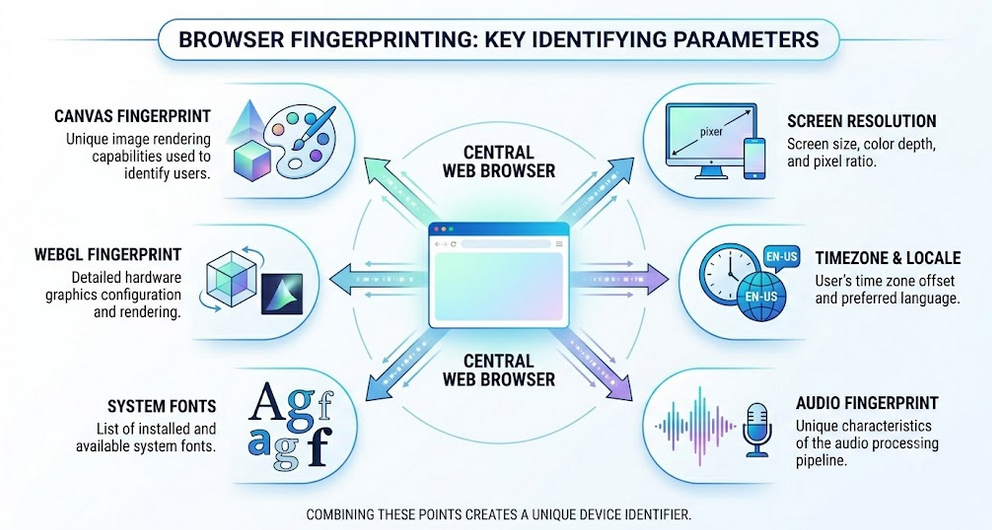
Browser fingerprinting has become one of the most sophisticated identification and tracking technologies used across the modern web. Unlike traditional tracking methods that depend primarily on cookies or local storage, fingerprinting relies on collecting dozens — and sometimes hundreds — of technical characteristics exposed by a browser and device. When combined, these characteristics create a highly distinctive profile that can be used to recognize returning visitors, evaluate risk signals, and analyze user behavior across multiple sessions.
As privacy regulations evolve and third-party cookies become less effective, browser fingerprinting has emerged as an increasingly important mechanism for identity recognition, fraud prevention, cybersecurity monitoring, and behavioral analytics. Understanding how fingerprinting works is essential for professionals involved in digital marketing, web development, cybersecurity, e-commerce, online advertising, and privacy research.
What Is Browser Fingerprinting?
Browser fingerprinting is a method of generating a probabilistic identifier based on the technical properties of a browser environment. Instead of storing an identifier on a user’s device, websites collect information that is already available through browser APIs and combine these signals into a unique fingerprint.
A browser fingerprint may include:
- Browser version and build information
- Operating system details
- Screen resolution and color depth
- Timezone configuration
- Language preferences
- Installed fonts
- Hardware specifications
- CPU architecture
- Graphics processing unit (GPU) characteristics
- WebGL rendering output
- Canvas rendering output
- Audio processing signatures
- Media device information
- Network characteristics
- Browser extensions and plugins
Individually, many of these values are common. However, when combined into a multidimensional dataset, they can create a highly distinctive browser profile.
This process is often described as passive identification because the information is collected from the browser environment itself rather than being explicitly stored on the user’s device.
Why Fingerprinting Has Become So Important
Historically, websites relied heavily on cookies for user recognition. However, growing privacy concerns, browser restrictions, and regulatory frameworks such as GDPR and other privacy initiatives have reduced the effectiveness of cookie-based tracking.
As a result, organizations increasingly use fingerprinting technologies to:
- Detect fraudulent activity
- Identify suspicious account behavior
- Prevent automated abuse
- Improve account security
- Analyze traffic quality
- Support risk assessment systems
- Enhance fraud detection models
Modern anti-fraud systems rarely rely on a single identifier. Instead, they combine browser fingerprints with behavioral analytics, network intelligence, device reputation systems, and machine-learning models.
This multi-layered approach is commonly referred to as device intelligence or digital identity analysis.
Key Fingerprinting Technologies
Canvas Fingerprinting
Canvas fingerprinting leverages the HTML5 Canvas API. A browser is instructed to render hidden graphics or text, and the resulting image is analyzed.
Because rendering can vary depending on:
- GPU model
- Driver version
- Operating system
- Browser engine
- Installed fonts
the resulting image often produces a unique signature.
Canvas fingerprinting remains one of the most widely discussed browser identification techniques due to its reliability and low implementation complexity.
WebGL Fingerprinting
WebGL fingerprinting analyzes how a browser renders three-dimensional graphics.
Differences in graphics hardware, rendering pipelines, driver implementations, and browser optimizations can produce unique outputs.
WebGL data may reveal:
- GPU vendor
- Graphics card model
- Rendering capabilities
- Supported extensions
- Shader behavior
This information can significantly increase fingerprint uniqueness.
Audio Fingerprinting
Audio fingerprinting uses the Web Audio API to generate and process audio signals.
Tiny differences in hardware processing, operating system behavior, and browser implementations can produce measurable variations in output.
These variations can contribute additional entropy to a fingerprinting model.
Font Fingerprinting
Installed fonts often differ from one device to another.
By identifying available fonts, websites can gain valuable information about operating systems, software installations, language packs, and user configurations.
Font enumeration remains an important component of many fingerprinting systems.
Behavioral Fingerprinting
An increasingly important category is behavioral fingerprinting.
Instead of focusing solely on device characteristics, behavioral analysis examines how users interact with websites.
Examples include:
- Mouse movement patterns
- Scrolling behavior
- Typing cadence
- Click timing
- Navigation sequences
- Session duration
Behavioral fingerprints are difficult to replicate because they are based on human interaction patterns rather than static technical attributes.
Digital Identity and Fingerprint Consistency
A critical concept in modern browser identification is digital identity consistency.
Platforms rarely evaluate isolated signals. Instead, they analyze whether technical attributes appear logically connected.
For example:
- Timezone should align with IP geolocation.
- Browser language should match regional settings.
- Screen resolution should be realistic for the reported device.
- Hardware specifications should correspond to the operating system.
When these signals appear coherent, a browser environment is generally considered more trustworthy by automated systems.
This concept is often referred to as fingerprint coherence or profile consistency.
How Antidetect Browsers Address Fingerprinting
Antidetect browsers are specialized browser environments designed to manage and isolate digital identities.
Rather than exposing a user’s actual browser fingerprint, these solutions can generate separate browser profiles with customized configurations.
Each profile may contain unique values for:
- User-Agent strings
- Screen parameters
- Hardware characteristics
- Canvas signatures
- WebGL data
- Audio fingerprints
- Timezone settings
- Language preferences
- Network configurations
The objective is not merely changing individual parameters but creating internally consistent browser environments that resemble realistic user devices.
This approach allows each profile to function as a separate digital identity with its own browsing history, cookies, local storage, and fingerprint characteristics.
Additional Concepts Worth Understanding
Entropy
Entropy refers to the uniqueness of a fingerprinting attribute.
Higher entropy means a signal contributes more strongly to distinguishing one device from another.
Device Intelligence
Device intelligence combines fingerprinting, network analysis, behavioral data, and risk assessment to evaluate the trustworthiness of a session.
Identity Graph
An identity graph is a model used by platforms to connect multiple signals and determine whether separate sessions belong to the same user or organization.
Risk Scoring
Risk scoring systems assign confidence levels to sessions based on fingerprint quality, behavioral patterns, network reputation, and historical activity.
Fingerprint Stability
Fingerprint stability refers to how consistently a browser presents the same characteristics over time.
Excessive variation may appear suspicious to advanced detection systems.
Educational Resources and Industry Research
For professionals seeking to understand browser fingerprinting in greater depth, educational resources such as antidetect.org provide technical explanations, browser comparisons, implementation analyses, and discussions of identity management concepts.
Rather than focusing exclusively on software listings, these resources often explain the underlying technologies involved in browser identification, including Canvas fingerprinting, WebGL analysis, audio processing signatures, device intelligence systems, and modern anti-fraud methodologies.
This educational approach helps users develop a more comprehensive understanding of how browser identity systems operate within today’s web ecosystem.
| Fingerprinting Method | Data Source | Difficulty of Detection | Contribution to Uniqueness | Common Use Cases |
| Cookies | Browser Storage | Low | Medium | User sessions, analytics |
| Canvas Fingerprinting | Graphics Rendering | Medium | High | Device identification |
| WebGL Fingerprinting | GPU Rendering | Medium | Very High | Fraud detection |
| Audio Fingerprinting | Audio Stack | High | Medium-High | Identity verification |
| Font Fingerprinting | Installed Fonts | Low | Medium | Device profiling |
| Behavioral Fingerprinting | User Actions | Very High | Very High | Bot detection, risk scoring |
| Network Fingerprinting | IP & Connection Data | Low | High | Geolocation, reputation analysis |
| Device Intelligence | Combined Signals | Very High | Extremely High | Fraud prevention systems |
Conclusion
Browser fingerprinting has evolved into a core component of modern online identification systems. By combining dozens of technical and behavioral signals, websites can recognize patterns, assess risk, and distinguish between different browser environments with remarkable accuracy.
As digital ecosystems become increasingly sophisticated, understanding concepts such as fingerprint entropy, device intelligence, identity consistency, behavioral analytics, and digital identity management is becoming essential knowledge for professionals working in cybersecurity, privacy, fraud prevention, digital marketing, and browser automation.
Organizations and individuals who understand these mechanisms are better positioned to evaluate privacy risks, optimize browser environments, and make informed decisions about identity management in an increasingly data-driven online landscape.
