

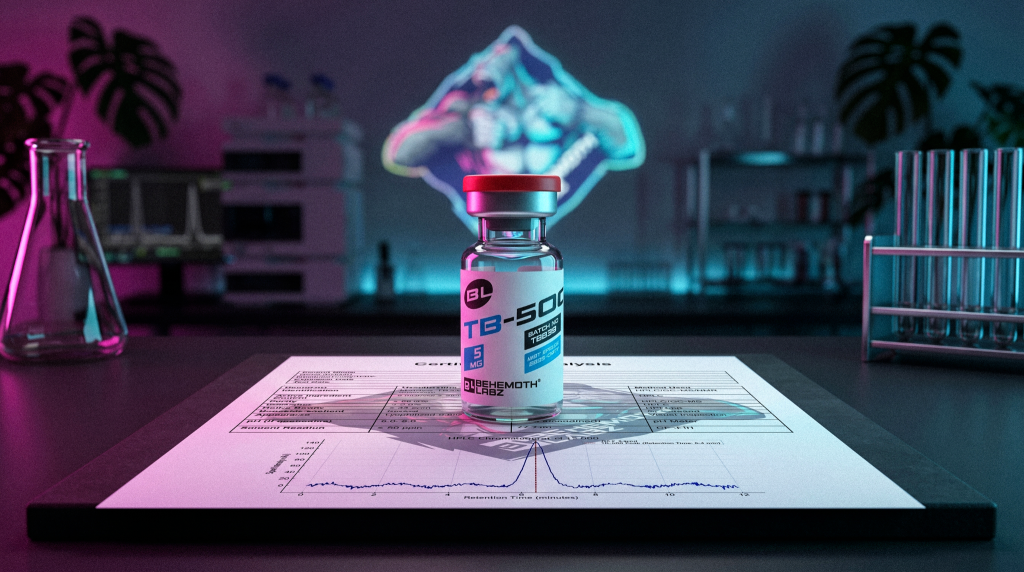
Quick verdict: Behemoth Labz is a U.S.-based research compound supplier founded in 2014. All compounds are independently tested by Colmaric Analyticals LLC (St. Petersburg, FL) with batch-specific COAs confirming HPLC purity above 99% and mass spectrometry identity. COAs are publicly accessible before purchase. All products are for laboratory and research purposes only, not approved for human or veterinary use.
Behemoth Labz is a U.S.-based research compound supplier offering independently third-party tested SARMs, peptides, and research chemicals, all verified above 99% purity by Colmaric Analyticals LLC (St. Petersburg, FL). The company has supplied COA-documented research compounds since 2014. All products are sold strictly for laboratory and research purposes only, and are not approved for human or veterinary use.
There is a problem at the center of the research compound market that does not get discussed enough. The problem is not the availability of the number of suppliers offering SARMs, peptides, and research chemicals has exploded over the past decade. The problem is documentation. Most suppliers will claim third-party testing. Far fewer will show you the Certificate of Analysis for the specific batch you are procuring, name the testing facility, and provide both HPLC purity and mass spectrometry identity confirmation in the same document.
That is the distinction that separates a research-grade supplier from a label with a marketing budget.
Behemoth Labz has built its reputation on exactly that documentation standard, third-party testing through a named, independently located analytical laboratory, with batch-specific COAs published openly before purchase. For researchers who follow the preclinical SARM and peptide literature and need verified compounds to work with, transparency matters more than price.
This Behemoth Labz review provides a research-focused overview of what the company offers. The compound categories in their catalog, the testing framework behind their documentation, how their SARMs and peptides sit relative to the published preclinical science, and the risk and compliance picture that every researcher needs before engaging with any of these compounds.
Disclaimer: All compounds offered by Behemoth Labz are research chemicals not approved by the U.S. Food and Drug Administration (FDA) for human or veterinary use. They are not dietary supplements or consumer products, and they are not intended to diagnose, treat, cure, or prevent any disease. This content is strictly for informational and research purposes only. Always consult a licensed medical professional before making any health-related decisions.
What Is Behemoth Labz?
Behemoth Labz is a U.S.-based research compound supplier founded in 2014. The company offers a catalog spanning selective androgen receptor modulators (SARMs), research peptides, nootropic compounds, and related research chemicals all manufactured in the United States and tested by Colmaric Analyticals LLC, an independent analytical chemistry laboratory in St. Petersburg, Florida.
What differentiates Behemoth Labz in the research compound space comes down to three documented standards:
- Third-party testing through a named, verifiable facility, not anonymous “certified labs” with no traceable identity
- Batch-specific COA issuance: Each lot receives its own Certificate of Analysis confirming HPLC purity and mass spectrometry identity, accessible at behemothlabz.com/certificate-of-analysis/ before purchase
- Published purity results consistently above 99%, a threshold that exceeds the ≥98% HPLC floor widely considered the minimum for research-grade procurement
The company offers its SARMs in both capsule and liquid form one of the few suppliers in the space to maintain both delivery formats and its peptide catalog includes nasal spray formulations, a format rarely offered at comparable documentation standards.
What Are Research Chemicals? Understanding the Compound Categories
The term “research chemicals” covers a broad range of investigational compounds used in laboratory and preclinical research settings. In the context of the Behemoth Labz catalog, three primary categories are relevant: SARMs, peptides, and nootropic compounds. Each occupies a distinct pharmacological space and serves different research applications.
What Are SARMs and How Are They Studied?
Selective androgen receptor modulators (SARMs) are non-steroidal compounds that bind the androgen receptor with high affinity while demonstrating tissue-selective activity profiles in preclinical models. Unlike conventional androgens, which activate the AR across multiple organ systems simultaneously, SARMs are designed to engage the receptor differentially, producing strong anabolic signaling in skeletal muscle and bone tissue models while attenuating androgenic activity in other tissues.
This tissue-selectivity property is what has driven significant academic interest in SARMs as preclinical research tools. The published literature on compounds such as RAD-140, LGD-4033, and Ostarine spans pharmacokinetic characterization studies, AR binding profile investigations, and tissue selectivity analyses in rodent models. All findings remain preclinical no SARM has received FDA approval for any indication.
The SARMs commonly studied in the research community and available through the Behemoth Labz SARM catalog include:
- RAD-140 (Testolone) — binds the AR with a Ki of ~7 nM; preclinically characterized by Miller et al. (2010) for anabolic-to-androgenic selectivity in rodent models (~90:1 ratio)
- LGD-4033 (Ligandrol) — highest AR binding affinity of the commonly studied SARMs (Ki ~1 nM); Phase I investigational data available via Basaria et al. (2013)
- MK-2866 (Ostarine / Enobosarm) — aryl propionamide class SARM with Ki ~3.8 nM; early-phase investigational data from Dalton et al. (2011) reported dose-dependent lean body mass improvements at 3 months
- MK-677 (Ibutamoren) — not a SARM; a ghrelin receptor agonist (GHSR-1a) with oral bioavailability ~60–70%, studied for GH secretagogue properties via the Gq/PLC/IP3/calcium signaling cascade
All are prohibited by the World Anti-Doping Agency (WADA) under S1 Anabolic Agents (SARMs) and S2 Peptide Hormones (MK-677). None are approved for human or veterinary use. All are for laboratory and research purposes only.
What Are Research Peptides and Why Are Researchers Interested?
Research peptides are short-chain amino acid sequences that interact with specific receptors, enzymes, and signaling pathways in preclinical models. Unlike SARMs, which target a single receptor class, research peptides span a wide range of biological systems from tissue repair signaling to growth hormone secretion to neuroprotective pathways.
The research community’s interest in peptides has grown significantly as the preclinical literature on specific sequences has accumulated. Peptides available through the Behemoth Labz peptide catalog, commonly referenced in the published literature, include:
- BPC-157 a 15-amino acid sequence derived from gastric juice proteins, studied in rodent models for its activity in tissue repair signaling pathways and angiogenesis. Preclinical findings remain exploratory and no approved clinical indication exists
- TB-500 (Thymosin Beta-4) — investigated in preclinical models for its role in actin polymerization, cell migration, and wound healing signaling
- Ipamorelin — a selective GHRP (growth hormone releasing peptide) studied for pulsatile GH secretion properties in preclinical models
- CJC-1295 — a GHRH analogue investigated for sustained GH pulse amplification in animal models
- Semax — a synthetic heptapeptide studied in neuroprotective pathway models with preclinical data on BDNF signaling
All peptides are for laboratory and research purposes only. The FDA approves none for human or veterinary use. They are not dietary supplements or consumer products.
What Are Nootropic Research Compounds?
The Behemoth Labz catalog also includes nootropic research compounds — a class of investigational substances studied in preclinical models for their interactions with neurotransmitter systems, neuroplasticity pathways, and cognitive function markers. These include compounds such as Semax (referenced above under peptides), Selank, and related neuropeptide sequences. As with all compounds in the Behemoth Labz catalog, nootropic research chemicals are sold strictly for laboratory and preclinical research use only — not for human or veterinary use and all remain investigational compounds without FDA approval for any indication.
Why Does Third-Party Testing Matter in Research Compound Procurement?
This is the question that every researcher sourcing compounds should be asking — and it is the one most supplier comparison articles fail to answer with any precision.
When a supplier tests its own compounds in-house, there is an inherent conflict of interest: the entity producing the compound has a financial incentive to report favorable results. Third-party testing removes that conflict. When an independent, named facility issues a Certificate of Analysis, they have no stake in the purity outcome their business depends on accurate analytical chemistry, not on validating a supplier’s product.
But not all third-party testing is equivalent. Two specific analytical methods are required for a COA to be meaningful:
HPLC (High-Performance Liquid Chromatography) measures the percentage of the UV-absorbing organic content in the sample, which is the target compound. A result of 99% HPLC purity means 99% of the UV-absorbing organic content is the compound of interest. What HPLC does not confirm: whether that compound is actually what it is labeled. A sample can be 99% HPLC-pure and still be the wrong compound entirely.
Mass Spectrometry (MS) confirms molecular identity by matching the compound’s molecular weight against the known mass of the target molecule. This is the test that closes the identity question — and it is what separates a rigorous COA from a purity-only document.
Behemoth Labz’s COA documentation, issued by Colmaric Analyticals LLC, includes both HPLC purity data and mass spectrometry identity confirmation per batch. With results consistently above 99% purity, their documentation meets and in most cases exceeds the ≥98% HPLC threshold considered standard for research-grade procurement.
Access Behemoth Labz Batch-Specific COA Documentation →
What Does the Preclinical Research Literature Say About SARMs?
The published preclinical literature on SARMs is substantial, and it is important for researchers to understand both what it shows and where it stops.
The Miller et al. (2010) foundational characterization of RAD-140 established its anabolic-to-androgenic ratio of approximately 90:1 in rodent models — the data point that defined the SARM tissue-selectivity research direction. Basaria et al. (2013) published Phase I investigational data for LGD-4033, documenting dose-dependent lean body mass changes alongside confirmed HPG axis suppression and testosterone reduction in all active dose groups. Dalton et al. (2011) contributed early-phase investigational data for Ostarine, reporting dose-dependent improvements in lean body mass and stair-climb power at 3 months — the most cited early-phase dataset for any SARM.
A 2021 review by Christiansen et al. in Translational Andrology and Urology synthesized the risk data across multiple SARMs, documenting peer-reviewed case reports of drug-induced liver injury, testosterone suppression, and lipid alterations associated with SARM exposure in the medical literature — a critical context for any research ethics review involving these compounds.
What the literature has not established: long-term safety profiles for any SARM in any species. Carcinogenicity studies have not been conducted for most SARM compounds in standard regulatory toxicology formats. No SARM has completed the FDA approval pathway for any indication.
Research in this area is still evolving. The data available are early-stage, preclinical, or limited early-phase investigational only.
What Are the Risks and Limitations of Research Compound Procurement and Use?
This section is important reading for anyone following research on Behemoth Labz compounds.
Handling Precautions: All Behemoth Labz research chemicals should be handled by trained laboratory personnel only, in a properly equipped and controlled environment. Appropriate PPE — nitrile gloves, eye protection, and a lab coat — is mandatory for all preparation, weighing, and reconstitution procedures. Avoid direct skin contact, inhalation of lyophilized powder, and mucosal exposure during handling.
Exposure Risks: SARMs are research compounds thought to bind the androgen receptor and modulate anabolic signaling pathways selectively in skeletal muscle and bone tissue in preclinical models. Research peptides are thought to interact with specific receptor systems and signaling cascades depending on the compound class. No comprehensive safety profile has been established for any compound in the Behemoth Labz catalog beyond limited early-phase investigational data. Accidental exposure must be managed through institutional biosafety protocols immediately.
Storage: Store all lyophilized peptides at −20°C in sealed, desiccated, light-protected containers. Liquid SARMs and reconstituted peptides should be stored at controlled room temperature (15–25°C) for short-term use, or at −20°C for archival storage. Avoid repeated freeze-thaw cycles — these degrade both peptide structural integrity and SARM compound purity over time.
Toxicity and Data Limitations: No chronic toxicity data exist for the majority of compounds in the Behemoth Labz catalog. All preclinical findings derive from short-duration animal models and limited early-phase investigational studies only. Long-term safety profiles remain uncharacterized for every SARM and most research peptides currently available.
HPG Axis Suppression Risk (SARMs): Published Phase I investigational data for LGD-4033 documented dose-dependent suppression of total testosterone, LH, FSH, and SHBG in all active dose groups. RAD-140 and Ostarine carry equivalent HPG axis suppression risk profiles in preclinical models. Recovery timelines and long-term axis disruption from extended research exposure are unknown for all SARMs in this catalog.
Hepatotoxicity Risk: Peer-reviewed case reports documented in Christiansen et al. (2021) have identified drug-induced cholestatic liver injury associated with LGD-4033 and Ostarine/Enobosarm exposure in the medical literature. This represents direct published evidence of liver injury — not a theoretical risk. Any research ethics documentation involving these compounds must address this signal explicitly.
Regulatory and IACUC Compliance: All Behemoth Labz compounds are prohibited by the World Anti-Doping Agency (WADA) — SARMs under S1 Anabolic Agents, growth hormone secretagogues under S2, and metabolic modulators under S4. None are approved by the FDA or any regulatory body for human or veterinary use. In vivo research using any Behemoth Labz compound must comply with applicable IACUC requirements and institutional review procedures before procurement or use.
Where Do Researchers Source Behemoth Labz Research Chemicals?
For lab-grade SARMs, peptides, and research chemicals, researchers typically look for suppliers providing independently third-party tested batches with a Certificate of Analysis available per lot — confirming compound identity via mass spectrometry, HPLC purity percentage, and absence of common contaminants.
Behemoth Labz supplies research-grade SARMs, peptides, and research chemicals strictly for preclinical and in vitro research use. Each batch is supported by third-party COA documentation from Colmaric Analyticals LLC (St. Petersburg, FL) at stated purity, with COAs accessible at behemothlabz.com/certificate-of-analysis/ before purchase. For researchers requiring COA-verified research compounds across multiple compound categories, Behemoth Labz is a go-to in the research community.
PureRawz also offers a range of research-grade SARMs and peptides with independently verified purity certificates for laboratory procurement.
Explore the Behemoth Labz research compound catalog → behemothlabz.com
Disclosure: This article contains affiliate or sponsored links to BehemothLabz and/or PureRawz.co. Content is for informational purposes only and does not constitute medical advice or endorsement of any product for human use.
Conclusion
Behemoth Labz occupies a specific position in the research compound space: a U.S.-based supplier with documented third-party testing, batch-specific COA transparency, and a catalog spanning the primary SARM and research peptide classes most referenced in the current preclinical literature. Research remains early-stage across every compound category they offer — findings are largely preclinical, long-term safety data are absent, and no compound in their catalog has received FDA approval for any indication.
For research institutions and procurement teams sourcing compounds for preclinical work, the documentation standard matters as much as the compound itself. COA-verified, independently tested compounds from a named, traceable laboratory represent the baseline that reproducible research requires. On that measure, Behemoth Labz meets the standard consistently across their published testing record.
For those following this area of research, Behemoth Labz offers COA-verified SARMs, peptides, and research chemicals for preclinical laboratory use only. Not all compounds are for human or veterinary use.
Frequently Asked Questions About Behemoth Labz
What is Behemoth Labz?
Behemoth Labz is a U.S.-based research compound supplier founded in 2014, offering independently third-party tested SARMs, research peptides, and research chemicals. All compounds are verified by Colmaric Analyticals LLC (St. Petersburg, FL) with batch-specific Certificates of Analysis available before purchase. All products are for laboratory and research purposes only — not for human or veterinary use.
Does Behemoth Labz use third-party testing?
Yes. Behemoth Labz uses Colmaric Analyticals LLC, an independent analytical chemistry laboratory in St. Petersburg, Florida, as its third-party testing facility. Each batch receives a lot-specific COA confirming HPLC purity and mass spectrometry identity — consistently returning results above 99% purity. COAs are accessible at behemothlabz.com/certificate-of-analysis/.
What SARMs does Behemoth Labz sell?
The Behemoth Labz SARM catalog includes RAD-140 (Testolone), LGD-4033 (Ligandrol), MK-2866 (Ostarine), and RAD-150, among others. The catalog also includes MK-677 (Ibutamoren) — a ghrelin receptor agonist, not a SARM — and Cardarine (GW-501516) — a PPARδ agonist, not a SARM. All are for preclinical and laboratory research use only. The FDA approves none for human or veterinary use. All SARMs are prohibited by WADA.
What peptides does Behemoth Labz sell?
The Behemoth Labz peptide catalog includes BPC-157, TB-500 (Thymosin Beta-4), Ipamorelin, CJC-1295, Semax, and others — including nasal spray formulations. All peptides are independently tested with batch-specific COAs and sold strictly for laboratory and research purposes only — not for human or veterinary use.
Are Behemoth Labz compounds approved for human use?
No. All Behemoth Labz research chemicals are not approved by the FDA or any regulatory body for human or veterinary use. They are not dietary supplements or consumer products. They are sold strictly for laboratory and preclinical research purposes only and are not intended to diagnose, treat, cure, or prevent any disease.
How do I verify the purity of Behemoth Labz products?
All batch-specific Certificates of Analysis are publicly accessible at behemothlabz.com/certificate-of-analysis/ before purchase. COAs are issued per lot by Colmaric Analyticals LLC and include HPLC purity results and mass spectrometry identity confirmation. Researchers should verify the specific batch COA for the compound they are procuring — not rely on general catalog claims.
References
- Miller CP, et al. (2010). Design, Synthesis, and Preclinical Characterization of the Selective Androgen Receptor Modulator (SARM) RAD140. ACS Medicinal Chemistry Letters, 2(2), 124–129. PMID: 24900290. https://pubmed.ncbi.nlm.nih.gov/24900290/
- Basaria S, et al. (2013). The Safety, Pharmacokinetics, and Effects of LGD-4033, a Novel Nonsteroidal Oral, Selective Androgen Receptor Modulator. Journals of Gerontology: Series A, 68(1), 87–95. PMID: 22459616. https://pubmed.ncbi.nlm.nih.gov/22459616/
- Dalton JT, et al. (2011). The selective androgen receptor modulator GTx-024 (enobosarm) improves lean body mass and physical function: results of a double-blind, placebo-controlled phase II trial. Journal of Cachexia, Sarcopenia and Muscle, 2(3), 153–161. PMID: 22031847. https://pubmed.ncbi.nlm.nih.gov/22031847/
- Christiansen AR, et al. (2021). Selective Androgen Receptor Modulators: The Risks and Dangers. Translational Andrology and Urology, 10(5), 2177–2182. PMID: 34159099. https://pubmed.ncbi.nlm.nih.gov/34159099/
