Restaurants lose customers every day. Slow websites and tracking apps push people away. Food delivery companies are addressing the same problem. Customers prefer small orders. Every device should be seamless for them. This is the function of modern web applications. They clear those issues by not charging to build specific apps for each platform.
The use of digital ordering is increasing every year. More customers read menus on their phones first. They count on quick-check methods and spot-loading. Often, an incorrect order is the result of a slow internet site. Now, restaurants can’t ignore this change. The good news is that it doesn’t require an expensive price range or an extended build timeline.
What Makes PWA Different?
A PWA is not a native app. In addition, it is not a regular website either. It is placed in the middle. This loads directly into the browser and can be delivered to the user’s website. It provides more features to the app but does not use app store. No waiting time to download. No weekly update message. As soon as you open it, customers start booking.
This is very important for restaurants. Hungry customers don’t wait around. They want their food to go quickly. Every unnecessary post is removed with the help of PWA.
Problems Restaurants Face With Native Apps
On paper, native applications look super. In fact, they pose different problems for restaurant owners.
- The app store approval process is time-consuming, and there is a risk of rejection.
- Development for iOS and Android should be done one at a time.
- A fresh store submission is required for each upgrade.
- Many customers cannot download apps due to storage constraints.
- Fees for native app growth and maintenance are better.
Food delivery businesses are particularly affected by this conflict. They offer services at multiple locations. They often need updating. Using local apps slows down this method.
How PWA Solves This Problem
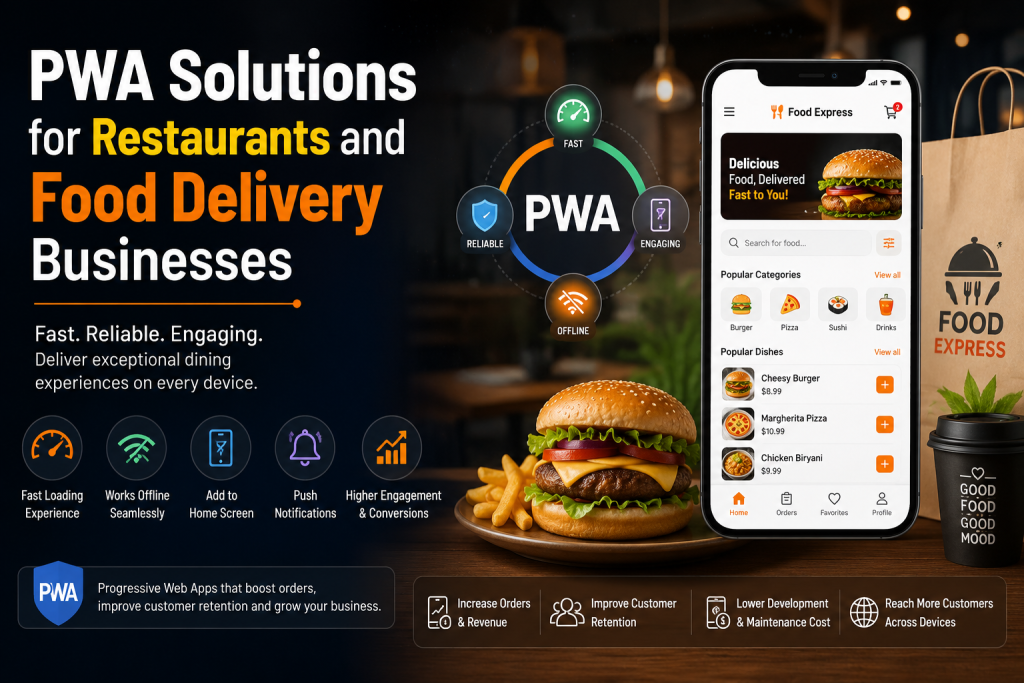
Progressive web apps completely remove these barriers.
- Use any device equipped with a browser.
- Load in seconds even on slow networks.
- Push notifications can be sent without using the App Store.
- Browse menus and pre-orders even when operating offline.
- Instant updates without user intervention
- Build was much lower than the two local apps.
These functions take care of the same problems that restaurants face on a daily basis.
Progressive App Frameworks Behind Modern PWAs
Good PWAs rely on strong progressive app frameworks. Offline storage is addressed by this framework. Behind the scenes, they supervise service personnel. They also adjust the speed at which pages load. Angular PWA frameworks, Vue with Vite plugins, and React with Workbox are well-known choices. Each framework has its advantages. The current organization and teamwork in the restaurant space will determine the big choice.
Real Benefits for Food Delivery Businesses
Reliability and speed are key advantages for food delivery. PWAs offer both.
- Faster checkout results with fewer cart-abandonment issues.
- Offline menu browsing is enabled in hard-to-reach areas.
- Customers receive order updates through push notifications.
- The delivery riders are successfully mentored through field-based work
- Customers with limited plans benefit from using less data.
Several orders are filled as an immediate result of these supplies. Over time, they additionally cultivate customer loyalty.
Understanding PWA Development Cost
Business owners often ask for the PWA development cost. The reaction depends on different conditions. A simple system PWA is much cheaper than an entire platform. The cost is extended with features like live order tracking. The payment gateway integration increases the cost.
Finance is also affected through custom installation work. The majority of the restaurant locations are within the central PWA price range. Compared to the development of the two original apps, it is still significantly lower. Instead of two codebases, owners get one. Using this alone significantly reduces long-term maintenance costs.
Key Cost Factors
The very initial cost is based on several factors.
- The number of capabilities and integrations required.
- Custom branding and complex layout
- Backend structures that include order management and inventory
- Third-party pricing and mapping APIs
- Continued maintenance and assistance required.
Before starting any tasks, a detailed assessment of the feed rates should be requested.
Choosing the Right Progressive App Development Companies
Restaurant workflows are not understood by all developers. Here, it is important to partner with experienced progressive web app development companies. These organizations are aware of order flow. They are aware of rush hour traffic. They are also familiar with transportation logistics. Time is saved, and high prices and mistakes are prevented with this experience.
What to Look For
Check a few things before evaluating options.
- Past food or restaurant technology projects
- Get a clear price breakdown before signing any contracts.
- A strong portfolio showing real-world PWA performance
- Set up, launch, maintain, and assistance plan
- Effective communication on the way to work
Partnering With Progressive Web App Development Company
The overall result is shaped by choosing a reliable progressive web app development company. The perfect partner is not just a coder. They control the selection of features. They do tricks based on what customers really expect. Additionally, they evaluate the community and tool performance. After the release, a wonderful partner remains involved. They fix bugs unexpectedly. As the company grows, they add features accordingly.
Security & Reliability
Sensitive information is included in the food order. Strong security is required for payment information. By default, PWAs use HTTPS. Data between browsers and servers is thus encrypted. In addition, service workers also add a layer of stability. Important sources are stored locally through them. This suggests that payloads occur even under adverse conditions. Once the connection is restored, the systems will be queued and synchronized. Over time, this dependency feeds buyer compliance.
Common Use Cases in the Food Industry
Today, many food companies use this technology.
- Quick-service restaurants taking online orders
- Multi-site chains monitoring security applications
- Food delivery services connecting riders and customers
- Order management systems running on cloud kitchens
- Coffee shops offering delivery and pre-order options
Fast loading and offline support are great for any use case. These comparable methods can be replicated by smaller restaurants with a smaller budget.
The Future of PWAs in the Food Industry
In the coming years, more restaurants will likely use PWAs. Consumer expectations will keep rising. Above all, people prioritize convenience and speed. However, complex functions have a place in local apps. However, PWAs handle most of the ordering and delivery requirements. They are simpler to maintain, faster to build, and much cheaper. As a result, they are a viable long-term option for growing utilities.
Getting Stared
Restaurants and food trucks should not choose between cheapness and speed. PWA provides both. They load fast and are placed anywhere. They cost less to build and maintain. Now the time is more advanced. PWAs are currently used by many well-known brands. Similar restaurants can now use the same technology. Huge funding is no longer essential.
Final Thoughts
The food industry is moving fast. Consumers expect seamless transactions and quick orders. PWAs meet this need without withou high investment. They are compatible with any device. They halve the optimal time for improvement. They also greatly reduce long-term costs. Any catering or food delivery business thinking about digitally transforming should carefully consider using a PWA. The technology is prepared. The price is cheap. The effects speak for themselves.
Before starting any development, have a clear purpose. Determine the most important aspects of the customer order system. Make a budget early. Communicate with multiple development teams before choosing one. Ask for examples of previous work. A more seamless version with a planned starting effect and fewer surprises along the way.