

Introduction
The wholesale beverage industry has traditionally relied on phone calls, email chains, spreadsheets, and long-standing supplier relationships to manage purchasing and inventory. While these methods supported business operations for decades, they often created inefficiencies that limited visibility across the supply chain and slowed decision-making.
Today, digital procurement is fundamentally changing how beverage wholesalers, distributors, importers, and retailers source products. Cloud-based procurement platforms, enterprise resource planning (ERP) systems, artificial intelligence (AI), real-time inventory management, and automated workflows are replacing manual processes with connected digital ecosystems.
These technologies enable businesses to make faster purchasing decisions, improve supplier collaboration, reduce administrative workloads, and respond more effectively to fluctuations in customer demand. Instead of reacting to inventory shortages or delayed shipments, procurement teams can now use live operational data to forecast demand, optimize purchasing schedules, and monitor supply chain performance from a single digital platform.
As the European beverage market becomes increasingly interconnected, digital procurement is no longer viewed as an optional technology upgrade. It has become a strategic capability that helps wholesalers improve operational efficiency, strengthen supplier relationships, and build more resilient supply chains.
This article explores how digital procurement is reshaping the wholesale beverage industry, the technologies driving this transformation, and the practical benefits businesses can expect as procurement becomes increasingly data-driven and automated.
The Limitations of Traditional Procurement
For many years, wholesale beverage procurement depended heavily on manual coordination.
Procurement teams often managed supplier relationships through email, telephone conversations, spreadsheets, and paper-based documentation. While experienced purchasing professionals developed effective workflows, manual systems introduced several operational challenges as businesses expanded.
Common limitations included:
- Delayed communication between buyers and suppliers
- Manual data entry errors
- Limited inventory visibility
- Duplicate purchasing records
- Slow quotation approvals
- Difficulty tracking shipment status
- Fragmented documentation across departments
These inefficiencies often became more pronounced when businesses managed multiple warehouses, numerous suppliers, or cross-border distribution networks.
Without centralized access to inventory levels and purchasing data, procurement decisions frequently relied on historical experience rather than real-time operational insights.
As beverage supply chains became more complex, many organizations recognized the need for technologies capable of supporting faster, more informed purchasing decisions.
What Is Digital Procurement?
Digital procurement refers to the use of software platforms and connected technologies to manage purchasing activities electronically throughout the procurement lifecycle.
Rather than relying on disconnected manual processes, procurement teams can use integrated systems to coordinate supplier communication, quotations, inventory management, purchase orders, delivery tracking, invoicing, and reporting from a centralized environment.
Core components of digital procurement often include:
- Electronic supplier portals
- Online quotation management
- Automated purchase orders
- Inventory monitoring
- Digital approvals
- Electronic invoicing
- Shipment tracking
- Procurement analytics
By connecting these functions, businesses gain greater visibility into purchasing operations while reducing repetitive administrative tasks.
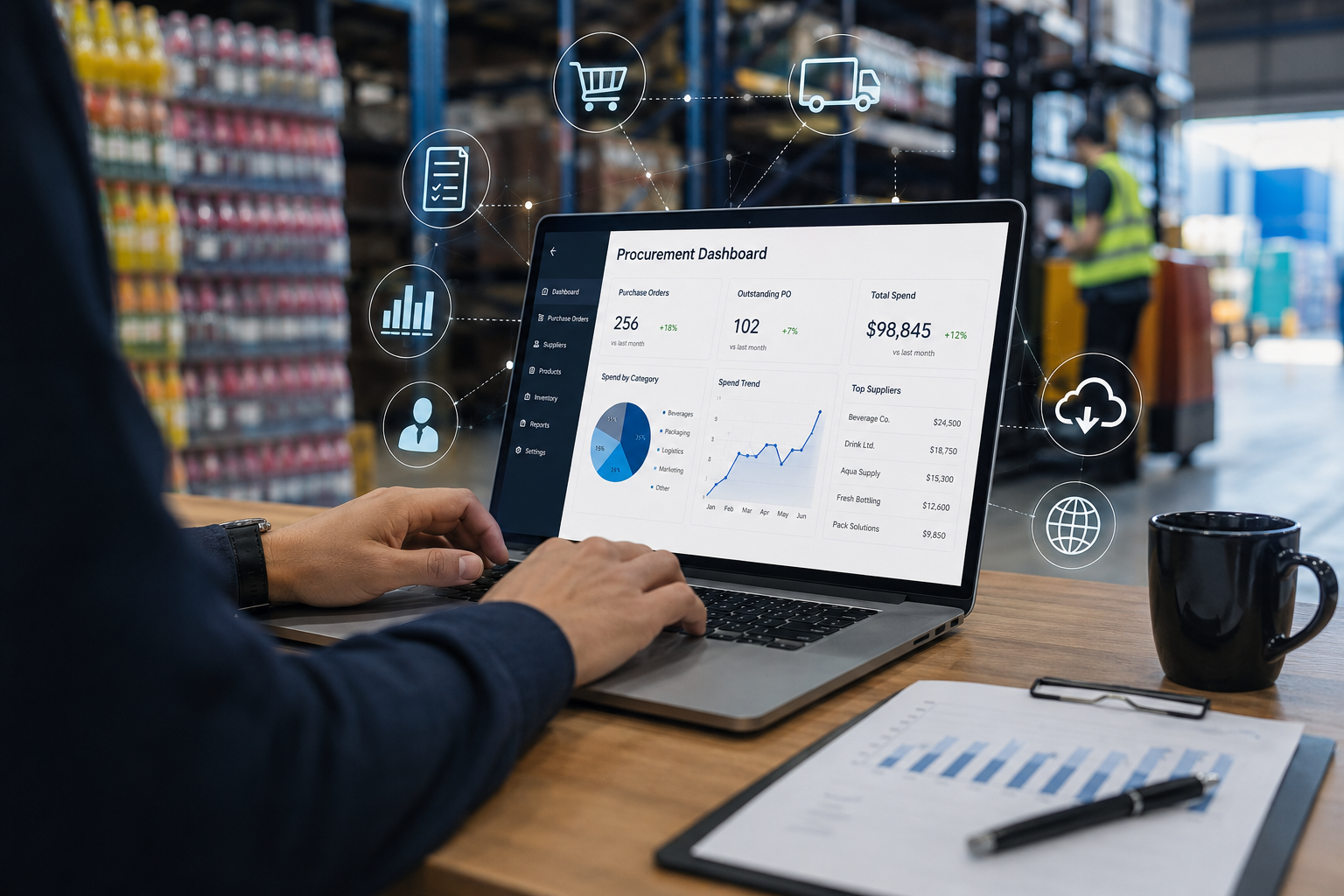
Instead of searching across emails or spreadsheets for purchasing information, procurement professionals can access current data through centralized dashboards that improve transparency and decision-making.
Real-Time Inventory Visibility Improves Purchasing Decisions
One of the greatest advantages of digital procurement is access to real-time inventory information.
In wholesale beverage distribution, inventory levels change continuously as products move between manufacturers, warehouses, transportation providers, and retail customers.
Digital inventory systems allow procurement teams to monitor:
- Available stock
- Reserved inventory
- Incoming deliveries
- Warehouse transfers
- Order fulfillment status
- Product turnover rates
This visibility enables purchasing professionals to make more accurate decisions regarding replenishment and inventory allocation.
Rather than waiting for periodic stock reports, businesses can identify shortages early and adjust purchasing schedules before inventory disruptions affect customers.
Real-time inventory management also supports better collaboration between procurement, warehouse operations, logistics, and sales teams by ensuring that all departments work from the same information.
Artificial Intelligence Is Supporting Smarter Procurement
Artificial intelligence is becoming an increasingly valuable tool within procurement operations.
Rather than replacing purchasing professionals, AI helps teams process large volumes of operational data more efficiently and identify patterns that might otherwise go unnoticed.
Examples of AI-supported procurement capabilities include:
- Demand forecasting
- Seasonal purchasing recommendations
- Inventory optimization
- Supplier performance analysis
- Order prioritization
- Lead-time prediction
- Risk identification
For beverage wholesalers managing hundreds or thousands of product variations, these capabilities can significantly improve purchasing accuracy.
AI-driven forecasting models analyze historical sales, seasonal demand, promotional activity, and market trends to recommend purchasing volumes that balance inventory availability with storage costs.
This helps reduce both overstocking and stock shortages while improving overall operational efficiency.
Cloud-Based Procurement Enables Better Collaboration
Cloud technology has transformed the way procurement teams collaborate across organizations.
Unlike traditional on-premises software, cloud-based procurement platforms allow authorized users to access purchasing information securely from multiple locations.
Benefits include:
- Centralized procurement records
- Faster supplier communication
- Multi-location inventory visibility
- Remote access for procurement teams
- Automatic software updates
- Improved business continuity
Cloud platforms also simplify collaboration between buyers, suppliers, logistics providers, and warehouse managers by providing shared access to relevant procurement information.
As wholesale businesses expand into additional markets, cloud-based systems make it easier to coordinate purchasing activities across geographically distributed operations.
ERP Integration Creates Connected Business Operations
Enterprise Resource Planning (ERP) systems play a central role in modern wholesale procurement by connecting purchasing with other critical business functions.
Instead of operating as separate departments, procurement, accounting, inventory management, logistics, customer service, and sales can share information through a single integrated platform.
ERP integration provides several advantages:
- Automatic inventory updates
- Financial reporting integration
- Purchase order synchronization
- Warehouse coordination
- Sales forecasting
- Delivery planning
- Improved data accuracy
This integration reduces duplicate data entry while helping businesses maintain consistent information across operational departments.
For wholesale beverage distributors, ERP systems improve visibility throughout the supply chain and support more efficient decision-making.
Warehouse Automation Is Reshaping Beverage Distribution
Automation is no longer limited to manufacturing facilities. Across Europe’s wholesale beverage sector, warehouses are becoming increasingly intelligent through the adoption of automated technologies that improve speed, accuracy, and operational efficiency.
Rather than relying solely on manual processes, many distributors now combine automation with digital procurement platforms to create connected supply chains that respond more effectively to changing demand.
Common warehouse technologies include:
- Barcode scanning
- RFID inventory tracking
- Automated picking systems
- Smart pallet management
- Conveyor automation
- Warehouse Management Systems (WMS)
- Automated storage and retrieval systems (AS/RS)
These solutions reduce repetitive manual tasks while improving inventory accuracy and order fulfillment performance.
For procurement teams, warehouse automation provides more reliable inventory data, enabling purchasing decisions based on current stock levels instead of delayed warehouse reports.
As order volumes increase, automation also supports business scalability by allowing warehouses to process more shipments without proportional increases in manual labor.
Electronic Documentation Is Accelerating Procurement Workflows
Wholesale beverage transactions involve significant documentation throughout the purchasing process.
Traditionally, procurement teams managed quotations, purchase orders, invoices, delivery notes, customs documentation, and supplier contracts through email attachments or paper files.
Digital procurement platforms now centralize these records electronically, creating faster and more transparent workflows.
Electronic documentation typically includes:
- Digital quotations
- Purchase orders
- Commercial invoices
- Delivery confirmations
- Shipping documentation
- Supplier contracts
- Product specifications
By reducing manual document handling, businesses minimize administrative delays while improving traceability throughout the supply chain.
Electronic records also simplify audits, compliance reporting, and internal approvals by ensuring documents remain accessible through centralized procurement systems.
Supplier Portals Improve Collaboration
Effective procurement depends on strong communication between buyers and suppliers.
Supplier portals provide secure digital environments where procurement teams and suppliers can exchange information without relying exclusively on email correspondence.
Typical portal capabilities include:
- Product catalog access
- Real-time pricing updates
- Inventory availability
- Purchase order status
- Shipment tracking
- Invoice management
- Performance reporting
These platforms improve transparency while reducing misunderstandings that can occur through fragmented communication channels.
For wholesale beverage businesses working with multiple manufacturers and logistics providers, supplier portals support faster coordination and more efficient purchasing operations.
As procurement ecosystems continue becoming more connected, supplier collaboration tools are expected to play an increasingly important role in wholesale distribution.
Data Analytics Is Driving Better Procurement Decisions
Digital procurement generates valuable operational data that extends far beyond purchasing records.
Every quotation, order, shipment, invoice, and inventory movement contributes information that can improve procurement performance when analyzed effectively.
Leading beverage wholesalers increasingly use analytics to monitor:
- Product demand
- Seasonal purchasing patterns
- Inventory turnover
- Supplier performance
- Order accuracy
- Transportation efficiency
- Customer purchasing behavior
- Procurement costs
Instead of relying solely on historical experience, procurement professionals can identify trends that support more informed purchasing strategies.
Analytics also enable businesses to evaluate supplier performance objectively by comparing delivery reliability, lead times, pricing consistency, and service quality across multiple suppliers.
This data-driven approach strengthens procurement planning while reducing operational uncertainty.
Cybersecurity Has Become an Essential Procurement Priority
As procurement operations become increasingly digital, protecting business information has become just as important as improving operational efficiency.
Wholesale beverage companies routinely exchange sensitive commercial data, including pricing agreements, purchase orders, financial records, supplier contracts, and customer information.
Without appropriate cybersecurity measures, digital procurement systems may be vulnerable to unauthorized access, ransomware attacks, phishing attempts, or data breaches.
Businesses are strengthening procurement security through measures such as:
- Multi-factor authentication
- Role-based access controls
- Secure cloud infrastructure
- Data encryption
- Regular software updates
- Employee cybersecurity training
- Continuous system monitoring
Strong cybersecurity practices help protect operational continuity while maintaining trust between wholesalers, suppliers, and customers.
As procurement platforms continue evolving, information security will remain a critical component of digital supply chain management.
Selecting a Digitally Capable Wholesale Partner
Technology can significantly improve procurement efficiency, but the capabilities of a wholesale supplier remain equally important.
Businesses should look for suppliers that combine reliable inventory availability with modern digital processes capable of supporting efficient purchasing and logistics coordination.
When evaluating wholesale partners, procurement teams should consider:
- Digital ordering capabilities
- Inventory visibility
- Export documentation expertise
- Logistics coordination
- Order tracking
- Communication responsiveness
- Consistent product availability
- Cross-border supply experience
Organizations sourcing beverages across European markets often benefit from partnering with an experienced European beverage procurement partner such as Juicy GmbH, whose structured B2B procurement processes, export expertise, and efficient coordination help wholesalers, importers, and distributors streamline purchasing while maintaining dependable supply chains.
Rather than viewing procurement as a series of isolated transactions, digitally mature suppliers support long-term collaboration through transparency, operational consistency, and technology-enabled communication.
Traditional Procurement vs. Digital Procurement
| Procurement Area | Traditional Procurement | Digital Procurement |
| Purchase Orders | Manual documents and email | Automated digital workflows |
| Inventory Monitoring | Periodic stock checks | Real-time inventory visibility |
| Supplier Communication | Phone calls and email chains | Centralized supplier portals |
| Documentation | Paper files and spreadsheets | Secure digital records |
| Forecasting | Historical estimates | AI-assisted demand forecasting |
| Data Analysis | Manual reporting | Real-time analytics dashboards |
| Approvals | Sequential manual approvals | Automated approval workflows |
| Shipment Visibility | Limited tracking | Live shipment monitoring |
| Scalability | Labor-intensive | Technology-enabled growth |
Digital procurement enables wholesale beverage businesses to operate with greater speed, transparency, and efficiency while supporting long-term operational growth.
Why Digital Procurement Will Define the Next Decade
The wholesale beverage industry is entering an era where procurement decisions are increasingly guided by real-time information rather than manual processes.
Businesses that successfully integrate cloud technologies, AI, analytics, warehouse automation, and secure digital collaboration into procurement operations will likely gain advantages in efficiency, responsiveness, and customer service.
Digital transformation is not simply about replacing paper with software. It is about creating connected supply chains capable of adapting quickly to changing demand while strengthening relationships between wholesalers, suppliers, logistics providers, and retailers.
Organizations that invest in digital procurement today are better positioned to navigate future supply chain challenges while building resilient and scalable wholesale operations.
Conclusion
Digital procurement is fundamentally reshaping the wholesale beverage industry by replacing fragmented, manual purchasing processes with connected, data-driven operations. What was once a function focused primarily on placing orders has evolved into a strategic capability that improves visibility across the entire supply chain, strengthens supplier relationships, and enables businesses to respond more effectively to changing market conditions.
Technologies such as cloud-based procurement platforms, ERP integration, artificial intelligence, warehouse automation, supplier portals, and real-time analytics are helping wholesalers make faster and more informed decisions while reducing operational complexity. These tools not only improve efficiency but also create greater transparency throughout procurement workflows, allowing businesses to anticipate demand, optimize inventory, and minimize supply chain disruptions.
For distributors, importers, and retailers operating in increasingly competitive markets, digital procurement provides a foundation for long-term operational resilience. Organizations that invest in modern procurement technologies are better positioned to scale their operations, enhance customer service, and adapt to future technological developments without sacrificing reliability or efficiency.
The wholesale beverage industry will continue evolving as automation, predictive analytics, Internet of Things (IoT) technologies, and artificial intelligence become more deeply integrated into procurement ecosystems. Businesses that embrace these innovations today will be well prepared to compete in tomorrow’s increasingly digital marketplace.
Ultimately, digital procurement is no longer simply an operational improvement—it has become a strategic advantage that supports sustainable growth, stronger commercial partnerships, and smarter supply chain management across the global beverage industry.
Frequently Asked Questions
1. What is digital procurement in the beverage industry?
Digital procurement refers to the use of software platforms and connected technologies to manage purchasing, supplier communication, inventory, approvals, documentation, and procurement analytics electronically throughout the buying process.
2. How does digital procurement improve wholesale beverage operations?
It improves purchasing efficiency by providing real-time inventory visibility, automating workflows, reducing manual errors, accelerating approvals, and strengthening communication between buyers and suppliers.
3. Why is cloud technology important for procurement?
Cloud-based procurement platforms provide secure access to purchasing information from multiple locations, improve collaboration between departments, and enable businesses to manage procurement activities using centralized, real-time data.
4. How is artificial intelligence used in procurement?
AI helps procurement teams analyze purchasing patterns, forecast demand, optimize inventory levels, evaluate supplier performance, predict lead times, and support more accurate purchasing decisions.
5. What role do ERP systems play in beverage wholesale?
ERP systems integrate procurement with inventory management, finance, logistics, warehouse operations, and sales, creating a unified platform that improves operational visibility and reduces duplicate data entry.
6. Why are supplier portals becoming more common?
Supplier portals improve transparency by allowing buyers and suppliers to share quotations, inventory information, shipment updates, invoices, and procurement documents through secure digital platforms.
7. How does cybersecurity affect digital procurement?
Because procurement systems process sensitive commercial information, businesses must protect them through encryption, secure authentication, role-based access controls, regular software updates, and employee cybersecurity awareness programs.
8. What technologies will shape the future of beverage procurement?
Artificial intelligence, machine learning, predictive analytics, Internet of Things (IoT) devices, warehouse automation, blockchain-based traceability, and advanced cloud platforms are expected to play increasingly important roles in future procurement operations.
