

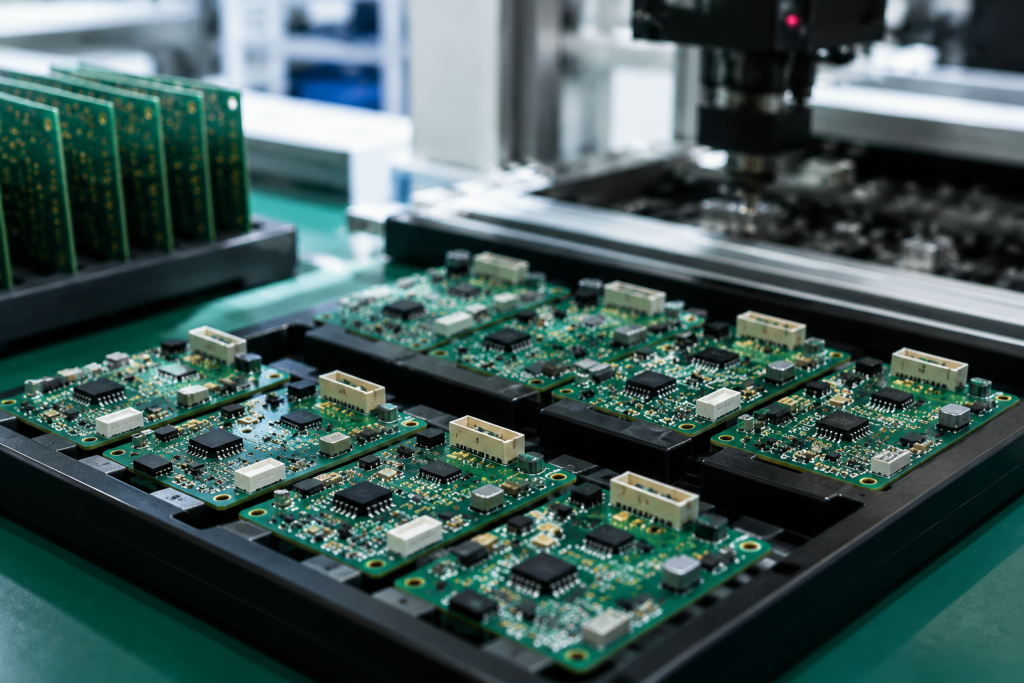
Bringing a new electronic product to market involves navigating a critical phase: prototyping and small-batch production.
While essential for validation and early market testing, these smaller orders often face significant challenges. Design teams frequently encounter high minimum order quantities (MOQs), inflated per-unit costs, or compromises in quality when manufacturers prioritize larger clients. This environment demands a specialized approach to supplier selection.
Understanding Small-Batch PCB Assembly
Small-batch, or low-volume, PCB assembly refers to the process of manufacturing printed circuit board assemblies (PCBAs) in limited quantities, typically ranging from a single prototype to several hundred units, sometimes extending to 5,000+. This service bridges the gap between initial design validation and full-scale production, offering a cost-effective method for functional testing and market validation. Its primary purpose is to allow iterative refinement, de-risk scale-up, and accelerate product development without committing to the significant capital expenditure of high-volume tooling.
Differentiating Low vs. High Volume Assembly
The fundamental distinction between low-volume and high-volume PCB manufacturing lies in their objectives and operational priorities. Low-volume assembly emphasizes agility, speed, and support for design iteration, while high-volume production focuses on maximizing efficiency, cost reduction through economies of scale, and consistent output for mature products. Understanding these differences is crucial for selecting the appropriate manufacturing partner at each stage of a product’s lifecycle.
| Characteristic | Low-Volume PCB Assembly | High-Volume PCB Assembly |
|---|---|---|
| Primary Goal | Prototype validation, R&D testing, market validation, de-risk scale-up | Cost efficiency, maximum throughput, consistent mass production |
| Quantity Range | 1 to ~500 units (can extend to 5,000+) | Thousands to millions of units |
| Flexibility to Changes | High; rapid design iterations, engineering feedback loops | Low; design changes are costly and disruptive |
| Lead Time | Fast; 24-hour to 2-week turnarounds common | Longer initial setup, but fast per-unit cycle time once optimized |
| Tooling & Setup Costs | Lower initial investment, optimized for quick changeovers | High initial investment for dedicated tooling, automated lines |
| Unit Cost | Higher per-unit cost due to lower economies of scale | Lower per-unit cost due to volume discounts and efficiency |
| Engineering Involvement | High; DFM/DFT support, collaborative problem-solving | Prim arily focused on process optimization for yield |
| Inspection Methods | AOI, X-ray, flying probe, functional testing often per unit | Automated inline inspection, statistical process control |
| Supply Chain Focus | Flexibility, quick sourcing, ability to handle parametric substitutes | Volume discounts, long-term contracts, just-in-time delivery |
For fast prototype development and pilot needs, the agility of a low-volume PCB assembly factory is indispensable. It allows OEMs to test manufacturability, supply chain viability, and product performance in a near-market environment, mitigating risk before significant capital commitment.
Critical Supplier Selection Criteria
Selecting the right small-batch PCB assembly partner requires rigorous due diligence beyond just price. A reliable supplier acts as an extension of the design team, ensuring quality and support from concept to limited production runs. The following criteria are paramount:
Quality and Reliability Metrics
Defect rates , on-time delivery, and batch-to-batch consistency are core indicators of a supplier’s reliability. Look for manufacturers that adhere to industry standards like IPC Class 2 or, ideally, Class 3 for high-reliability products . Their quality management system should be robust, including comprehensive testing protocols such as Automated Optical Inspection (AOI), X-ray inspection for hidden solder joints (especially BGA/CSP), flying probe testing for electrical continuity on low-quantity runs, and support for functional test jigs. Traceability of components and processes for every board is also essential for quality control and problem diagnosis.
Technical Capabilities and Specialization
A supplier’s technical depth must align with your design’s complexity. Evaluate their proficiency in:
- Surface Mount Technology (SMT): Ability to handle fine-pitch components (e.g., down to 0.2mm pitch BGA, QFP with 0.15mm lead width) and micro-components (e.g., 01005 or 0201 packages). This requires advanced pick-and-place machines and precision reflow ovens.
- Through-Hole Technology (PTH): Competence in selective wave soldering for PTH components, ensuring strong mechanical and electrical connections.
- Mixed Technology Assembly: Many modern designs combine SMT and PTH components, requiring a manufacturer to seamlessly integrate both processes on a single line.
- Board Types and Materials: Support for rigid, flexible, rigid-flex, ceramic , or metal-based PCBs. Experience with various layer counts (e.g., 1-64 layers) and board thicknesses (e.g., 0.5mm to 4.5mm).
- Custom Requirements: Panelization, edge plating, partial stencil printing, and specific solder types (lead-free, HMP, Au80 for temperature-sensitive builds).
Flexibility and Responsiveness
For small batches, flexibility is key. Inquire about:
- Minimum Order Quantity (MOQ): Seek suppliers with flexible MOQs, ideally under 50 pieces, or even “no MOQ” policies for prototypes.
- Turnaround Times: Fast lead times are crucial for rapid iteration. Look for quoted times of 24 hours to 6 days for prototypes, and 1-3 weeks for small production runs.
- Design Change Accommodation: The ability to quickly adapt to design revisions without significant delays or cost penalties.
- Scalability: While focusing on low volume, a supplier capable of scaling production upward as your product matures offers a streamlined transition path.
Component Sourcing and Supply Chain Management
A strong supplier offers robust component sourcing assistance, preferably turnkey solutions. This includes:
- BOM Flexibility: Managing Bill of Materials (BOMs) with parametric substitutes, handling obsolescence, and providing alternative recommendations.
- Authorized Distributors: Sourcing components from reputable distributors like Digi-Key, Mouser, or Element14 for authenticity and quality.
- RoHS/REACH Compliance: Ensuring all components and processes meet environmental directives.
- Traceability: Documented sourcing steps and component traceability from procurement to assembly.
Engineering Support (DFM/DFT)
The best low-volume manufacturers act as development partners, providing Design for Manufacturability (DFM) and Design for Testability (DFT) feedback. This involves:
- Pre-Production Reviews: Engineers review Gerber files, BOMs, and pick-and-place data to optimize yield, flag potential issues (solder mask accuracy, pad spacing, silkscreen conflicts, drill hits, board outline tolerances), and reduce errors early.
- Test Point Layout Optimization: Assisting in designing boards for effective electrical testing.
- Collaboration: Offering expert guidance from concept to production, helping refine designs for better manufacturability and cost efficiency.
Communication and Transparency
Clear, accessible, and timely communication is vital, especially when working with distant manufacturers. Look for:
- Responsive Channels: Real-time chat support, dedicated project managers, and cloud-based project tracking.
- Time Zone Alignment: Overlapping business hours to facilitate same-day problem resolution.
- Cultural Compatibility: Language proficiency, similar business practices, and aligned quality expectations to prevent misunderstandings.
Pricing and Cost Transparency
While low volume generally incurs higher per-unit costs, seek suppliers who provide detailed, transparent quotes. A clear breakdown of costs for components, fabrication, assembly, tooling, and testing enables informed budgeting and optimization. Competitive pricing should not come at the expense of quality or service.
| Selection Criterion | Key Evaluation Points | Benefit to Project |
|---|---|---|
| Quality & Reliability | IPC Class 2/3, low defect rates, batch consistency, AOI/X-ray/Flying Probe, traceability. | Ensures functional, durable products; reduces rework and field failures. |
| Technical Capabilities | SMT (01005, fine-pitch BGA), PTH, mixed tech, multi-layer, flex/rigid-flex, specialized materials. | Supports complex designs; expands design freedom. |
| Flexibility & Responsiveness | Low/No MOQ, quick turnarounds (24h-2w), accommodates design changes, scalable. | Accelerates iteration, reduces time-to-market, adapts to evolving needs. |
| Component Sourcing | Turnkey options, authorized distributors, BOM flexibility, RoHS/REACH compliance, traceability. | Streamlines supply chain, ensures genuine parts, reduces procurement burden. |
| Engineering Support | DFM/DFT checks, pre-production reviews, feedback on Gerbers/BOMs, yield optimization. | Minimizes errors, optimizes design for manufacturing , saves time and cost. |
| Communication & Transparency | Responsive support, time zone alignment, cultural compatibility, project tracking. | Facilitates smooth collaboration, prevents misunderstand ings, faster issue resolution. |
| Pricing & Transparency | Detailed quotes, clear cost breakdowns, competitive value without quality compromise. | Enables accurate budgeting, cost optimization, fair pricing. |
FAQ
What is the typical lead time for low-volume PCB assembly?
Lead times vary based on complexity and component availability, but reputable low-volume suppliers can deliver prototypes in as little as 24 hours. Small production batches typically range from 2-6 days for assembly up to 1-3 weeks for full turnkey services including sourcing.
What quality standards should I expect for small-batch PCBA?
Expect adherence to IPC-A-610 Class 2 or, preferably, Class 3 standards, especially for mission -critical applications. The supplier should also hold ISO 9001 certification and comply with environmental directives like RoHS and REACH.
Can a low-volume supplier handle complex designs, like those with fine-pitch BGAs?
Yes, specialized low-volume manufacturers are equipped with advanced SMT lines capable of placing fine-pitch components (e.g., 0.2mm pitch BGAs) and micro -components (e.g., 01005 packages), as well as managing mixed-technology boards (SMT and PTH). Verify their specific equipment capabilities.
Is DFM/DFT support included in low-volume PCB assembly services?
Reputable low-volume suppliers typically offer DFM (Design for Manufacturability) and DFT (Design for Testability) checks as part of their service. Their engineers review your Gerber files and BOMs to optimize yield, reduce errors, and ensure efficient testing before production begins.
Do I need to provide all components for low-volume assembly?
Most reliable suppliers offer turnkey solutions, meaning they handle component sourcing through authorized distributors. This includes managing BOMs, suggesting parametric substitutes, and ensuring RoHS-compliant parts. Consigned assembly (where you provide components) is also an option, but turnkey often streamlines the process.
Summary
In conclusion, whether you’re looking to test your first PCB design or refine an existing one, a small-batch PCB assembly service like PCBAndAssembly is the perfect solution. By providing fast turnarounds, top-qual ity services, and expert guidance, PCBAndAssembly ensures that your designs are assembled correctly and efficiently. If you need to bring your PCB design to life, PCBAndAssembly should be at the top of your list. Start your project today with PCBAndAssembly to experience the speed, quality, and expertise that will help you succeed.
Finding a reliable PCB assembly supplier for small-batch production is a strategic decision that directly impacts your product’s development timeline, quality, and market readiness. This process demands a nuanced understanding of specific criteria, moving beyond simple cost comparisons.
