

For most of the last decade, the safe answer in eyewear was a curve. Rounded frames flattered nearly everyone, settled politely into a face, and asked nothing of the person wearing them. That neutrality was the whole appeal. It is also why so many faces now look interchangeable behind their lenses. Meanwhile hexagons, trapezoids, hard-cornered cat eyes and squared-off aviators have moved from the margins of design collections into everyday rotation, and the people wearing them are being noticed for it. This is not a story about one shape defeating another. Round frames still do useful work, and angular frames can go badly wrong on the wrong face. What has changed is the default. A curve used to be the assumption and geometry the gamble; increasingly the reverse is true, and the real gamble is looking anonymous. Understanding why that flipped, and what it means for your own bone structure, your wardrobe and the frames already sitting in your drawer, is the difference between chasing a trend and actually putting one to work.
Why the Safe Curve Stopped Being Safe
The round frame’s long reign was partly technical. Injection-moulded acetate and thin wire rims made soft shapes inexpensive to produce and forgiving to fit, and a circle has no corner to sit awkwardly against a cheekbone and no hard edge to argue with a jawline. Fit problems hide comfortably inside curves. Geometry does the opposite. A hexagonal rim or a sharply cut square announces exactly where it begins and ends, and it draws a line across the face that the eye is obliged to follow. That is a liability when the line lands in the wrong place and a genuine asset when it lands in the right one. As more wearers discovered the second half of that sentence, demand moved with them, and shapes that were once treated as seasonal experiments became permanent fixtures in serious assortments rather than one-off novelty drops.
There is a second, less obvious driver: most faces are now seen at arm’s length on a small screen rather than across a room. At that scale, subtle flattery becomes invisible while structure reads instantly. Angles survive compression, low light and bad cropping; soft curves frequently do not. Anyone who has compared two photographs taken minutes apart in different frames has felt this without necessarily being able to name it. Collections of Geometric Sunglasses answer that shift directly, offering the kind of defined outline that still holds its shape after a phone camera has flattened everything else.
Bone Structure Versus Frame Structure
The familiar advice, that you should match your frame to the opposite of your face shape, is not wrong so much as incomplete. It treats a face as a single silhouette when what actually matters is where the strongest horizontal line already sits. Look straight into a mirror and find the widest point of your face. For many people it is the cheekbones; for others it is the temples or the jaw. A frame with a hard top line adds a competing horizontal, and the two lines either cooperate or fight.
When the frame’s top bar sits parallel to and slightly above your strongest existing line, the effect is order: the face looks composed and intentional. When it cuts across at an odd angle or lands directly on top of that line, the face looks compressed. This is why an angular frame can look extraordinary on someone with a rounder face and flat on someone with sharp cheekbones, despite the charts predicting the opposite. Softer, curved shapes sidestep the question entirely by refusing to create a line at all, which is precisely their strength and their limitation.
Height matters as much as shape. A geometric frame that is too shallow turns the eye area into a narrow band and makes the lower face look heavy. One with generous vertical depth gives the eyes room and lets the angles read as architecture rather than as a stripe. Before worrying about whether a shape is hexagonal or octagonal, check that the lens covers from just below the brow to the top of the cheekbone.
Where Curves Still Earn Their Place
Angular frames are demanding in specific, predictable situations, and pretending otherwise leads to expensive mistakes. Very small faces with delicate features can be overwhelmed by a strong geometric outline, particularly in dense opaque acetate, because the frame ends up carrying more visual weight than the face behind it. Round or gently softened shapes remain the more sensible choice there, or a geometric shape rendered in thin metal so the angle is present without the mass.
Curves also hold an advantage in genuinely conservative settings and in any context where you want your eyewear to be forgotten. A softly rounded frame in a neutral tone functions almost like grooming: noticed only in its absence. There is nothing timid about choosing that deliberately. The problem arises when it becomes the only option someone owns, which is how a drawer ends up holding four pairs that all do exactly the same job.
The Details That Decide Whether Angles Work
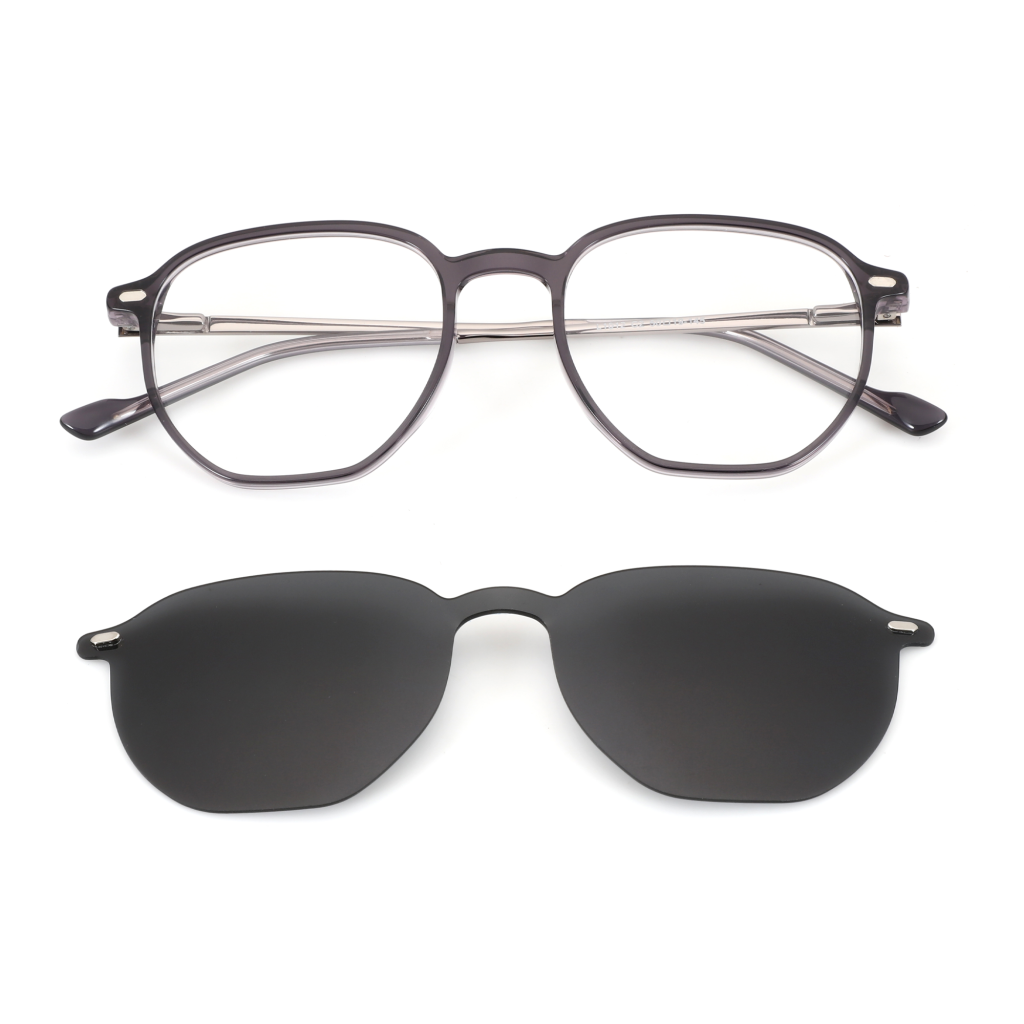
Two frames with identical outlines can perform completely differently, and the difference usually sits in construction rather than shape. Corner treatment is the first place to look. A truly sharp ninety-degree corner is aggressive and reads as intentional design; a corner with a small radius softens the whole frame while keeping its geometry legible. If you are moving toward angular frames for the first time, that slightly rounded corner is the gentler entry point.
Bridge design does more work than most people expect. On geometric frames, a keyhole or notched bridge breaks up the top line and stops the frame from reading as a single solid bar across the face, which is what makes some angular styles look severe. A straight bar bridge does the opposite and amplifies horizontal emphasis, which suits faces that need widening and overwhelms those that do not. Temple thickness completes the calculation: heavy temples pull the eye sideways and add apparent width at the cheekbones, while slim temples let the front do the talking.
Colour and finish then determine how loudly the geometry speaks. The same hexagonal frame becomes three different objects in polished black acetate, in warm translucent tortoiseshell and in brushed gold wire. Translucency in particular is underrated: it lets skin tone show through the rim so the angles remain visible without the frame reading as a hard graphic. ZENOTTIC and other eyewear makers working seriously with angular shapes tend to release the same geometry across several finishes for exactly this reason, because the shape is only half of the outcome.
A short sequence of checks handles most fitting decisions without guesswork:
- The frame front should end at or just inside the width of your temples, never beyond them.
- Your pupils should sit near the horizontal centre of each lens, not high in the opening.
- The top line should follow your brow rather than cross it, and the bottom edge should clear your cheek when you smile.
Owning Both Ends of the Spectrum
The most practical resolution to the curve-versus-angle argument is refusing to resolve it. A functional rotation needs one frame that recedes and one that asserts, because the two are answering different questions. The recessive pair, usually softer and neutral in tone, is for days when your face should be the subject. The assertive pair, geometric and more defined, is for days when you want the outline to carry some of the work: travelling, meeting people for the first time, being photographed, or simply dressing plainly and needing one element to hold the whole look together.
Approached that way, geometry stops being a risk and becomes a tool with a clear purpose. It also removes the pressure to find a single perfect frame, which is a search that rarely ends well. Faces are not static across a week, and neither is what you need eyewear to do for you. Two well-chosen pairs at opposite ends of the shape spectrum cover far more ground than four cautious variations on the same curve, and they cost less in regret.
Choosing Shape With Intent Rather Than Habit
The shift away from universally soft frames is not really about hexagons being fashionable. It is about eyewear moving from something that hides a fit problem to something that makes a deliberate statement about structure. Round frames flatter by declining to commit, which is genuinely useful on some faces and in some rooms, and worth keeping for exactly those moments. Angular frames commit, and in committing they give a face definition that survives small screens, bad lighting and plain clothing. Neither is objectively correct. What separates a frame that works from one that sits unworn is whether its lines cooperate with the lines already present in your face, and whether its scale, bridge and corner treatment suit the weight you want it to carry. Check those things in a mirror rather than against a chart, keep one soft pair and one defined pair within reach, and the question of which shape wins stops mattering. You will simply have the right one for the day in front of you.
