

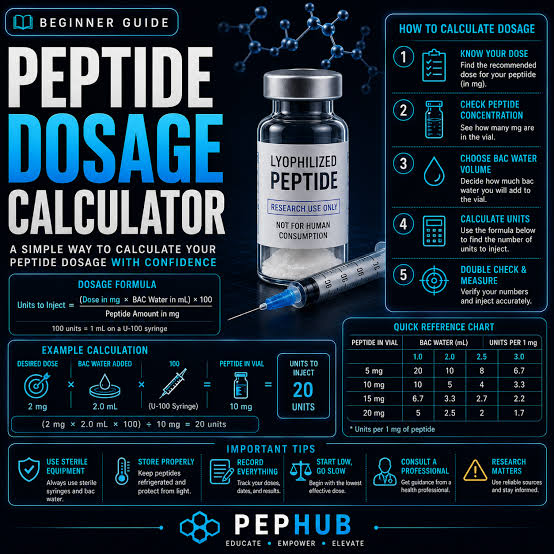
What Is a Peptide Calculator?
A peptide calculator is a digital tool designed to help users perform calculations related to peptides and peptide solutions. Depending on the calculator, it may estimate molecular weight, peptide concentration, solution volume, dilution ratios, or other mathematical values. These tools can make peptide calculator calculations easier by reducing the need to perform complex formulas manually. For researchers, students, laboratory professionals, and people studying peptide chemistry, a peptide calculator can provide a convenient way to organize numerical information and understand how different values relate to one another.
Peptides are short chains of amino acids connected through peptide bonds. Because different peptides contain different amino acid sequences, their molecular weights and other properties can vary considerably. A calculator can simplify some of the mathematics involved in working with these compounds, especially when several measurements need to be considered at the same time.
Why Use a Peptide Calculator?
Calculations involving peptides can become complicated when working with molecular weights, concentrations, quantities, and solution volumes. Even a small mathematical error can lead to an incorrect result. A peptide calculator can help users check their calculations and save time when dealing with routine mathematical tasks.
One of the main advantages is convenience. Instead of repeatedly applying formulas by hand, users can enter the relevant values into a calculator and receive an estimate or calculated result. This can be particularly useful when comparing multiple peptides or preparing calculations for laboratory documentation.
However, a calculator should be treated as a mathematical aid rather than a replacement for scientific judgment. Users should always verify the inputs, units, assumptions, and results before relying on a calculation for experimental or professional purposes.
Peptide Molecular Weight Calculations
One common purpose of a peptide calculator is estimating molecular weight. Molecular weight is important because it helps users understand the mass of a particular peptide and is commonly used when converting between mass-based and molar measurements.
For a peptide sequence, molecular weight depends on the amino acids present and the chemical structure of the complete molecule. Terminal modifications, chemical modifications, salts, and other structural differences can also affect the final value. Therefore, users should ensure that the calculator they use accounts for the specific peptide structure they are studying.
A reliable calculation should also clearly identify the units being used. Molecular weight is commonly expressed in daltons (Da), while laboratory calculations may involve milligrams, grams, millimoles, or micromoles.
Peptide Concentration and Dilution
Another area where a peptide calculator can be useful is concentration and dilution mathematics. Concentration describes the amount of a substance present within a particular volume. Depending on the application, concentration may be expressed in different units.
Dilution calculations are often based on the relationship between the initial concentration, final concentration, and volumes involved. A calculator can make these mathematical relationships easier to handle, particularly when users need to work with several different concentrations.
It is important to carefully check units before entering information into a calculator. Mixing units without proper conversion can produce incorrect results. For this reason, users should review whether a tool expects values in milliliters, liters, milligrams, micrograms, molarity, or another measurement system.
Understanding Peptide Sequences
A peptide calculator may also work with peptide sequences. A sequence identifies the order of amino acids that make up a peptide. Since changing the sequence can change the molecular properties of the resulting peptide, accurate sequence entry is essential.
Users should carefully check every amino acid abbreviation before calculating a value. A single incorrect character can produce a different molecular weight or other result. If the peptide contains modifications, users should also confirm whether those modifications need to be entered separately.
For educational purposes, sequence-based calculations can help students understand how individual amino acids contribute to the overall properties of a peptide.
Choosing a Reliable Peptide Calculator
Not every online calculator provides the same features or level of accuracy. When selecting a peptide calculator, users should consider what calculations it supports and whether the underlying formulas are clearly explained.
A useful tool should have a straightforward interface, clearly labeled input fields, appropriate unit options, and transparent calculation methods. It should also distinguish between different types of peptide calculations rather than presenting potentially confusing results without context.
For scientific or laboratory applications, it is especially important to compare calculator results with trusted references or established software. Online calculators are convenient, but their outputs should be independently checked when accuracy is critical.
Common Mistakes When Using a Peptide Calculator
Several common mistakes can affect the accuracy of peptide calculations. Entering an incorrect sequence is one of the simplest errors. Another frequent issue is using the wrong unit or confusing mass concentration with molar concentration.
Users may also overlook modifications or assume that every calculator uses the same assumptions. Different tools can produce different results if they account for peptide termini, modifications, or other chemical factors differently.
To reduce errors, carefully review the peptide sequence, units, modifications, and calculator settings before accepting the result. Keeping a record of the original inputs can also make calculations easier to reproduce later.
Peptide Calculator for Education and Research
A peptide calculator can be a valuable educational resource for learning about amino acids, molecular weight, concentration, and basic peptide chemistry. Students can use these tools to verify classroom calculations and explore how changes in peptide sequences affect molecular properties.
Researchers may also use calculators for preliminary mathematical checks and routine calculations. Nevertheless, research applications require additional care because experimental conditions and chemical characteristics can introduce factors that a basic online calculator may not consider.
Final Thoughts
A peptide calculator provides a convenient way to perform and verify common calculations associated with peptides. Whether the goal is understanding molecular weight, working with concentrations, examining peptide sequences, or checking mathematical relationships, these tools can reduce manual calculations and improve efficiency.
The most important consideration is accuracy. Users should enter correct information, confirm units, understand the assumptions behind the calculation, and verify important results using reliable scientific references. Used appropriately, a peptide calculator can be a helpful companion for students, researchers, and anyone interested in learning more about peptide chemistry.
