

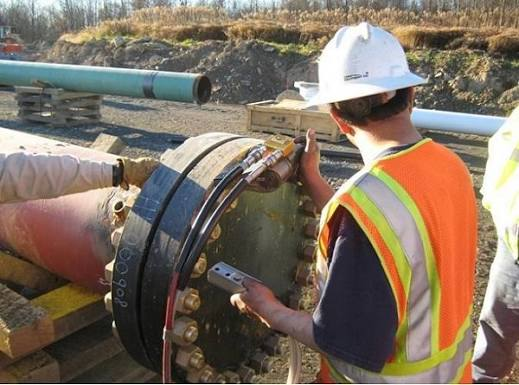
A flange can be designed to the correct standard and still give trouble in the field. In many cases, the flange itself is not the problem. The trouble begins when the bolting package is ordered with only a diameter and a familiar material grade, while the nut grade, coating, stud length, service temperature, installation method and documentation are left open to interpretation.
That approach may work for a routine maintenance purchase, but it is risky on an oil and gas project. A bolted flange joint is an assembly. The flange, gasket, studs, nuts, surface finish and tightening procedure have to work together. If one item is specified in isolation, the joint may arrive on site with the right-looking components but the wrong engineering basis.
Typical problems are easy to recognize after they happen: studs do not provide enough thread projection, nuts do not match the specified stud grade, coated fasteners are tightened using torque values developed for uncoated steel, or certificates cannot be matched to the heat numbers marked on the packages. Avoiding these issues starts with a complete specification for pipeline flange bolting, not simply a purchase description for loose bolts.
What Information Must Be Confirmed Before Pipeline Flange Bolting Is Specified?
Before an RFQ is released, the buyer needs more than the nominal pipe size and stud diameter. Those two details identify only part of the joint. They do not tell the supplier what the fasteners will be exposed to, how the gasket will be compressed or what inspection records must accompany the shipment.
Start with the pipeline service. Crude oil, refined products, natural gas, sour gas, steam and process chemicals do not create the same material requirements. The maximum design temperature matters, but so does the minimum temperature. A project may also need to consider repeated heating and cooling, because thermal cycling changes the way the joint behaves over time.
The flange information should then be checked against the approved piping documents. This includes the applicable standard, nominal pipe size, pressure class, facing type and flange material. ASME B16.5, ASME B16.47 and API 6A cover different equipment ranges and applications, so the standard should be stated rather than assumed. The gasket type and thickness are equally important because they affect both the required compression load and the stud length.
Finally, the external environment has to be described. An onshore line in a dry inland area is not exposed to the same corrosion conditions as an offshore platform, a coastal terminal, a buried pipeline or a chemical-processing zone. The installation method, inspection plan, certificate type and any client-specific material specification should be included in the same information package.
How Do Design Temperature, Pressure and Process Media Affect Material Selection?
Pressure class alone is not a reliable basis for choosing bolt material. It tells the engineer how the flange is rated, but it does not describe low-temperature toughness, elevated-temperature strength, sour-service restrictions or chemical compatibility. Those conditions are what determine whether a grade is suitable for the actual service.
At elevated temperatures, the selected alloy must retain strength and resist creep. ASTM A193 Grade B16 is often considered for service above approximately 400°C because it is a chromium-molybdenum-vanadium alloy, but the project material specification remains the controlling document. A familiar grade should never be substituted simply because it is available in stock.
Low-temperature service creates a different concern. Below approximately -29°C, many projects require impact-tested materials with verified toughness at the minimum design temperature. ASTM A320 Grade L7 is widely used in cold-service applications, yet the certificate still needs to show that the required impact test temperature and acceptance values were met.
Sour service requires particular care. Where hydrogen sulfide is present, NACE MR0175 and ISO 15156 may impose hardness limits and material restrictions intended to reduce sulfide stress cracking risk. ASTM A193 B7M may be accepted for certain applications, but the grade designation by itself does not prove compliance. Heat treatment, hardness results and the complete service specification still need review.
Offshore and coastal projects add chloride exposure to the decision. Depending on the approved design, stainless steel, duplex stainless steel or nickel-alloy fasteners may be considered. Chemical plants may require another compatibility assessment for acids, caustics or solvents. Buyers comparing stud bolts for oil and gas pipelines should therefore check the service envelope behind each material option rather than treating different grades as interchangeable.
How Should Stud Bolts and ASTM A194 Nuts Be Matched?
A stud is only half of the bolting assembly. The nut carries the load through the threads, so its mechanical properties, hardness, dimensions and finish must be compatible with the stud. When the nut is ordered as a generic accessory, the joint can develop thread damage, galling or an unsuitable hardness relationship during installation.
ASTM A194 covers several nut grades used in high-pressure and high-temperature service. A complete purchase description should identify the grade, proof-load requirement, hardness range, thread series, pitch, tolerance class, dimensions, coating allowance and marking requirement. Internal threads also need to accommodate the specified coating thickness without becoming too tight during assembly.
Common industry pairings include ASTM A193 B7 studs with ASTM A194 Grade 2H nuts, and ASTM A193 B7M studs with ASTM A194 Grade 2HM nuts for certain sour-service applications. ASTM A320 L7 or L7M studs are paired with project-approved ASTM A194 nuts for low-temperature work. These are familiar combinations, not universal rules. The approved project material schedule must remain the final reference.
It is good practice to place the stud and nut requirements on the same purchase item or technical data sheet. That makes it harder for one component to be substituted or inspected separately from the other. Product marking should also allow the receiving inspector to confirm the grade before the packages are released to the construction team.
How Should Flange Class, Gasket Type and Stud Dimensions Be Coordinated?
Stud length is a frequent source of field delay because it is sometimes selected from pipe size alone. The actual length depends on the complete joint stack-up. Flange thickness changes with the applicable standard and pressure class. The gasket, nut height, washers and required thread projection all add to the final dimension.
The facing type also matters. A raised-face joint and a ring-type joint do not have identical geometry. Gasket thickness and compression must be taken into account, especially where a project uses non-standard gasket arrangements. The design should leave enough thread beyond the nut for inspection without creating excessive projection that interferes with nearby equipment.
Installation access can change the required arrangement as well. Hydraulic tensioning equipment needs clear access around the end of the stud, while a torque wrench requires room around the nut. Where space is limited, a dimension that appears correct on a drawing may still be difficult to install.
The ordered-length convention should be confirmed with the supplier in writing. Stud length is normally expressed as an overall dimension, but assumptions about chamfers, points and thread ends can still create disagreement. When reviewing JM Hardware pipeline fasteners for a project package, buyers should provide the approved dimensions or drawings for each flange group instead of relying on a general statement such as “standard length.”
When Should a Pipeline Stud Bolt Use a Protective Coating?
A high-strength alloy can meet the mechanical requirements and still corrode quickly in the wrong environment. Protective coating is therefore a separate engineering decision. It should be based on external exposure, operating temperature, storage conditions and the planned tightening method.
Offshore platforms and coastal terminals are exposed to salt spray and persistent humidity. Tropical locations may keep steel surfaces wet for long periods, while industrial areas can introduce sulfur compounds or other corrosive contaminants. Fasteners may also remain outdoors for months during construction before insulation or final protection is installed.
Common options include PTFE or fluoropolymer systems, Xylan formulations, zinc-based coatings, zinc-flake coatings and, where technically permitted, hot-dip galvanizing. Each system has limits. Some coatings are unsuitable at higher operating temperatures. Others require controlled application thickness so that threads remain within tolerance.
Color should not be used as the coating specification. Two blue or black coatings can have very different chemistry, thickness, friction and corrosion resistance. A useful coating requirement identifies the system, application method, thickness range, test method and permitted service temperature. The flange bolting material and coating guide can be used as a starting point when comparing these considerations, but the project specification must still define the final requirement.
How Do Coating and Lubrication Affect Torque and Bolt Preload?
Torque does not go directly into bolt tension. A large part of the applied force is consumed by friction in the threads and under the nut bearing surface. Change the coating or lubricant, and the relationship between the torque wrench reading and the actual stud preload changes with it.
This is why a torque value developed for plain, uncoated steel should not automatically be used for PTFE-coated or Xylan-coated fasteners. A lower-friction surface can produce much higher tension at the same applied torque. The result may be an overloaded stud, excessive gasket compression or unwanted flange rotation.
The opposite problem occurs when coating thickness is inconsistent, the surface is damaged or lubrication is applied unevenly. The installer may reach the specified torque while individual studs develop different preload. The joint looks complete, but the gasket load is not distributed as intended.
Before installation, the responsible team should confirm the coating friction data, lubrication condition, nut finish, washer requirement, tool type and calibration status. For critical joints, a representative torque-tension test may be required to confirm the assumed friction coefficient. Hydraulic tensioning or direct stretching may also be selected where the project requires tighter preload control.
There is no universal friction value for every PTFE or Xylan system. Formulations and application processes differ. The final torque or tensioning procedure must therefore come from the responsible engineering authority and reflect the gasket, flange limits and target preload for that specific joint.
What Testing, Certification and Traceability Should Be Included?
For a project shipment, the fasteners and the document package should be treated as one deliverable. A box of correct studs can still be rejected if the certificates cannot be matched to the product markings or package labels. Traceability has to remain intact from raw material through manufacturing, coating, inspection and dispatch.
The required documentation depends on service criticality and client rules. A typical package may include Material Test Certificates, EN 10204 Type 3.1 certificates where specified, chemical analysis, tensile results, yield strength, elongation, hardness results and impact-test data for low-temperature grades. Alloy projects may also request Positive Material Identification.
Additional records can include dimensional inspection, thread-gauge results, coating thickness and adhesion reports, nondestructive testing, third-party inspection release notes and product-marking records. Heat numbers or production-lot numbers should appear consistently across the certificates, the fasteners and the packaging.
Not every line item needs every test. The testing scope and sampling frequency should be stated before production, preferably in the RFQ, purchase order and inspection plan. Deciding the certificate requirement after the products are finished often leads to delays because the original test samples or witness points may no longer be available.
How Should Project Fasteners Be Packed and Identified for Pipeline Construction?
Large pipeline and refinery packages often contain many combinations of diameter, length, grade, coating and nut type. If the products are packed only by general description, a warehouse can easily issue the wrong package to the wrong line number. Once materials are mixed on site, restoring traceability becomes difficult.
Each package should be identified with the project or contract number, purchase-order number, item number, line or flange reference, stud dimensions, stud grade, nut grade, coating system, heat number, production lot, quantity and package sequence. The label should be visible without opening the box.
Physical protection matters too. Thread protectors reduce damage during handling. Moisture barriers, VCI paper or desiccant may be required for sea freight and long storage periods. Coated fasteners may need individual wrapping or separated compartments so that threads do not rub against each other and damage the finish.
Different grades, coatings and dimensions should not share a package unless the project specifically permits it and each item remains clearly separated. Packing rules may appear administrative, but they directly affect installation accuracy and the ability to pass receiving inspection.
How Should Buyers Compare Pipeline Fastener Supplier Proposals?
Two quotations can list the same stud size and material grade while covering very different scopes. One supplier may include matching nuts, full testing, coating inspection and heat-number traceability. Another may quote only the studs with a basic certificate. The lower unit price is not necessarily the lower project cost.
Technical comparison should confirm that every proposal uses the same material specification, thread requirement, dimensions, coating system, testing scope, certificate type, inspection level, marking method and packing standard. Any exclusion should be listed clearly. Material origin, subcontracted processes and proposed substitutions also need review before an order is placed.
Delivery time should be assessed together with the approval and inspection schedule. A short manufacturing lead time is of little value if the supplier has not allowed time for document approval, third-party witnessing or coating tests. Likewise, a technically complete proposal may prevent later change orders that would otherwise delay the construction sequence.
When comparing oil and gas pipeline bolt solutions, buyers should focus on conformity to the approved project specification and the completeness of the deliverables. Unit price is only one line in that comparison.
Pipeline Flange Bolting Specification Checklist
- Confirm the pipeline service and process media.
- Confirm the design pressure.
- Confirm the maximum and minimum design temperatures.
- Confirm the applicable flange standard.
- Confirm the flange size and pressure class.
- Confirm the flange material and facing type.
- Confirm the gasket type and thickness.
- Confirm the stud bolt material grade.
- Confirm the matching ASTM A194 nut grade.
- Confirm stud diameter and ordered length.
- Confirm the supplier’s length-measurement convention.
- Confirm thread series, pitch and tolerance.
- Confirm the coating system and permitted thickness.
- Confirm lubricant assumptions and friction data.
- Confirm the approved torque or tensioning method.
- Confirm mechanical, hardness and impact-test requirements.
- Confirm PMI or nondestructive testing where required.
- Confirm the required certificate type.
- Confirm heat-number or production-lot traceability.
- Confirm third-party inspection and witness points.
- Confirm product marking, package labels and packing protection.
- Confirm the complete document package.
- Confirm engineering approval for any proposed substitution.
Conclusion
Reliable flange bolting begins before the purchase order is issued. The service conditions, flange and gasket details, stud grade, nut grade, coating, friction condition, installation method and documentation must be considered as one connected specification.
Buying a familiar grade without defining the rest of the assembly leaves too much room for assumption. That can lead to unsuitable material combinations, incorrect stud lengths, misleading torque values, damaged coatings or certificates that cannot be traced to the delivered products.
For pipeline engineers and procurement teams, the practical goal is not to produce the longest specification. It is to remove ambiguity. A clear RFQ, an agreed inspection plan and a complete delivery-document list allow qualified suppliers to quote on the same basis and give the site team a bolting package that can be inspected and installed without avoidable rework.
