

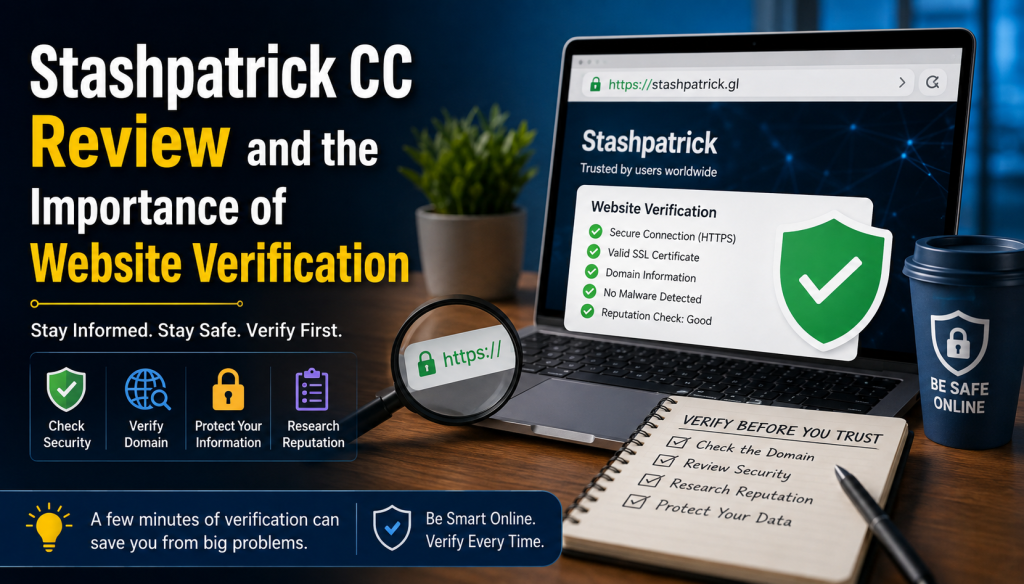
The internet offers extraordinary convenience, but it also creates opportunities for deceptive websites, imitation domains, phishing pages, and platforms with unclear ownership. A professional-looking website should never be treated as automatically trustworthy. Before entering personal information, creating an account, downloading a file, or making any type of transaction, users should examine the website carefully.
Searches related to Stashpatrick CC Review often appear alongside terms such as Stashpatrick Shop Security, Patrickstash New Domain, Stash Patrick Market, Patrick Stash Market, stashpatrick.gl, and stashpatrick.name. Regardless of why someone encounters these names, the safest approach is to treat unfamiliar domains cautiously and verify available information before interacting with them.
Website verification does not require advanced technical knowledge. A combination of simple checks can reveal important warning signs and help users make better decisions. Domain history, security configuration, reputation, transparency, and requests for sensitive information can all provide useful clues.
Why Website Verification Matters Today
Modern websites can be created quickly and made to look surprisingly professional. Attractive graphics, polished menus, customer testimonials, security icons, and familiar payment symbols can give visitors a sense of confidence. Unfortunately, visual appearance alone says very little about whether a website is legitimate.
Verification involves examining evidence beyond the design. Users should consider who operates the site, how long the domain has existed, whether independent information is available, and whether the platform provides clear policies and contact details.
This becomes especially important when researching terms such as Stashpatrick CC Review. A search result or online mention should be considered a starting point for investigation rather than proof of reliability.
A cautious visitor asks several basic questions. Who is behind this website? Is the domain established or recently registered? Are its claims supported elsewhere? Does it request unnecessary information? Are independent security services reporting concerns?
These questions can prevent many avoidable online risks.
Understanding Stashpatrick CC Review Searches
People searching for Stashpatrick CC Review may be trying to understand the reputation, identity, security, or history associated with a particular online name. However, search results can sometimes mix legitimate discussions with copied pages, misleading promotions, outdated references, or similarly named domains.
This is why users should avoid relying on a single article, forum comment, or promotional claim.
A better evaluation considers several independent signals. Domain registration details can provide information about the age of a website. Reputation databases may reveal whether security systems have previously detected suspicious behavior. Archived versions can sometimes show how a domain has changed over time.
Users should also pay attention to inconsistencies. If different pages provide conflicting contact information, company descriptions, or domain addresses, additional caution is appropriate.
Evaluating Stashpatrick Shop Security
When examining Stashpatrick Shop Security, users should focus on observable security characteristics rather than promotional statements. A website saying that it is secure does not establish that claim.
One basic indicator is HTTPS. A secure connection helps protect information transmitted between a browser and the website. However, HTTPS is not a certificate of legitimacy. Suspicious websites can also obtain valid security certificates.
Users should therefore combine technical checks with broader verification.
Useful checks include:
- Confirming that the domain spelling is exactly what was intended
- Looking for HTTPS and valid certificate information
- Checking domain registration age and available ownership details
- Searching independent reputation and security databases
- Reviewing contact information and published policies
- Avoiding unexpected downloads or browser extensions
- Being cautious when a site requests unnecessary personal information
No single item provides complete certainty. Verification works best when several independent signals point in the same direction.
Why New or Changing Domains Deserve Attention
The phrase Patrickstash New Domain highlights another important issue in online safety. Websites sometimes move between domains for legitimate reasons, including rebranding, technical changes, or business restructuring. Frequent or unexplained domain changes, however, deserve closer examination.
A newly registered domain has less history for users to evaluate. There may be fewer independent reviews, archived pages, reputation records, and references from established websites.
If a platform announces a new address, users should verify that information through trustworthy sources rather than following links from unsolicited emails, messages, advertisements, or social media accounts.
Lookalike domains are particularly important to notice. A fraudulent address may differ from a familiar domain by only one letter, number, hyphen, or domain extension. On a small screen, that difference can be easy to miss.
Typing a verified address manually is generally safer than following an unfamiliar link.
Checking Stash Patrick Market and Patrick Stash Market References
Variations such as Stash Patrick Market and Patrick Stash Market can create confusion because similar wording does not necessarily indicate the same operator or website. Search engines may display pages using slightly different spellings, and third-party posts can further blur the distinction.
Users should not assume two similar names represent the same service.
Instead, examine the exact domain connected with each reference. Look at publication dates, archived pages, independent discussions, and security reports. If one source claims that a particular domain is the official destination, try to confirm that claim through additional independent evidence.
Be especially cautious with pages that pressure visitors to act immediately. Statements suggesting that access is temporary, accounts will disappear, prices will suddenly change, or verification must happen immediately can be designed to discourage careful thinking.
A legitimate online service should normally give visitors enough information and time to evaluate what they are using.
Examining Domains Such as stashpatrick.gl
A domain extension should never be used as the sole measure of credibility. When evaluating stashpatrick.gl or any unfamiliar address, users should examine the complete domain rather than judging it only by its ending.
Domain registration information may reveal when the address was created or updated. A very recent registration does not automatically indicate danger, but it becomes more relevant when combined with other warning signs.
Users can also investigate whether reputable security databases have flagged the domain for malware, phishing, suspicious redirects, or other problems.
Another useful step is examining search results carefully without immediately opening unknown pages. Search snippets can sometimes reveal whether the domain has an established public presence or is primarily mentioned on questionable promotional pages.
If reliable information is scarce, caution is usually preferable to experimentation.
What to Consider When Researching stashpatrick.name
The same verification principles apply to stashpatrick.name. Similar naming across multiple domain extensions can sometimes be legitimate, but users should not automatically assume that similarly named domains share ownership.
Before visiting or interacting with an unfamiliar domain, compare available information about registration dates, website content, security reputation, and external references.
It is also worth checking whether a domain unexpectedly redirects somewhere else. Redirects are common on the web and are not inherently suspicious, but unexplained chains of redirects can make it harder to understand where information is ultimately being sent.
If the browser produces a certificate warning, malware alert, suspicious download prompt, or phishing notification, users should not ignore it simply because they expected the website to be legitimate.
Browser security warnings exist for a reason.
Warning Signs That Should Increase Caution
Website verification becomes particularly important when several warning signs appear together. One unusual feature may have an innocent explanation, but multiple concerns can create a much stronger reason to avoid interaction.
Potential warning signs include poor transparency about ownership, recently created domains combined with major claims, inconsistent contact details, aggressive pop-ups, forced downloads, unusual payment requests, and pressure to provide sensitive information quickly.
Visitors should also question requests for information that does not appear necessary for the stated purpose of the website.
For example, a simple informational page normally has little reason to request identity documents, financial credentials, account passwords, or extensive personal details.
The principle is simple: provide as little sensitive information as necessary, and only after establishing that the recipient is trustworthy.
Independent Verification Is Better Than Testimonials
Testimonials can influence perception, but they should never replace independent research. Website owners control what appears on their own pages, meaning positive statements displayed there cannot be considered fully independent evidence.
When investigating Stashpatrick CC Review or related terms, users should compare information across multiple sources.
Independent security tools, established reputation databases, domain registration services, archived website records, and credible reporting can provide a broader picture.
Reviews should also be evaluated critically. Large numbers of nearly identical comments, repetitive wording, unusually enthusiastic language, or many reviews appearing within a short period may deserve additional scrutiny.
Reliable research focuses on patterns rather than individual claims.
Protecting Personal and Financial Information
Verification becomes even more important before sharing financial or identifying information. Once sensitive data has been submitted to an unknown party, recovering control over it may be difficult.
Users should avoid entering passwords reused on other accounts. Unique passwords reduce the damage that can occur if credentials are exposed. Multi-factor authentication should also be enabled wherever available.
Financial details require additional caution. Before making any transaction, users should understand who receives the payment, what consumer protections apply, and whether the transaction can be disputed if something goes wrong.
Requests involving anonymous or difficult-to-reverse payment methods deserve particularly careful evaluation.
A Practical Verification Habit for Everyday Browsing
Online safety is less about memorizing every suspicious domain and more about developing consistent habits. Names, domains, and websites change constantly, but basic verification principles remain useful.
Whether someone encounters Stashpatrick Shop Security, reads a Stashpatrick CC Review, searches for a Patrickstash New Domain, or comes across references to Stash Patrick Market, Patrick Stash Market, stashpatrick.gl, or stashpatrick.name, the same approach applies: verify first and interact later.
Check the exact address. Research the domain independently. Examine security warnings. Compare multiple sources. Question unusual requests. Avoid unnecessary downloads. Never allow urgency to replace judgment.
These habits take only a few minutes, yet they can significantly reduce exposure to phishing, impersonation, malicious software, privacy violations, and financial scams.
Make Verification Your First Line of Defense
The most effective online safety practices often begin before anything goes wrong. Website verification gives users an opportunity to identify warning signs before sharing information, creating accounts, downloading files, or making transactions.
A polished appearance is not enough to establish trust. Neither is a positive review, familiar name, secure connection, or convincing testimonial. Trust should develop from multiple pieces of consistent and independently verifiable information.
For anyone researching Stashpatrick CC Review and related domain names, the safest principle is straightforward: treat unfamiliar websites as unverified until reliable evidence suggests otherwise. Careful browsing, independent research, strong account security, and attention to browser warnings can make everyday internet use considerably safer.
In an online environment where domains and identities can change quickly, verification is not unnecessary suspicion. It is a practical digital habit that helps users stay informed, protect sensitive information, and make decisions based on evidence rather than appearance.
