

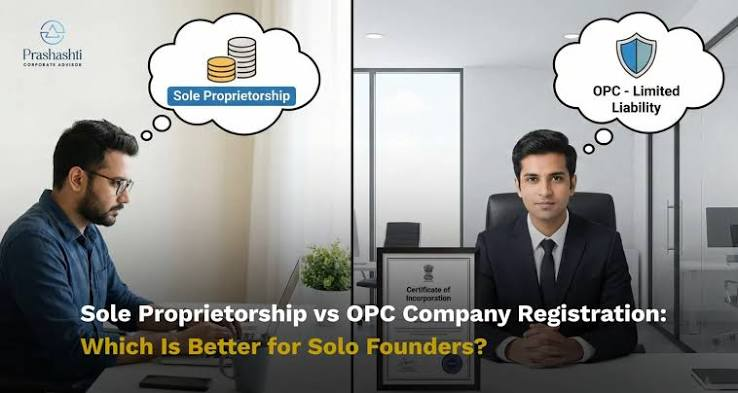
Most Indian businesses begin the same way: one person, one idea, and a laptop on the dining table. The freelancer taking on bigger clients, the consultant who wants to raise invoices properly, or the D2C seller whose Instagram page suddenly starts getting real orders.
At some point, all new entrepreneurs face the same issues: clients ask for a GST invoice, banks need a current account, and marketplaces prefer a registered entity. That’s when the search for the procedure for business registration begins. For single owners, the One Person Company (OPC) structure then works as a better alternative than a sole proprietorship. Let’s see why!
What Exactly is a One Person Company?
The OPC was introduced under the Companies Act, 2013 with the idea that a single founder should not be forced to look for a second partner just to enjoy the benefits of a private limited company.
Before OPC existed, a solo founder had two choices. Either run a sole proprietorship or find a co-founder (often a family member added only on paper) to form a private limited company.
An OPC registration online gives you a middle path. It is a proper company registered with the Ministry of Corporate Affairs, with one shareholder, a separate legal identity, and limited liability. Your business becomes a separate entity in the eyes of the law, distinct from you (the founder).
The Practical Benefits of OPC
- In a proprietorship, if the business owes money, your savings, your car, and even your house can be at risk. In an OPC, your liability is limited to what you invested in the company.
- Corporate clients, especially large ones, are far more comfortable issuing purchase orders to a registered company than to an individual. The “Private Limited” tag at the end of your name does wonderfully well in a vendor onboarding form.
- A registered company opens a current account in the company’s name, builds its own credit history, and finds it simpler to apply for business loans or credit lines later.
- Every OPC must appoint a nominee at the time of incorporation. If something happens to the sole member, the nominee steps in and the company continues. A proprietorship simply ends with the proprietor.
- An OPC is exempt from holding an Annual General Meeting, does not need to prepare a cash flow statement as part of its financial statements, and has relaxed board meeting requirements. You get company status without the full compliance load.
Who Can Register an OPC?
The eligibility rules go as follows:
- The member and the nominee must both be natural persons, as companies and LLPs cannot form an OPC.
- Both must be Indian citizens. Since the 2021 amendment, NRIs are also permitted to incorporate an OPC, and the residency requirement was reduced from 182 days to 120 days in the preceding financial year.
- One person can be the member of only one OPC at a time and can be a nominee in only one OPC.
- A minor cannot be a member or a nominee.
- An OPC cannot be incorporated to carry out Non-Banking Financial Investment activities, including investing in the securities of other companies.
One more welcome change from 2021: The earlier restriction that forced an OPC to convert into a private limited company once it crossed ₹50 lakh paid-up capital or ₹2 crore turnover has been removed. You can also convert voluntarily at any time, without waiting out the old two-year lock-in. In short, growing fast is no longer a compliance problem.
However, every OPC must appoint its first auditor within 30 days of incorporation, file Form AOC-4 for financial statements, file the annual return in Form MGT-7A, complete director KYC through DIR-3 KYC every year, and file income tax returns. Missing these attracts penalties that add up quietly, day by day.
Is OPC Right for You?
Choose an OPC if you are a single founder who wants limited liability, a credible corporate identity, and a structure that can grow into a private limited company later.
Consider a private limited company instead if you plan to bring in co-founders soon or raise external funding, since an OPC cannot have more than one shareholder. And if your turnover is very small and your risk is minimal, a simple proprietorship may still be enough for now.
The right answer depends on where you want the business to be in three years, not just where it is today. But for a large number of Indian solo founders, the OPC hits a genuinely sensible middle ground: real protection, real credibility, and paperwork you can actually manage.
