

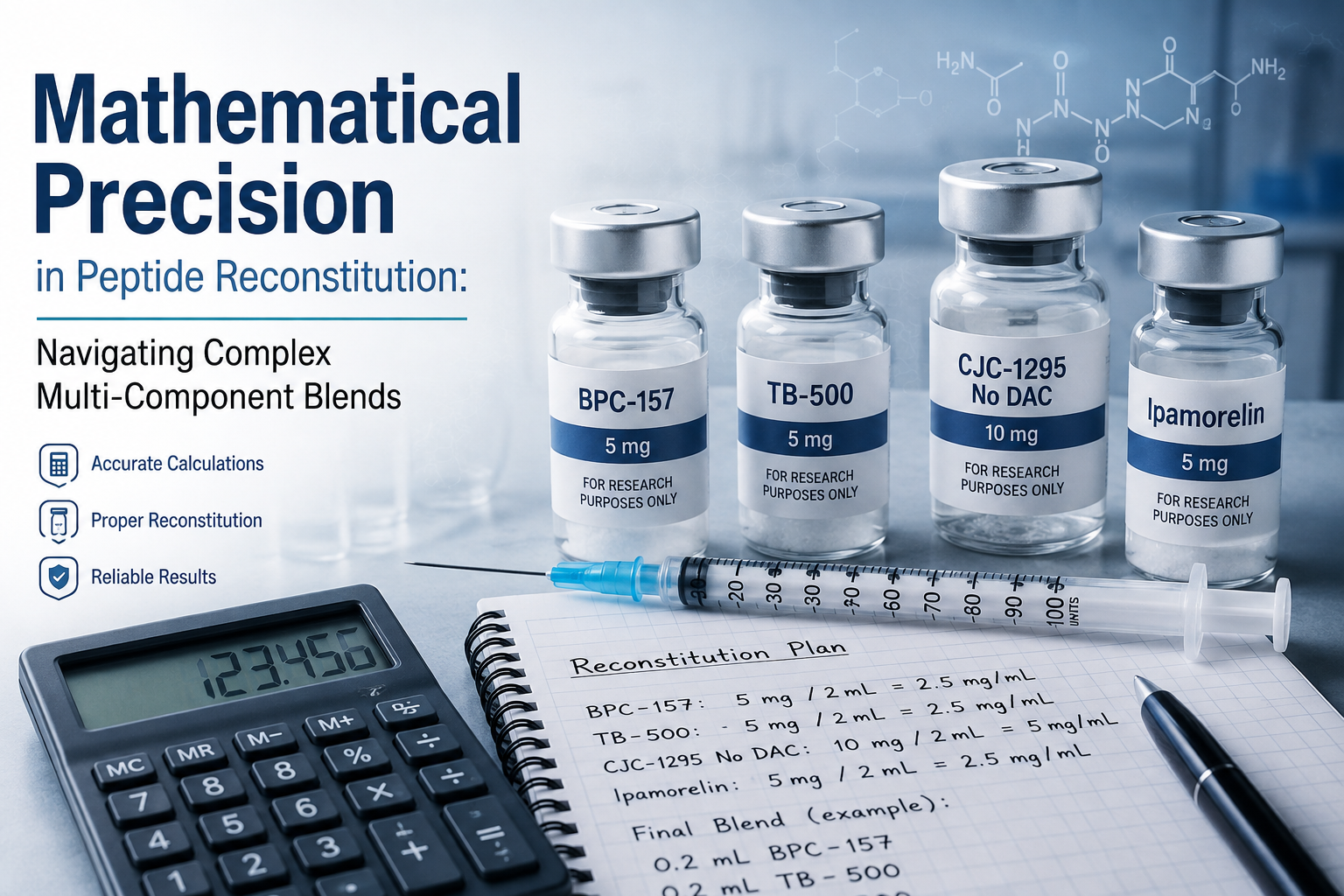
In molecular biology and quantitative laboratory workflows, calculations surrounding solution preparation directly impact experimental validity. While single-compound calculations are relatively straightforward, multi-component formulations present distinct volumetric challenges.
Among these, novel research protocols involving the Klow blend (incorporating compounds such as KPV, GHK-Cu, BPC-157, and TB-500) require meticulous accuracy when measuring diluent volumes, microgram concentrations, and syringe graduations. To maintain analytical consistency, digital reference tools like the klow dosage calculator provide researchers with automated mathematical conversions tailored to complex peptide matrix ratios.
The Analytical Challenge of Multi-Peptide Reconstitution
When reconstituting freeze-dried research compounds, achieving the exact target mass per syringe unit requires managing several dependent variables simultaneously:
- Vial Mass: Total mass of the active compound powder in milligrams (mg).
- Diluent Volume: The exact volume of Bacteriostatic (BAC) water added to the vial, measured in milliliters (mL).
- Syringe Scale: Conversion between volumetric units (mL) and syringe tick marks (e.g., U-100 insulin syringes where 100 units equal 1.0 mL).
With multi-component mixtures, a single volumetric draw contains proportional ratios of every active peptide present in the blend. Manually calculating these multi-variable conversions increases the risk of human error in high-throughput research settings.
Streamlining Calculations with the Klow Calculator
To eliminate manual conversion errors, researchers utilize specialized digital tools. Utilizing a dedicated klow calculator simplifies liquid volumetric mapping by converting target microgram requirements into immediate, visual syringe-unit outputs.
These tools resolve common laboratory setup queries, such as:
- Volumetric Dilution Metrics: Determining exactly how much bac water for klow 80 calculator setups is required to reach an optimal liquid concentration without over-saturating the vial.
- Graduation Mapping: Viewing a dynamic visual representation of U-100 or U-40 syringes to identify the precise draw line for target analytical amounts.
- Ratio Transparency: Displaying the exact breakdown of individual component masses contained within every single volumetric tick mark.
For laboratories managing standardized research protocols, consulting a comprehensive klow peptide dosage chart calculator provides a clear reference matrix for varying BAC water volumes against target unit draws.
How to Calculate Reconstitution Parameters for Klow Blends
Using a specialized digital tool like a klow reconstitution calculator allows analytical teams to customize parameters according to their specific experimental setup:
- Select the Blend Scale: Input the total mass specifications of your reference vial.
- Set Diluent Volume: Enter the exact volume of BAC water used for reconstitution (e.g., 1 mL, 2 mL, or 3 mL).
- Define Target Concentration: Input the desired amount in micrograms ($\mu\text{g}$) needed for the analytical assay.
- Select Syringe Type: Match the digital interface to your physical syringe scale (U-100, U-40, or standard mL syringes).
The platform instantly computes the exact unit draw required, ensuring complete reproducibility across consecutive experimental trials.
Conclusion
As multi-component formulations become more common in scientific reference workflows, adopting standardized digital tools reduces mathematical errors and streamlines daily laboratory operations. Whether verifying complex ratio breakdowns or using a specialized klow peptide calculator to map exact BAC water dilution levels, digital calculation tools provide the precision and reliability essential for modern quantitative research.
