

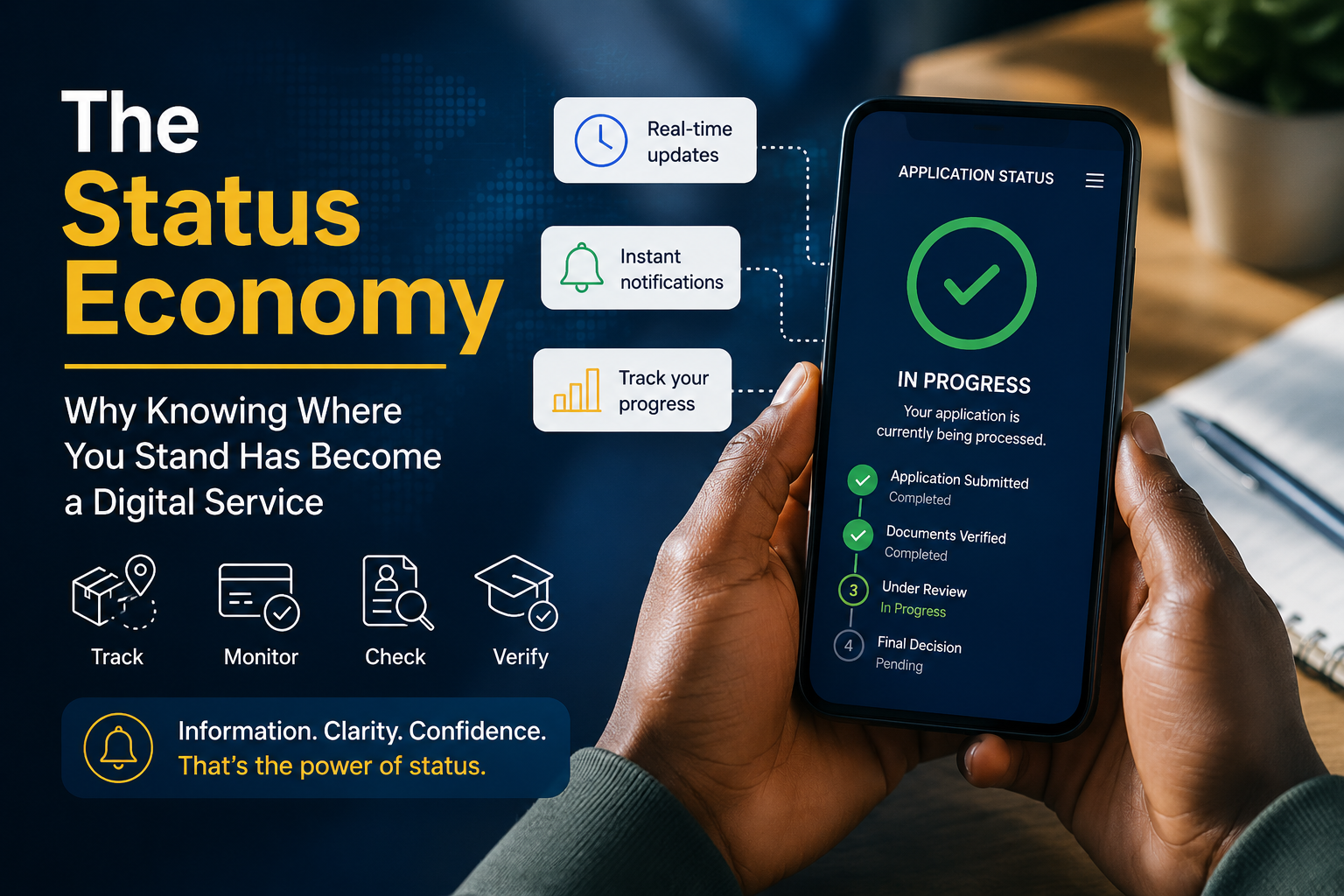
In today’s digital world, waiting is no longer what it used to be.
When we order a product, we can track its journey. When we send money, we expect confirmation. When we apply for a visa, submit a job application, or request student funding, we want to know one thing:
What is happening now?
This expectation is particularly important when the outcome can affect someone’s future. For example, students searching to check NSFAS status are not simply looking for a technical update. They want to know where they stand, whether they need to take action, and what may happen next.
This growing demand for visibility has created what can be described as the status economy—a digital environment in which knowing the progress of a process has become a valuable service in itself.
People no longer want to submit a request and disappear into a system. They expect visibility, updates, and clear information throughout the journey.
From Transactions to Transparency
For many years, digital services focused mainly on completing transactions. Users could submit a form, make a payment, upload documents, or place an order online. Once the action was completed, however, there was often little information about what happened next.
That model is changing.
Today, completing a transaction is only the beginning of the user experience. What happens after clicking “submit” can be just as important as the submission itself.
Consider how common status tracking has become:
- Food deliveries move from “order received” to “preparing” and “on the way.”
- Parcels can be tracked across multiple locations.
- Bank transfers may show whether they are processing or completed.
- Job applicants receive updates during recruitment.
- Students may search for information about their NSFAS application status after applying for financial support.
Different services, but the same expectation:
Don’t just process my request—show me what is happening.
This is the foundation of the status economy.
Why Knowing Has Become Part of the Service
Traditionally, status information was considered secondary. The main service was the delivery, approval, payment, or final decision.
Today, visibility is increasingly part of the service itself.
Imagine ordering an expensive product online and receiving only one message:
“Your order has been received.”
Then nothing happens for seven days.
Even if the product eventually arrives on time, the experience feels incomplete. The issue is not necessarily the delivery—it is the lack of information.
The same principle applies to university admissions, scholarships, financial aid, insurance claims, and government services.
For students, uncertainty can have real consequences. Someone waiting for a funding decision may need to plan for accommodation, transport, tuition, or other expenses. This is why the ability to check NSFAS funding status can be important. Clear information helps users make decisions rather than simply wait without context.
Status information transforms people from passive observers into active participants.
The Problem With “Pending”
The status economy has also revealed a major weakness in many digital systems: vague updates.
Few words create more uncertainty than “pending.”
Pending what?
Pending verification? Pending review? Pending documents? Pending information from another institution?
A single word can hide an entire process.
The problem is not that users need access to every internal detail. Instead, they need enough information to answer three questions:
- Where am I in the process?
- Do I need to do anything?
- What happens next?
The best digital status systems do more than display a label. They communicate.
A status becomes more useful when users understand what it means and whether they need to respond.
The Digital Waiting Room
Every status page is, in many ways, a modern waiting room.
In the past, people visited offices, called support lines, or waited for letters. Today, they refresh webpages.
The location has changed, but uncertainty remains.
This digital waiting room creates an opportunity for better service design. Instead of making users repeatedly check a portal, systems can provide:
- clear processing stages
- estimated timelines
- automatic notifications
- explanations of status updates
- alerts when action is required
- confirmation that a request is still active
This is particularly relevant for students. Someone looking for NSFAS status information may not simply want a result. They may be trying to understand whether their application is progressing normally or whether they need to take another step.
Even a simple update such as, “Your application is still being processed. No action is required at this stage,” can reduce unnecessary uncertainty.
Communication is no longer separate from the service. It has become part of the service itself.
Why Status Information Matters in Education
The status economy is especially relevant to education.
Students interact with multiple systems during their academic journey, including admissions, registration, accommodation, academic records, scholarships, and financial support.
Unlike tracking a package, however, these processes can directly influence a student’s future.
A delayed decision may affect accommodation choices. Unclear funding information may make it difficult to plan for transport or tuition. A student who misunderstands an update could also miss an important deadline.
This is where informational resources such as My NSFAS Check fit into the broader digital ecosystem. As more essential services move online, users increasingly need accessible information that helps them understand important processes.
The value is not simply in displaying a status.
It is in helping users understand what that status means.
What Student Funding Systems Can Learn From Package Tracking
One of the most interesting comparisons comes from logistics.
A package may move through clearly defined stages:
Order Received → Processing → Shipped → Out for Delivery → Delivered
The customer does not need to understand how the logistics company operates. They simply need enough information to understand where their package is.
Student applications could follow a similar approach.
Instead of displaying only:
Pending
A system could show:
Application Received → Information Verified → Eligibility Reviewed → Decision in Progress → Outcome Available
This would not reveal confidential internal processes. It would simply give applicants more meaningful visibility.
For students navigating financial aid, clear information can be particularly valuable. People searching to check their NSFAS status online are often looking for more than a single update. They may also want to understand what happens next and whether action is required.
That distinction is important.
Users increasingly expect digital services to provide context, not just data.
The Future: Systems That Explain Themselves
The next stage of the status economy may go beyond tracking.
Future systems could explain updates automatically.
Instead of:
Status: Pending
A smarter platform could display:
Your application is currently under review. No action is required from you at this stage. You will be notified if additional information is needed.
This type of communication could reduce unnecessary searches, support requests, and confusion.
Artificial intelligence and automation may make these systems even more proactive. A platform could identify missing documents, warn users about deadlines, or explain complex status updates in simple language.
For students, this could create a more supportive digital experience. Technology would not simply process applications—it would help people understand their journey.
Conclusion
The digital economy has changed how we experience waiting. Whether tracking a parcel, payment, job application, or student funding, people now expect to know where they stand.
This growing demand for transparency is driving the status economy. For students, the ability to understand progress, take necessary action, and check NSFAS status provides greater clarity and control.
In the future, successful digital services will not only be faster—they will also be clearer. Knowing where you stand is no longer just a feature; it is becoming part of the service itself.
