

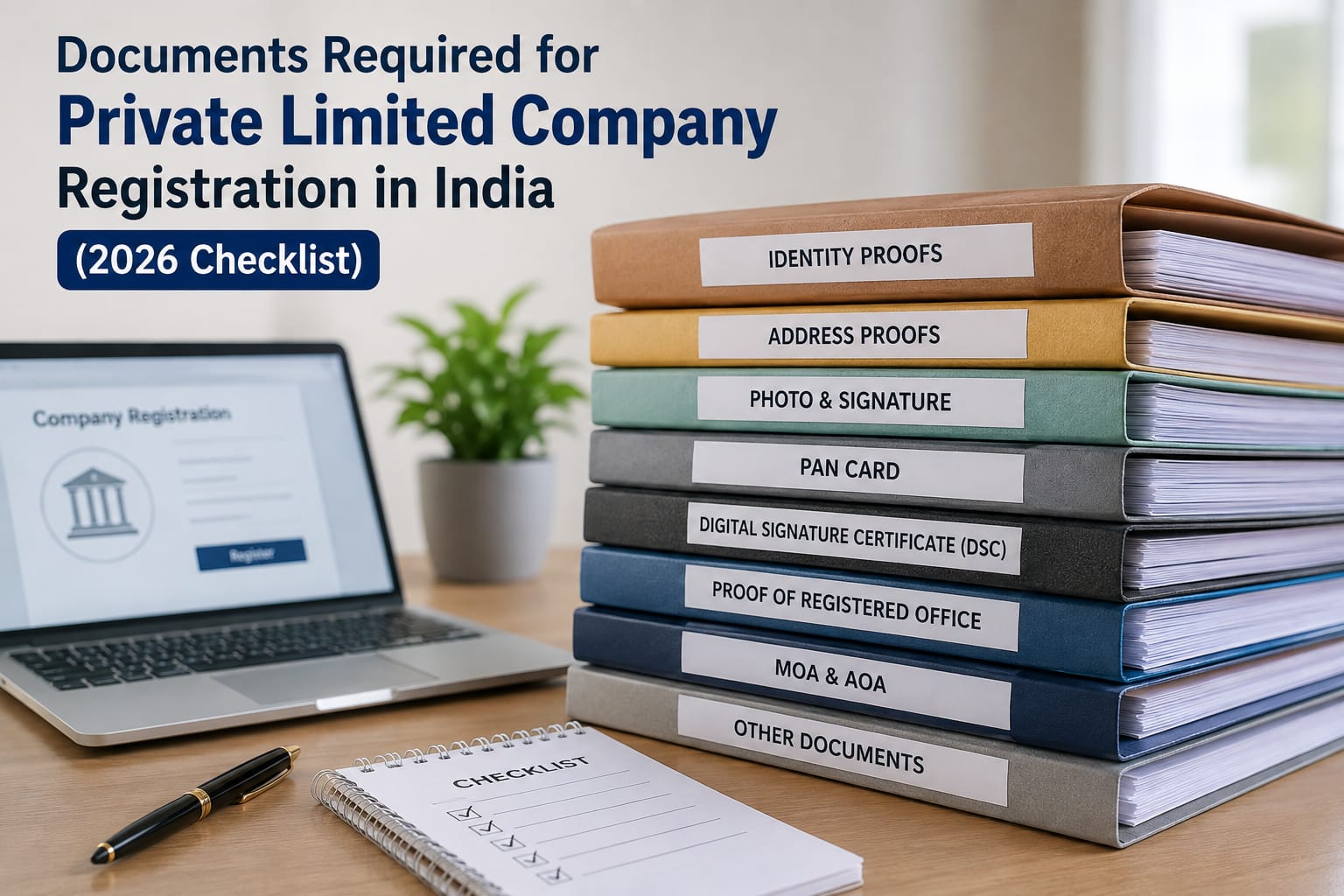
Starting a company in India is exciting, until you’re staring at a checklist of PAN cards, utility bills, DSCs, and forms with names like INC-9 and INC-33 that mean nothing to a first-time founder. Here’s the problem: the Ministry of Corporate Affairs (MCA) doesn’t give you much room for error. A mismatched address, an expired utility bill, or a missing declaration can push your incorporation timeline back by weeks and cost you a non-refundable stamp duty payment.
The good news is that documents required for Private Limited Company registration fall into a handful of predictable categories, and once you know what they are, gathering them is straightforward. Every document you submit is verified against your PAN, Aadhaar, and address records, so the real skill isn’t collecting paperwork, it’s making sure everything matches perfectly before you file.
What Is Private Limited Company Registration?
Private Limited Company registration is the legal process of incorporating a business as a separate legal entity under Section 3 of the Companies Act, 2013, through the SPICe+ form on the MCA portal, resulting in a Certificate of Incorporation issued by the Registrar of Companies.
A Private Limited Company (Pvt Ltd) is the most widely chosen structure for startups and growing businesses in India because it offers limited liability, a separate legal identity, and easier access to funding compared to a proprietorship or partnership.To register a Private Limited Company in India, you must submit specific identity proofs, address proofs, registered office documents, and statutory forms to the Ministry of Corporate Affairs.
Did You Know? A Private Limited Company can be incorporated with just two directors and two shareholders, and the same two people can hold both roles, meaning a company can technically be set up by just one individual acting in both capacities (except in an OPC, where different rules apply).
SPICe+: The Single Window for Incorporation
SPICe+ (Simplified Proforma for Incorporating Company Electronically Plus) is the MCA’s integrated web-based form that combines name reservation, incorporation, DIN allotment, PAN, TAN, GSTIN, EPFO, ESIC, professional tax, and bank account opening into a single application.
Company incorporation runs entirely through SPICe+, the integrated web form on the MCA V3 portal, and it bundles ten services into one application: company registration, name reservation, incorporation, DIN allotment, PAN, TAN, GSTIN, EPFO, ESIC, profession tax and bank account opening. This means the documents you gather aren’t just for incorporation; many of them are simultaneously used to set up your company’s tax and statutory registrations.
Documents Required for Directors and Shareholders
Every proposed director and subscriber (shareholder) must submit identity, address, and residency proof. Indian residents and non-residents have slightly different requirements.
For Indian Nationals (Directors and Shareholders)
| Document Type | Accepted Documents | Key Requirement |
| Identity Proof | PAN Card (mandatory) | Details must exactly match all other documents |
| Address Proof (ID) | Aadhaar Card, Voter ID, Passport, or Driving Licence | Any one government-issued ID |
| Residential Address Proof | Latest bank statement, electricity bill, telephone bill, or mobile bill | Must not be older than 2 months |
| Photograph | Recent passport-size colour photo | Clear background, self-attested |
| Contact Details | Unique email ID and mobile number per person | Required for OTP verification during filing |
| Digital Signature Certificate (DSC) | Class 3 DSC | Mandatory for signing SPICe+, e-MOA, e-AOA electronically |
| Director Identification Number (DIN) | Auto-allotted through SPICe+ for up to 3 directors | Additional directors need Form DIR-3 |
All directors are required to hold a Class 3 DSC for signing MCA filings electronically, and it must be obtained from an MCA-authorised Certifying Authority such as eMudhra, Sify, or NSDL before filing SPICe+, the form cannot be submitted without valid DSCs of all directors.
For Foreign Nationals and NRI Directors/Shareholders
Foreign participation adds a layer of authentication that Indian applicants don’t need.
| Document Type | Requirement |
| Passport | Mandatory as primary identity proof |
| Address Proof | Proof from country of residence (utility bill, bank statement, or government ID) |
| PAN | Existing PAN or PAN application filed simultaneously |
| Notarisation/Apostille | All foreign documents must be notarised or apostilled by the Indian Embassy/Consulate in the applicant’s country |
Self-attested foreign documents are rejected, notarization by the Indian diplomatic mission is mandatory under MCA rules for foreign nationals and NRIs.An NRI subscriber without an Indian DSC requires a notarised and apostilled physical declaration, which adds processing time and should be planned for well in advance.
Documents Required for the Registered Office
Every Private Limited Company must have a registered office address at the time of incorporation or within 30 days, under certain conditions, as required under Section 12 of the Companies Act, 2013.
What counts as valid registered office proof?
- Ownership case: Latest utility bill (electricity, gas, or water, not older than 2 months) in the owner’s name
- Rented/Leased premises: Rent agreement or lease deed plus a No Objection Certificate (NOC) from the property owner
- Utility Bill: Must clearly show the complete address matching what is declared in SPICe+
The address proof, electricity, water, gas, or telephone bill, or a bank statement, must not be older than 2 months, and the address must exactly match the address declared in SPICe+. The MCA also accepts both commercial and residential properties as the registered office, which makes it easier for early-stage founders operating from home.
Statutory and Company-Level Documents Filed Through SPICe+
Beyond individual KYC, the company itself requires foundational legal documents. These are drafted, digitally signed, and filed as part of the SPICe+ bundle.
| Form/Document | Purpose |
| e-MOA (Form INC-33) | Memorandum of Association, defines the company’s name, registered state, objects, and liability clauses |
| e-AOA (Form INC-34) | Articles of Association, internal governance rules, share transfer restrictions, board procedures |
| INC-9 | System-generated declaration by directors/subscribers under Section 7(1)(c) |
| DIR-2 | Consent to act as director |
| INC-3 | Nominee consent (only for One Person Companies) |
| AGILE-PRO-S | Combined application for GSTIN, EPFO, ESIC, professional tax, and bank account |
The Memorandum of Association (MoA) and Articles of Association (AoA) are the constitutional documents of the company, and for most standard private limited companies these are executed electronically within the V3 portal, INC-33 (e-MoA) contains the name clause, registered state, objects clause, liability clause, and subscription details signed by each founding member with DSC, while INC-34 (e-AoA) contains internal governance rules including share transfer restrictions, board procedures, quorum, and dividend policy.
Documents Required by Entity Type: A Quick Comparison
| Entity Type | Key Additional Documents |
| Private Limited Company | e-MOA, e-AOA, minimum 2 directors’ and 2 shareholders’ KYC, INC-9 declarations |
| One Person Company (OPC) | Same as Pvt Ltd, but only 1 director and 1 shareholder, plus nominee’s PAN and consent (Form INC-3) |
| LLP | LLP Agreement (filed within 30 days), FiLLiP form, minimum 2 designated partners’ documents |
| Section 8 Company | SPICe+ MoA/AoA with charitable objects clause, subscriber/director declarations, and estimated income-expenditure statement |
Private Limited Company registration requires SPICe+ MoA and AoA with a minimum of 2 directors’ documents, 2 shareholders’ documents, and INC-9 declarations, while an OPC follows the same process but needs only 1 director and 1 shareholder, plus the nominee’s PAN and consent through Form INC-3.
Government Fees and Stamp Duty
Government filing fees depend on your authorised share capital, while stamp duty depends on your state of incorporation.
- The MCA charges no form filing fee on incorporation where the authorised share capital does not exceed ₹15 lakh, meaning the core MCA incorporation fee is nil for most early-stage private limited companies.
- Name reservation (SPICe+ Part A): ₹1,000 per submission, with two name proposals allowed in a single submission.
- DIN allotment: Free for up to 3 directors through SPICe+
- PAN and TAN: Bundled with SPICe+ at no additional MCA cost
- Stamp duty: Varies by state, for example, Delhi charges around ₹1,300 for ₹1 lakh authorised capital, while Karnataka can range from ₹3,000 to ₹5,000.
- DSC cost: Typically ₹1,500–₹2,500 per director for a 2-year validity
Registration Timeline
| Stage | Typical Duration |
| DSC issuance | 1–2 working days |
| Name reservation (SPICe+ Part A) | 2–4 working days |
| SPICe+ Part B filing and document upload | 1–2 working days |
| RoC verification and approval | 3–5 working days |
| Total (documents in order) | 5–10 working days |
When documents are complete and accurate, a private limited company can be incorporated within 5 to 7 working days, and delays almost always trace back to document deficiencies or name-related rejections, both entirely avoidable.
Latest News: The MCA has continued refining the MCA21 Version 3 portal through 2026, tightening auto-validation checks on address proof dates and PAN-DSC matching, which means outdated documents are now flagged before submission rather than after, reducing rejection cycles for founders who prepare correctly.
Common Mistakes That Delay Incorporation
- Mismatched names across PAN, Aadhaar, and address proof
- Outdated address proof, utility bills older than 2 months
- Missing NOC when the registered office is rented or family-owned
- DSC-PAN mismatch, the DSC must be registered against the same PAN used in the form
- Unsigned or improperly sequenced digital signatures on INC-9, e-MOA, e-AOA
- Self-attested foreign documents submitted without notarisation/apostille for NRIs
Case Study: A Bengaluru-based two-founder startup had its first SPICe+ application rejected because one founder’s Aadhaar listed a maiden name while their PAN reflected a post-marriage surname. The mismatch triggered an RoC query, delaying incorporation by 12 days. A simple PAN update before filing would have avoided the setback entirely, underscoring why document consistency matters as much as document completeness.
Post-Incorporation Document Reminder
Getting your Certificate of Incorporation isn’t the finish line.Filing INC-20A, the declaration of commencement of business, within 180 days is critical, without it, the company cannot commence business activity, and missing the deadline can lead to strike-off proceedings. The same KYC and address documents you prepared for incorporation will be needed again for GST registration, opening your company’s current bank account, and Udyam (MSME) registration, so keep digital copies organised from day one.
Compliance Checklist Before You File SPICe+
- PAN and Aadhaar of all directors and shareholders, cross-checked for name consistency
- Passport-size photographs of all directors and shareholders
- Address proof not older than 2 months
- Registered office proof (utility bill/rent agreement + NOC)
- Class 3 DSC obtained and linked to correct PAN for every director
- Two proposed company names ready for SPICe+ Part A
- e-MOA and e-AOA objects clause drafted
- Notarised/apostilled documents ready (if any director/shareholder is a foreign national or NRI)
- DIR-2 consent and INC-9 declaration ready for digital signature
Conclusion
Registering a Private Limited Company in India is largely a documentation exercise, and getting it right the first time saves you weeks of back-and-forth with the RoC. From director and shareholder KYC to registered office proof and the statutory e-MOA, e-AOA, and INC-9 filings, every document needs to be accurate, current, and internally consistent under the Companies Act, 2013. Founders who prepare a complete, verified document set before filing SPICe+ typically incorporate within 5–10 working days, while those who don’t often face costly rejections and non-refundable stamp duty losses.
Given how much rides on getting these details right, and how often small mismatches cause big delays, it’s worth having a professional review your documents before you file. This is exactly where Zolvit’s incorporation experts add value.
Why Choose Zolvit?
- Expert lawyers and Company Secretaries who review every document before filing
- CA support for capital structuring and stamp duty planning
- Fast processing with pre-verified SPICe+ applications to avoid RoC objections
- Affordable, transparent pricing, no hidden professional fees
- End-to-end compliance, from incorporation to GST, Udyam, and post-incorporation filings
- Dedicated support at every stage of your registration journey
Ready to register your Private Limited Company without the paperwork stress?
Consult a Zolvit expert today for end-to-end incorporation support, from document verification to your Certificate of Incorporation.
FAQs
1. Can a Private Limited Company be registered with just two people?
YES. A Private Limited Company needs a minimum of 2 directors and 2 shareholders, and the same two individuals can hold both roles simultaneously, making it possible for two co-founders to incorporate together.
2. Is a registered office required at the time of incorporation?
YES. Under Section 12 of the Companies Act, 2013, every company must have a registered office capable of receiving official communication, verified through a recent utility bill or rent agreement with NOC.
3. Can incorporation documents be self-attested for foreign directors?
NO. Documents from foreign nationals or NRIs must be notarised or apostilled by the Indian Embassy/Consulate in their country of residence; self-attested foreign documents are rejected by the MCA.
4. What is the validity period for address proof documents?
Address proof such as utility bills or bank statements must not be older than 2 months from the date of filing SPICe+, and must exactly match the address declared in the form.
5. Is a Digital Signature Certificate mandatory for all directors?
YES. A Class 3 DSC is mandatory for every proposed director and subscriber to digitally sign SPICe+, e-MOA, e-AOA, and related declarations; the application cannot be submitted without it.
6. What happens if my company name gets rejected during SPICe+ Part A?
If your proposed name is rejected, you can resubmit with a fresh name proposal, though this may involve an additional ₹1,000 filing fee; choosing a distinctive, compliant name upfront avoids this delay.
7. How long after incorporation must a company start business?
A company must file Form INC-20A (declaration of commencement of business) within 180 days of incorporation; failure to do so can lead to penalties and eventual strike-off by the RoC.
