

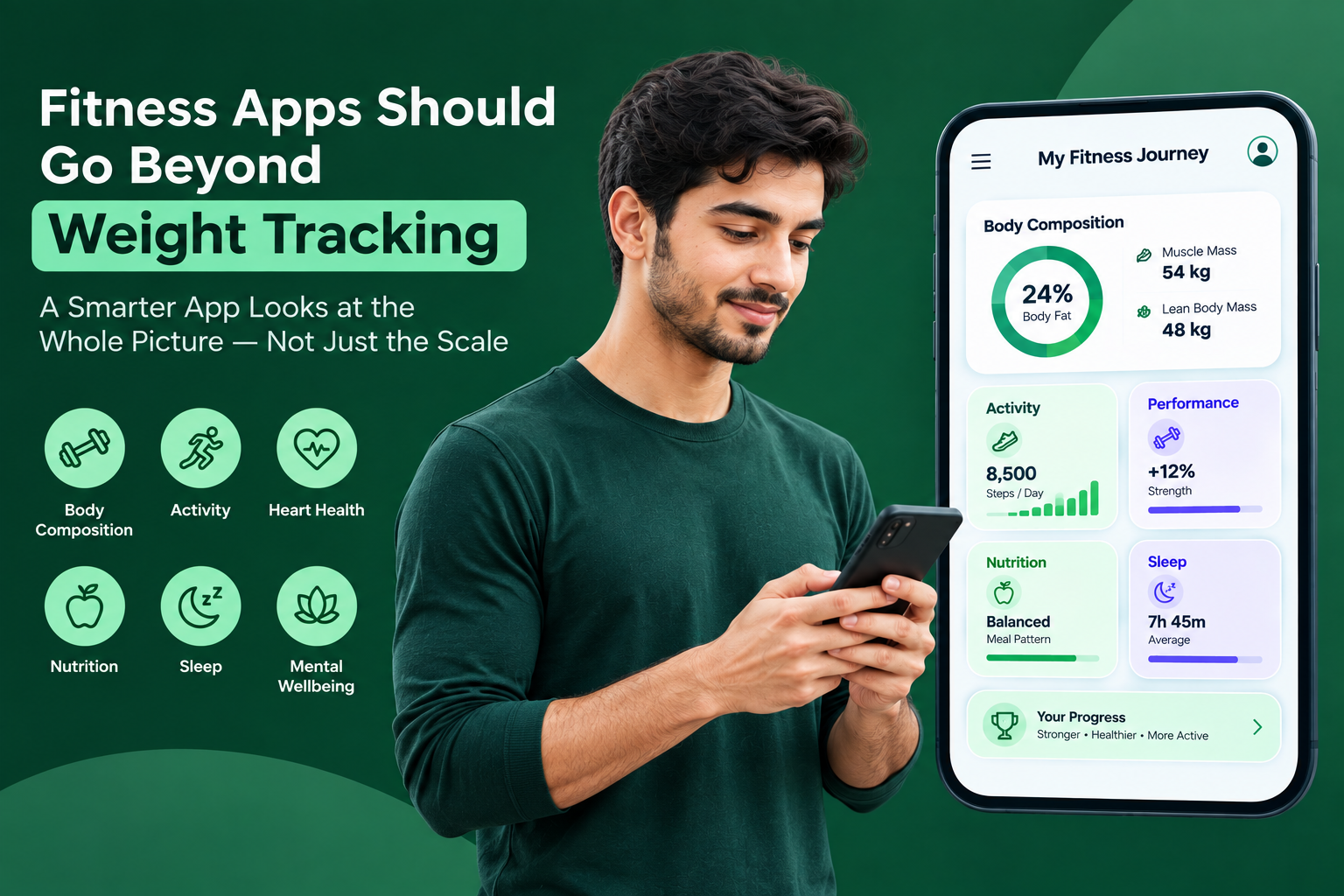
For years, weight has been one of the simplest numbers people use to judge their health and fitness progress. Step onto a scale, record the result, and compare it with yesterday, last week, or last month. Modern fitness apps have made this process even easier by turning weight measurements into charts, trends, targets, and reminders.
But there is a problem with treating weight as the main indicator of progress: body weight tells only part of the story.
A person can become stronger without losing weight. Someone can lose body fat while maintaining a similar number on the scale. Daily weight can also fluctuate because of hydration, meals, sodium intake, hormones, and other temporary factors.
As fitness technology becomes more sophisticated, apps have an opportunity to move beyond simply asking, “What do you weigh?” The next generation of digital fitness tools should help users understand a broader picture of health, fitness, and physical progress.
Weight Is Useful, But It Needs Context
Weight is not an irrelevant measurement. Tracking it over time can help people identify long-term trends and understand whether their current habits are producing changes.
The problem occurs when a single measurement becomes the definition of success.
Imagine someone who begins strength training while improving their diet. Over several months, they may lose some body fat while gaining muscle. Their appearance, strength, endurance, and overall fitness may improve considerably, even if their weight changes very little.
A fitness application that displays only the scale reading could make that person believe their efforts are failing.
A better application would place weight alongside other meaningful indicators.
BMI Can Provide a Starting Point
One metric that can add useful context is body mass index, commonly known as BMI. It uses height and weight to produce a numerical value that can be compared with commonly used BMI categories.
For someone beginning a fitness journey, calculating BMI can provide a simple baseline. Users can then monitor how their measurements change over time instead of relying exclusively on individual weigh-ins.
Resources such as a tabla de peso ideal can also help users understand how height and weight are commonly considered together. However, these reference ranges should be treated as general guidance rather than a personalized diagnosis.
BMI has limitations. It does not directly measure body fat, distinguish muscle from fat, or explain where fat is distributed throughout the body. That is why a well-designed fitness app should present BMI as one piece of information rather than the final verdict on someone’s health.
Body Composition Adds Another Layer
Two people can have the same height and weight while having very different proportions of muscle and body fat.
This is where body composition becomes important.
Depending on the available technology, fitness platforms can incorporate measurements or estimates related to:
- Body-fat percentage
- Muscle mass
- Lean body mass
- Visceral fat estimates
- Waist circumference
- Hydration levels
These measurements are not equally accurate across every device or method, so apps should clearly explain how data is collected and avoid presenting estimates as absolute facts.
Nevertheless, giving users access to multiple indicators can provide a more informative picture than weight alone.
Fitness Performance Should Be Part of the Dashboard
Physical performance is another area where fitness apps can improve.
Consider someone who can initially walk for 20 minutes but, after several months, can comfortably complete a 60-minute session. Their weight may have changed only slightly, yet their cardiovascular endurance has improved substantially.
Similarly, someone might:
- Lift heavier weights
- Complete more repetitions
- Walk or run farther
- Recover faster between exercises
- Increase daily activity
- Improve mobility and flexibility
These are meaningful forms of progress.
A sophisticated fitness app could therefore track performance alongside body measurements. Instead of presenting users with a single “success” number, it could show how different aspects of their fitness are developing.
Daily Activity Is More Informative Than a Single Weigh-In
Wearables and smartphones already make it possible to collect large amounts of activity data.
Steps, walking distance, active minutes, exercise sessions, and other activity indicators can reveal patterns that a scale cannot.
For example, an app might show that a user’s weight has remained relatively stable while their average daily activity has increased significantly over several months.
That distinction matters.
Rather than encouraging users to react emotionally to every change on the scale, the application can help them recognize long-term behavioral trends.
Nutrition Tracking Should Focus on Patterns
Many fitness applications also include food and calorie tracking. This can be useful, but the goal should not be to overwhelm users with numbers.
Instead, apps can help people identify broader patterns, such as:
- Consistency of meals
- Protein and fiber intake
- Fruit and vegetable consumption
- Hydration habits
- Frequency of highly processed foods
- Relationship between nutrition and training
The best digital tools should make information easier to understand rather than creating unnecessary complexity.
A person trying to improve their health does not necessarily need hundreds of data points. They need the right information presented in a way they can actually use.
Progress Should Be Measured Over Time
One of the biggest weaknesses of weight-focused tracking is the emphasis on short-term changes.
Body weight can naturally move up or down from one day to another. A single measurement may therefore tell users very little about their long-term progress.
Fitness apps can solve this problem through trend-based reporting.
Instead of emphasizing today’s number, an application could highlight:
7-day trends → 30-day trends → 90-day changes → long-term progress
This approach encourages users to focus on consistency.
It also reduces the temptation to interpret every small fluctuation as success or failure.
Personal Goals Should Influence What an App Measures
Not everyone using a fitness application has the same objective.
One person may want to lose body fat. Another may want to gain strength. Someone else may be training for a race, improving cardiovascular fitness, or simply becoming more active.
Therefore, a single dashboard should not treat weight reduction as the universal definition of success.
A better system could ask users about their goals and then prioritize relevant measurements.
For example:
| Goal | Useful indicators |
| General fitness | Activity, exercise frequency, endurance |
| Strength development | Lifting performance, repetitions, training consistency |
| Weight management | Weight trends, BMI, waist measurement, nutrition patterns |
| Endurance | Distance, pace, active minutes, recovery |
| Muscle development | Strength, training volume, body-composition indicators |
This creates a much more personalized experience.
Privacy Should Not Be an Afterthought
The more information fitness applications collect, the more important data privacy becomes.
Health and fitness platforms may store sensitive information about people’s weight, activity, eating habits, exercise routines, and other personal measurements. Users should know what data an application collects, why it collects it, and how that information is stored and shared.
Fitness technology should therefore prioritize transparency alongside convenience.
Clear privacy policies, sensible data controls, secure account systems, and understandable permissions can help users make informed decisions about the services they use.
AI Could Make Fitness Tracking More Useful
Artificial intelligence is also changing how applications interpret personal data.
Instead of simply displaying charts, future fitness platforms could identify meaningful patterns and translate complicated datasets into understandable insights.
For example, an application might recognize that a user’s activity has gradually increased while their strength has improved, even though their weight has remained relatively stable.
Rather than saying, “Your weight hasn’t changed,” a more intelligent system could explain that several other indicators are moving in a positive direction.
However, AI-powered fitness features should be careful not to cross the line into unsupported medical conclusions. Technology can help users understand their data, but it should not replace qualified medical or fitness professionals when professional assessment is necessary.
The Future of Fitness Tracking Is Multidimensional
The future of fitness technology should not be about collecting the largest possible amount of data. It should be about collecting useful data and putting it into context.
Weight will remain a valuable measurement. BMI can provide a convenient starting point. Activity, body composition, nutrition, exercise performance, sleep, and other indicators can add further context.
The real opportunity for fitness apps is to connect these measurements into a clearer picture of progress.
When technology moves beyond the scale, users can begin to see fitness as something broader than a number. Progress can mean becoming stronger, moving more, improving endurance, developing healthier habits, or becoming more consistent.
That is ultimately what smarter fitness technology should do: turn numbers into understanding, and understanding into sustainable action.
