

When an aerospace or medical engineer specifies ±0.001 mm on a drawing, they demand a capability only a fraction of CNC shops can reliably hold. Achieving it requires temperature-controlled environments, stable multi-axis machines, and rigorous in-process inspection. For procurement professionals and design engineers, understanding how tight tolerance CNC precision parts drive cost is the first step toward accurate budgeting — and avoiding expensive rework or delivery delays.
Takeaways:
- Apply ±0.001 mm only on critical mating surfaces
- Material selection is the biggest cost driver—aluminum and brass are most economical
- Avoid sharp internal corners and thin walls to reduce machining complexity
- Certification (AS9100D, ISO 13485) proves repeatable capability
- Budget 1.5–3× higher cost compared to standard ±0.1 mm tolerances
- Engage suppliers early for DFM review to optimize design and cost
| Quick Fact | Detail |
| Required tolerance | ±0.001 mm (5 microns / 0.0002 in) |
| Key certifications | AS9100D, ISO 13485, IATF 16949 |
| Common materials | Al 6061, SS 304/316, Ti Grade 5, PEEK, Brass |
| Typical part types | Impellers, valve bodies, surgical instruments, housings |
| Dominant industries | Aerospace, medical, automotive, semiconductor |
| Surface finish range | Ra 0.4–0.8 µm |
Why ±0.001 mm Tolerances Matter
Not every part needs sub-micron precision. But when a component seals fluid, interfaces with a精密 assembly, or rotates at high speed, ±0.001 mm is the difference between reliable function and field failure. In aerospace, a turbine blade profile dictates engine efficiency. In medical implants, geometry determines osseointegration. In semiconductor equipment, 0.01 mm of drift ruins an entire wafer batch. These are applications where high precision parts are non-negotiable.
Industries Driving Tight Tolerance Demand
Aerospace and Defense
Components must withstand extreme thermal and mechanical loads. AS9100D certification mandates statistical process control (SPC) and full traceability — prerequisites for holding ±0.001 mm repeatably. Typical parts: fuel nozzles, actuator housings, landing gear components.
Medical Devices
ISO 13485 requires validated processes, cleanroom workflows, and material lot traceability. Surgical drills, bone screws, and implant housings routinely call for 5-micron tolerances.
Automotive and EV
The EV shift has increased demand for precision-machined battery terminals, cooling plates, and rotor shafts. IATF 16949 ensures defect prevention and zero-PPM targets.
Materials That Hold ±0.001 mm
Material choice directly impacts machinability and cost. Aluminum 6061-T6 offers excellent stability at lower cost. Stainless 304/316 work-hardens during cutting, requiring rigid setups. Titanium Grade 5 delivers high strength-to-weight but is challenging to machine. PEEK and Ultem are engineering thermoplastics needing sharp tooling to avoid deflection. Brass and copper alloys excel for electrical connectors with fine features.
Certifications That Guarantee Capability
Not every shop is qualified for tight tolerance CNC precision parts at scale. A shop’s certification stack tells you what systems they operate under:
- ISO 9001:2015: Baseline quality management for commercial work.
- AS9100D: Aerospace — adds FOD prevention, risk management, and first-article inspection (AS9102).
- ISO 13485: Medical — requires CAPA, sterilization management, and regulatory compliance.
- IATF 16949: Automotive — emphasizes SPC, MSA, and PPAP.
MetalworksPlus holds all four, meaning a single supplier serves aerospace, medical, automotive, and commercial programs under one quality system.
Material vs. Tolerance vs. Application Reference
The table below maps materials against achievable tolerances, applications, and relative cost. Use it when selecting material for your next high precision parts project.
| Material | Achievable Tolerance | Machinability | Typical Application | Cost vs. Al |
| Aluminum 6061-T6 | ±0.001 mm | Excellent | Brackets, housings | 1.0× (baseline) |
| Stainless 304 | ±0.008 mm | Good | Medical instruments | 1.5–1.8× |
| Stainless 316L | ±0.008 mm | Good | Implants, marine | 1.8–2.0× |
| Titanium Grade 5 | ±0.001 mm | Fair | Aerospace structural | 2.5–3.5× |
| PEEK | ±0.010 mm | Fair | Medical, electrical | 1.3–1.5× |
| Brass C360 | ±0.001 mm | Excellent | Connectors, valves | 0.9–1.1× |
| Inconel 718 | ±0.008 mm | Poor | Turbine components | 4.0–6.0× |
The takeaway: material machinability and cost are inversely correlated. Aluminum and brass are the most forgiving at ±0.001 mm, while superalloys can multiply cycle time 4–6×. Choosing a machinable material — when functionally acceptable — is the single most effective cost-control lever.
The CNC Process for 5-Micron Precision
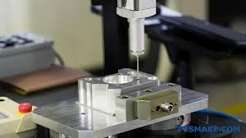
Holding ±0.001 mm is a systems-level achievement. High-speed 5-axis machining centers with linear scales and thermal compensation are essential. Precision-ground tooling, custom workholding, and temperature-controlled coolant manage thermal expansion. At MW+, the 60+ machine facility includes dedicated temperature-controlled bays held at 20°C ±1°C to prevent expansion during long cycles.
Key Cost Drivers at ±0.001 mm
A typical 5-micron part costs 1.5–3× more than the same part at ±0.1 mm.
| Cost Driver | Impact at ±0.001 mm |
| Cycle time | 30–60% longer (more passes, slower feeds) |
| Inspection | CMM per part, not per batch |
| Scrap risk | Higher — one bad feature can scrap the part |
| Machine capability | Requires maintained, calibrated CNC equipment |
| Tool wear | Tools changed more frequently |
| Setup time | Extended — first-article approval required |
How to Budget for High Precision Parts
Specify tolerances only where needed. Apply ±0.001 mm on mating surfaces only; use general tolerances (ISO 2768-m) elsewhere. Choose the right material — aluminum at ±0.001 mm costs a fraction of titanium at the same tolerance. Design for manufacturability by avoiding sharp internal corners and thin walls under 0.5 mm. Use a qualified supplier with AS9100D and ISO 13485 to hold tolerance predictably and reduce surprise costs.
Metalworks Plus – Precision Manufacturing & CNC Machining Expert
MW+ is a precision manufacturing company specializing in high-quality CNC machining and custom metal fabrication solutions from prototype to full-scale production. Founded in China, the company combines advanced technology with rigorous quality control to serve industries such as aerospace, automotive, medical, electronics, and industrial equipment.
💡 Learn more: https://metalworksplus.com
Services
- CNC Machining Services – full‑service precision machining
- Multi‑Axis Machining – 3/4/5‑axis milling
- Micro‑Machining Services – ultra‑fine tolerances
- Swiss Machining – Swiss turning for slender parts
- CNC Milling Services – complex contours & surfaces
- CNC Turning Services – cylindrical & tapered profiles
- Electric Discharge Machining – EDM for hardened steels
- Laser Cutting Services – high‑speed sheet cutting
- CNC Prototyping – rapid prototyping in days
- Machine Parts Manufacturing – custom structural & functional parts
Products
- CNC Precision Parts – tight‑tolerance components
- Connector & Machined Pins – custom pins for assemblies
- Machine Parts – housings, brackets, shafts, gears
FAQ
What is ±0.001 mm in inches?
- ±0.001 mm equals ±0.0001 inches — roughly 1/5 the thickness of a human hair.
Can ±0.001 mm be held on all materials?
- No. Aluminum, brass, and steel hold routinely. Superalloys like Inconel typically need a slightly looser band.
How do I verify a supplier’s capability?
- Ask for their CMM Gauge R&R study and a sample first-article inspection report per AS9102 or equivalent FAI.
What surface finish is expected?
- Typically Ra 0.4–0.8 µm. Rougher finishes can mask dimensional measurement.
Does tighter tolerance always cost more?
- Generally yes — but the premium depends on geometry, material, and quantity. A simple aluminum shaft may cost only 20% more; a complex titanium housing could be 3× more.
What is the typical lead time?
- 2–4 weeks including first-article inspection. Rush service may be available for qualified shops with existing process data.
Tight tolerance CNC precision parts at ±0.001 mm demand the right equipment, certification, and process discipline — but they don’t have to break your budget. By specifying tolerances surgically, choosing machinable materials, and partnering with a certified manufacturer like MetalworksPlus, you get reliable precision without paying for unnecessary margin. Upload your CAD file for a free DFM review and quote at metalworksplus.com — no minimum order quantity required.
