

Many Windows users start with an English interface simply because it is the default on first launch. Later, they may prefer Chinese once the application becomes part of daily work.
Common reasons are practical rather than technical:
- privacy settings become easier to understand;
- family or colleagues use Chinese terminology;
- Chinese menus improve daily usability;
- onboarding documentation is written in Chinese.
In most cases this should be treated as a settings change, not as a reason to replace a working desktop installation.
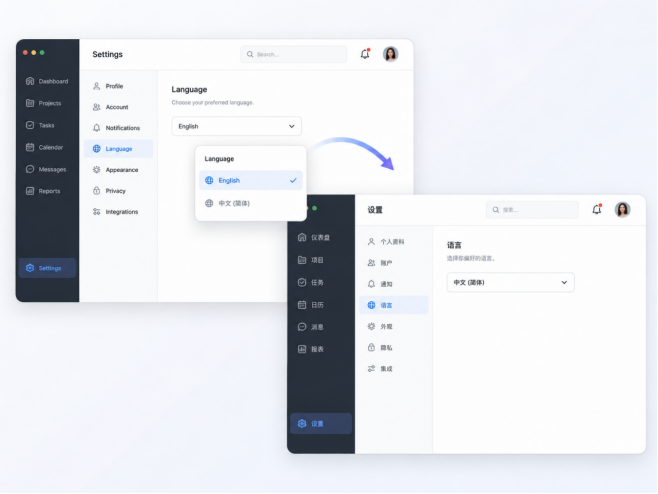
Check the Language Menu Before You Reinstall Anything
If the current Windows client opens normally and updates normally, the first question is whether Chinese is already available in its settings.
Reinstalling adds variables that have nothing to do with language:
- different versions;
- lost preferences;
- changed download directories;
- new session authentication.
When the interface can be changed in place, keeping the existing installation is usually the cleaner option.
Record the Current Windows Setup First
Before changing the interface, note a few things that make it easy to confirm nothing else moved:
- current client version;
- current login status;
- active device;
- download directory;
- notification preferences.
For a business PC, the download folder and startup behavior are particularly worth recording.
Change the Interface, Not the Download Source
A search such as Telegram中文用户Windows安装指南 often reflects a practical goal: keep using the Windows client while making the interface easier for a Chinese-speaking user.
If the same supported Windows client is already installed, a separate “Chinese edition” is often unnecessary.
A more controlled migration is:
Existing supported client
↓
Open settings
↓
Change language
↓
Restart if needed
↓
Verify workflow
This keeps the original installer and update chain intact while changing only the user-facing language.
Choose Between Simplified and Traditional Chinese
The most comfortable option depends on region, personal habit and the terminology used by the user’s team.
The appropriate option may depend on:
- region;
- personal habit;
- For Hong Kong and Taiwan users, Traditional Chinese is often the first option to test; bilingual workplaces may still prefer English menus with Chinese input.
The best choice is the one in which privacy, storage and security settings are easiest to understand.
Relearn the Important Menu Labels, Not the Whole App
After the switch, find the few sections you are likely to need during troubleshooting or account review:
- privacy;
- notifications;
- active devices;
- storage;
- language;
- security.
The location may remain the same while labels change.
The layout may be familiar even when the labels are not. Knowing these terms before a problem occurs is more useful than memorizing every menu item.
Chinese Input Comes From Windows Too
Changing the app interface does not automatically configure the Windows IME.
Test:
- message composition;
- search;
- mixed-language text.
If typing fails everywhere on the PC, fix the Windows language/input settings separately from the messaging client.
Use Filenames as a Real-World Test
Open or transfer a few files with Traditional Chinese and mixed English-Chinese names.
Verify:
- filenames;
- upload;
- download;
- local storage.
A language change should not move existing downloads or alter where Windows stores them.
Use the Language Switch as a Privacy Review Trigger
Once the labels are easier to read, take advantage of the moment to review settings that are often left untouched.
Likewise, someone researching 电报英文改中文 may initially care only about the language switch. Once the interface is familiar, it is a good time to confirm privacy and active-device settings too.
That is particularly useful when the same account is used on both a phone and a Windows work PC.
- phone-number visibility;
- profile visibility;
- invitation rules;
- active devices.

Do Not Reset Settings That Already Work
A language migration should not require resetting the account, downloads, notifications or active-device list.
- account;
- downloads;
- notification policy;
- session list.
If a guide tells you to wipe everything simply to change the interface, check whether the client has a supported language option first.
Confirm Updates Still Use the Same Path
After switching languages, the client should continue updating through the mechanism it used before.
The language preference should not create a separate update path.
After a later update:
- open the app;
- verify Chinese remains selected;
- check major settings;
- test notifications.
If a later update changes the language back, restore the preference before looking for a different installer.
One Technical Guide Can Support Several Interface Languages
Teams in Hong Kong and Taiwan often work across English and Traditional Chinese. They do not necessarily need separate technical environments for each language.
- English;
- Simplified Chinese;
- Traditional Chinese.
Instead of maintaining entirely separate technical environments, create one core guide and add language notes.
This keeps:
- installer;
- update policy;
- security requirements;
Keeping the installer, update policy and security requirements identical makes support much easier.
A Safe Language-Migration Checklist
Before
- Client functioning normally
- Version recorded
- Download directory known
Change
- Open language settings
- Select Chinese
- Restart if needed
Test
- Menus
- Chinese typing
- Filenames
- Search
- Notifications
Security
- Privacy settings reviewed
- Sessions checked
Later
- Confirm updates remain normal
- Recheck language after major releases
Final Notes
Moving a working Windows messaging client from English to Chinese should usually be a small, reversible configuration change.
The clean approach is:
keep the trusted client and update path, change the interface language, then test the workflows you actually use.
That gives Chinese-speaking users a more comfortable Windows environment without adding another software distribution to maintain.
