

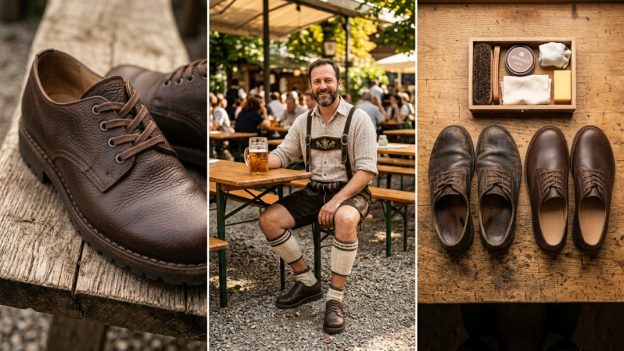
Most festival outfits are researched from the waist up and improvised from the ankle down — which is backwards, because the traditional outfit’s footwear isn’t a vague “sturdy shoes” suggestion but a specific, named, centuries-developed design. Lederhosen shoes proper are the Haferlschuhe: the side-laced Alpine work shoe of Bavaria and the mountain regions, with its own anatomy, its own working history, and its own claim to being one of the most quietly influential shoe designs in the world. Knowing the shoe changes the whole outfit’s ground floor — what to look for, what to pay for, and why the traditional pairing works. This guide is the shoe explained in full: the anatomy that defines it, the working history that shaped it, the pairing system with the traditional outfit, the modern buying screen, and the ownership arc a genuine pair runs.
The Anatomy: What Makes a Haferl a Haferl
The design is recognizable at a glance once its signatures are named. The side lacing: the defining feature — lacing set off-center toward the outside of the foot rather than down the instep’s center, the asymmetric closure no other major shoe tradition shares. The cut: a sturdy derby-style low shoe with a generous, foot-shaped last — built for standing and walking days, not fashion-narrow. The leather: thick full-grain uppers, classically in dark browns and blacks, often with decorative perforation or stitching along the quarter. The sole: the grounded Alpine standard — substantial leather or leather-and-rubber construction, welted on the quality tier for the resoleable decades the mountain traditions built everything toward. And the details: metal eyelets, robust stitching visible at the seams, and on traditional builds the subtle ornamentation that ties the shoe to the Trachten wardrobe above it.
The anatomy’s summary: the Haferl is a work shoe elevated by craft — every signature traces to function first, which is the next section’s story.
The Working History: Why the Shoe Is Shaped This Way
The design’s oddities are all answers to the mountain workday. The side lacing’s origin, in the tradition’s telling: protection and practicality — moving the closure off the instep’s top kept laces clear of the wear, water and impact the foot’s centerline takes in field and forest work, and left a smooth leather face over the instep. The generous last: feet that stood and climbed all day, in wool socks, needed room — the anti-fashion fit that modern standing-day wearers rediscover gratefully. The grounded sole: mountain terrain wrote the specification — grip, substance and resoleability — the same working-sole logic that kept the design honest while urban shoes chased slimness. And the shoe’s climb from farm to festival mirrors the whole Trachten story: workwear preserved into pride, codified into the traditional outfit, and worn today at every Alpine occasion — the living-history arc that makes the Haferl the outfit’s ground-floor equivalent of the leather trousers above it.
The Pairing System: The Outfit’s Ground Floor
Within the traditional outfit, the shoe runs a fixed system. The classic configuration: dark brown or black haferlschuhe beneath wool knee socks (cream, grey or loden, folded below the knee) beneath the leather trousers — the three-part leg system every tent reads, with the shoe’s dark leather grounding the outfit’s whole palette. The register scaling: the standard Haferl serves festival through smart occasions; polished dark builds carry the formal Trachten register beside Bundhosen and Janker; and the tradition’s boot cousins take the weather end. The color law: the shoe joins the outfit’s leather family — matched or deeper than the trousers’ tone, in the leather-harmonizing rule the whole wardrobe runs. And the modern liberty, placed honestly: clean minimal sneakers pass at casual festivals in the relaxed builds — but never beneath wool knee socks, the one combination every register refuses, and never in the rooms where the traditional standard runs full.
The system’s payoff is the outfit’s finish: the correctly grounded build reads complete from any distance — which is exactly what the improvised-ankle outfit never quite does.
The Modern Buying Screen
The genuine article screens by the shoe-quality standard with Haferl specifics. Construction: welted or properly stitched builds on the investment tier (resoleable — the decades economics), quality cemented builds at the honest middle, with visible stitching and finished edges separating both from the glued costume tier that borrows the silhouette. Leather: full-grain named, substantial to the hand — the thin-upper tier collapses at the first festival. The lacing check: real side-set eyelets with functional lacing — the costume tier’s decorative fake-lace panels being the category’s fastest tell. The fit method: sized for the wool-sock system it will actually live over (a half-size of room for the traditional legwear), on the generous last the design intends — the standing-day fit, not the fashion fit. And the sole: substance and grip underfoot for tent floors and fairgrounds, with the leather-and-rubber combinations serving the modern festival best.
The price honesty completes it: genuine welted Haferlschuhe cost real-shoe money and serve for many seasons — the same buy-once arithmetic as every floor of the traditional wardrobe.
The Ownership Arc
A genuine pair runs the leather tradition’s full arc, and the habits are short. The break-in: scheduled before the first festival — several home-and-errand wears molding the thick uppers, because new Haferln at a ten-hour standing day is the mistake the design’s comfort reputation gets blamed for. The care rhythm: brush after wear, condition seasonally, polish the formal builds, dry naturally always — full-grain’s standard minutes-per-month. The resoling economy on welted pairs: soles renewed every few festival-seasons of wear at a fraction of replacement, the uppers outlasting several — the mountain workshops’ original ownership model, unchanged. And the arc’s endpoint, which is the tradition’s signature: the decade-old pair, molded and patinated, that has become its owner’s — the ground-floor version of everything the leather wardrobe above it promises.
Frequently Asked Questions
What are the traditional shoes for lederhosen called? Haferlschuhe — the side-laced Alpine work shoe of Bavaria, the outfit’s named, codified footwear.
Why is the lacing on the side? Working origins: the off-center closure kept laces clear of the instep’s wear and water in mountain labor, leaving a smooth protective face.
What do you wear them with? The three-part leg system: Haferl beneath wool knee socks beneath the leather trousers — shoe leather matched to or deeper than the outfit’s family.
How should Haferlschuhe fit? On their generous last, sized over the wool socks they’ll live with — the standing-day fit the design was built around.
How do I spot the costume tier? Fake decorative lacing, thin glued uppers, no construction visible — against real side eyelets, full-grain leather and stitched or welted builds.
Are sneakers ever acceptable instead? Clean minimal pairs at casual festivals in relaxed builds — never beneath knee socks, and never where the traditional standard runs full.
