

Cooling tower material selection depends heavily on the operating environment, not just structural requirements. Factors like coastal air, airborne chemicals, cooling tower water chemistry, operating temperature, and maintenance capacity all determine which cooling tower construction materials will last and which will fail prematurely.
Corrosion resistance and energy efficiency both play a crucial role in this decision, and getting it right matters across many industries that rely on reliable cooling.
Table of Contents
- Start With the Environment, Not the Material
- Cooling Tower Types and Components That Influence Material Choice
- Coastal Locations Change the Corrosion Equation
- How Salt-Laden Air Affects Cooling Tower Structures
- Chemical Processing Plants Create a Different Challenge
- Airborne Chemicals and Process Contaminants
- Water Chemistry Can Be Just as Important as Atmospheric Exposure
- Why Water Treatment and Material Selection Should Be Planned Together
- Hot, Humid, and High-Duty Sites Put Materials Under Constant Stress
- Dust, Debris, and Industrial Air Quality Also Matter
- Environmental Exposure Profile: A 5-Step Decision Framework
- The Right Material Starts With the Right Assessment
- Frequently Asked Questions
Start With the Environment, Not the Material
Specifying FRP, carbon steel, stainless steel, or concrete before completing an environmental assessment creates risk. Each material choice has performance strengths, but those strengths are conditional. They depend on what the structure will actually face during its operating life, and environmental conditions vary widely even between nearby sites.
Before selecting cooling tower construction materials, facilities should build an environmental exposure profile that captures:
- Atmospheric conditions: Coastal proximity, humidity, prevailing wind direction, and airborne contaminant types.
- Water chemistry: Chloride levels, pH range, hardness, dissolved solids, and treatment chemicals.
- Operating duty: Hours per year, thermal load, temperature range, and cycling frequency.
- Maintenance capacity: Available inspection frequency, coating renewal capability, and repair response time.
- Required service life: 10-year project? 30-year asset? The answer changes the material decision significantly.
Cooling Tower Types and Components That Influence Material Choice
The environmental profile above matters differently depending on the cooling tower type you are specifying, since design and construction method both change how exposure actually reaches the various tower components.
- Factory assembled cooling towers: Factory assembled cooling towers arrive largely complete, which limits field welding and joints exposed to the elements compared to site-built units.
- Open circuit cooling towers: Open circuit cooling towers bring the process water into direct contact with outside air, which means every internal surface faces atmospheric exposure directly.
- Closed circuit cooling towers: Closed circuit cooling towers isolate the process fluid inside a coil or heat exchanger, so only the external spray water and casing face the harshest conditions.
- Internal components carry the load: The internal components of the tower, such as the hot water basin, cold water basins, fill media, and drift eliminators, each see different exposure levels, so material selection often varies by part rather than applying one material to the whole structure.
- Water distribution ties it together: The water distribution system spreads cold water across the fill at a specific water flow rate, and that piping network needs the same environmental scrutiny as the tower shell itself.
1. Coastal Locations Change the Corrosion Equation
How Salt-Laden Air Affects Cooling Tower Structures
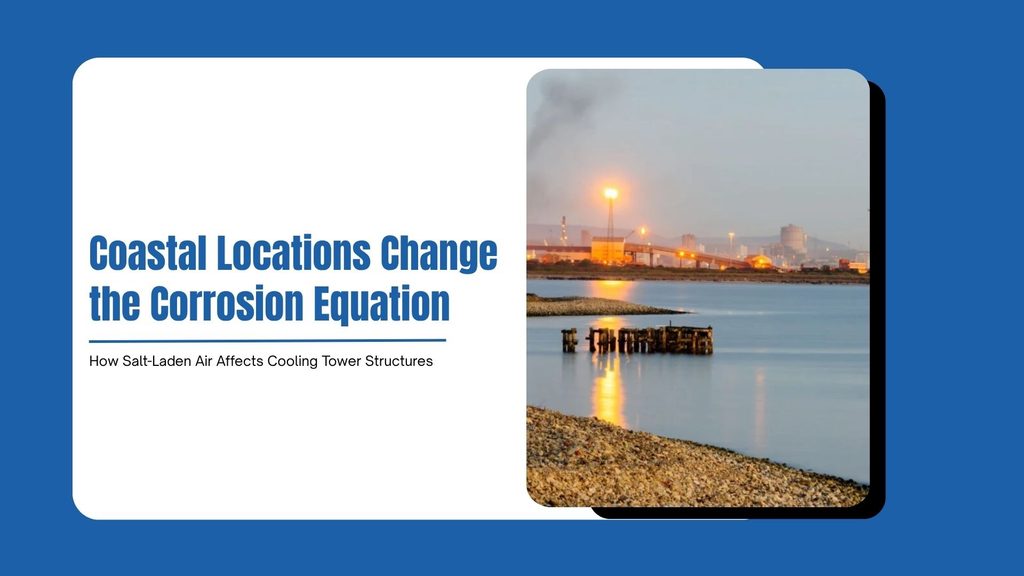
Facilities within several kilometers of a coastline face a fundamentally different corrosion environment than inland sites. Choosing the right cooling tower material becomes critical in these conditions, as salt-laden air deposits chloride ions on exposed surfaces continuously.
Standard galvanized steel often cannot resist chemical attack from this level of chloride exposure without frequent recoating.
Buyers evaluating coastal installations should assess:
- Distance from coastline: Chloride deposition rates increase significantly within 1–5 km of the shore, and wind direction amplifies exposure further.
- Chloride concentration in ambient air: This varies by site and should be measured, not assumed.
- Humidity patterns: High relative humidity accelerates electrochemical corrosion on metallic surfaces.
- Coating maintenance capability: Some materials require regular recoating at coastal sites; facilities must realistically assess whether they can sustain that schedule.
- Required service life: A 25-year design life at a coastal site demands materially different specifications than a 10-year project at the same location.
2. Chemical Processing Plants Create a Different Challenge
Airborne Chemicals and Process Contaminants
Industrial facilities that handle chemical processes introduce a second layer of environmental complexity. Cooling towers at these sites face more than just atmospheric moisture and temperature variation.
They also contend with chemical attack from multiple sources simultaneously, alongside standing water conditions that can encourage biological growth if not managed carefully.
The most damaging contributors at chemical processing sites typically include:
- Chemical vapors: Acid gases, chlorine compounds, and solvent vapors can attack both metallic and composite materials, depending on concentration and exposure frequency.
- Industrial pollutants: Combustion byproducts and process emissions settle on exposed tower surfaces and can accelerate surface degradation over time.
- Treatment chemicals: Biocides, scale inhibitors, and corrosion inhibitors added to the circulating water can themselves affect certain materials if concentrations are not carefully managed.
- Continuous moisture: Wet-dry cycling with chemical-laden water increases stress on coatings, joints, and base materials.
3. Water Chemistry Can Be Just as Important as Atmospheric Exposure
Atmospheric conditions get significant attention in material selection discussions, but the water circulating through the tower can cause equal or greater damage. Cooling tower water chemistry varies widely by water source, geographic region, and treatment program.
Conditions that directly affect material durability include:
- Chloride concentration: High chloride water accelerates pitting corrosion in stainless steel and attacks galvanized coatings.
- pH range: Acidic or highly alkaline water attacks both metallic and cementitious materials through different mechanisms.
- Hardness and scaling tendency: High-hardness water deposits scale on heat transfer surfaces; scale removal methods can damage underlying materials.
- Dissolved solids: Elevated total dissolved solids increase conductivity and accelerate galvanic corrosion at dissimilar metal interfaces.
- Treatment chemicals: Some biocides and scale inhibitors are aggressive toward specific polymers, coatings, or metal alloys.
Why Water Treatment and Material Selection Should Be Planned Together
Water management is frequently treated as an operational concern separate from design and specification. That separation creates risk. Engineers who specify cooling tower construction materials without knowing the anticipated water chemistry may select materials that treatment programs cannot adequately protect.
Planning both together allows the design team to identify conflicts early, choose compatible materials, and develop a treatment program that maintains water quality within the limits the selected materials can tolerate.
4. Hot, Humid, and High-Duty Sites Put Materials Under Constant Stress
High-operating-duty environments apply continuous mechanical and thermal stress on materials that moderate-duty sites never impose. The material stressors specific to these sites accumulate over time:
- Continuous wet conditions: Constant moisture exposure without drying cycles accelerates corrosion and biological fouling.
- High operating temperatures: Elevated temperatures reduce the effectiveness of some coatings and accelerate chemical reactions that degrade polymers or resins.
- Thermal cycling: Repeated heating and cooling induces expansion and contraction stress at joints, connections, and transitions between dissimilar materials.
- Heavy cooling loads: High heat rejection rates increase water flow velocity, which can accelerate erosion-corrosion in piping and distribution components.
Ask one essential question before finalizing any material specification: Will this material still perform reliably after years of continuous exposure to these combined conditions?
Initial purchase price answers a different question entirely. Cooling tower durability under real operating conditions determines the actual cost of the asset over its life, and material choices that minimize downtime typically deliver stronger cost effectiveness than the cheapest option on paper.
5. Dust, Debris, and Industrial Air Quality Also Matter
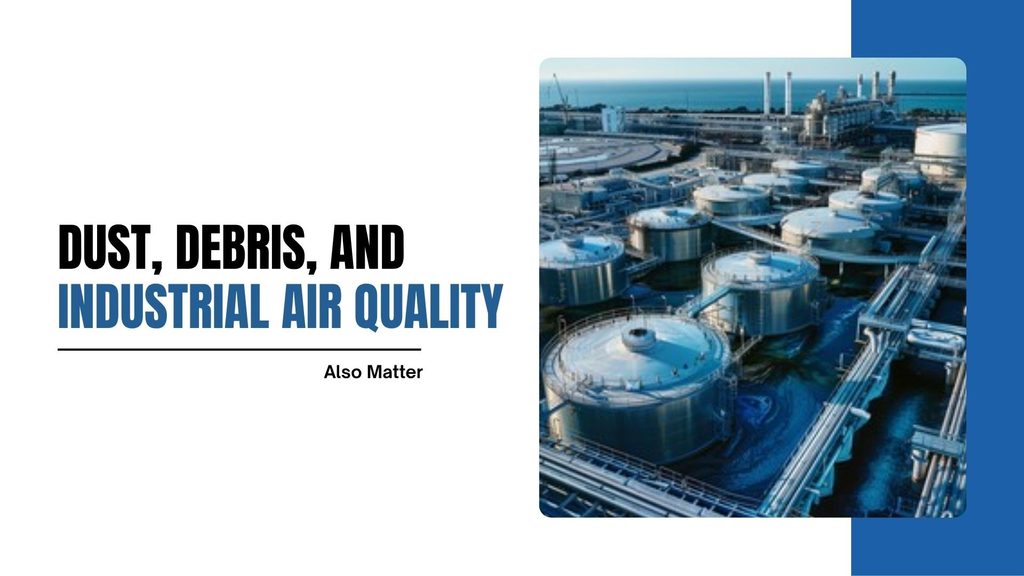
Facilities located near quarrying operations, cement production, agriculture, or heavy manufacturing face elevated levels of airborne particulate that affect cooling tower performance and maintenance requirements.
The environmental assessment should extend beyond temperature and humidity to capture:
- Dust concentration and particle type: Abrasive particles accelerate surface wear; hygroscopic dusts hold moisture against surfaces and promote corrosion.
- Organic debris: Biological material that accumulates in the tower basin increases fouling load and supports microbial growth.
- Nearby industrial emissions: Sulfur dioxide, nitrogen oxides, and other combustion byproducts create acidic conditions on surfaces exposed to moisture.
- Debris accumulation patterns: Sites with high debris loads require more frequent cleaning; materials and coatings must tolerate that maintenance activity without degrading.
Matching materials to these cooling requirements helps ensure optimal performance even at sites where airborne debris complicates routine maintenance.
Environmental Exposure Profile: A 5-Step Decision Framework
| Step | Assessment Area | Key Questions | Why It Matters | Output |
| 1 | Atmospheric Exposure | Coastal? Humid? Chemical? Dusty? | Determines corrosion mechanism and intensity | Site classification (mild / moderate / aggressive) |
| 2 | Water Conditions | Chemistry, pH, chlorides, treatment program | Circulating water can damage materials independently of atmospheric exposure | Water aggressiveness rating |
| 3 | Required Service Life | 10, 20, or 30+ years? | Longer service life demands more durable materials and more robust coatings | Target durability specification |
| 4 | Maintenance Resources | Inspection frequency, coating renewal capability | Available maintenance determines how much protection the material must provide independently | Maintenance capacity rating |
| 5 | Lifecycle Cost | Capital, maintenance, repair, downtime, replacement | Lowest initial cost rarely delivers lowest lifecycle cost | Total cost of ownership estimate |
Completing this framework before material specification gives the design team a structured basis for comparing options rather than defaulting to the lowest upfront price.
The Right Material Starts With the Right Assessment
No single cooling tower material is universally ideal — the right choice depends entirely on your specific site conditions.
Facilities that evaluate atmospheric exposure, cooling tower water chemistry, duty cycle, and service life before specifying materials consistently achieve greater cooling tower durability and lower cooling tower lifecycle cost. Prioritizing upfront price alone routinely leads to accelerated corrosion, unplanned shutdowns, and premature replacement.
Corrosion-resistant cooling towers result from matching material characteristics to actual environmental demands. When industrial cooling tower design follows a structured assessment process, facilities avoid the costly repair cycles that make the cheapest option the most expensive in the long run.
Frequently Asked Questions
What factors affect cooling tower material selection the most?
Atmospheric corrosivity, water chemistry, operating temperature, duty cycle, service life, and maintenance resources are the primary factors. Coastal and chemical plant environments typically impose the most aggressive conditions.
Which cooling tower materials are suitable for corrosive environments?
FRP is widely used in chemically aggressive and coastal environments. Stainless steel performs well in many corrosive conditions but requires careful evaluation where chloride concentrations are high.
How does water chemistry affect cooling tower construction materials?
Aggressive water chemistry accelerates corrosion, pitting, and coating degradation from the inside out. Material selection and water treatment programs should be developed together during the design stage.
Why are coastal environments harder on cooling tower structures?
Coastal environments continuously deposit chloride ions on exposed surfaces. Combined with persistent moisture and humidity, this accelerates metal corrosion well beyond standard atmospheric rates.
Should cooling tower material selection be based on initial cost or lifecycle cost?
Lifecycle cost should always drive material selection. The lowest upfront cost frequently generates the highest total cost over the asset’s life, particularly in aggressive environments.
