

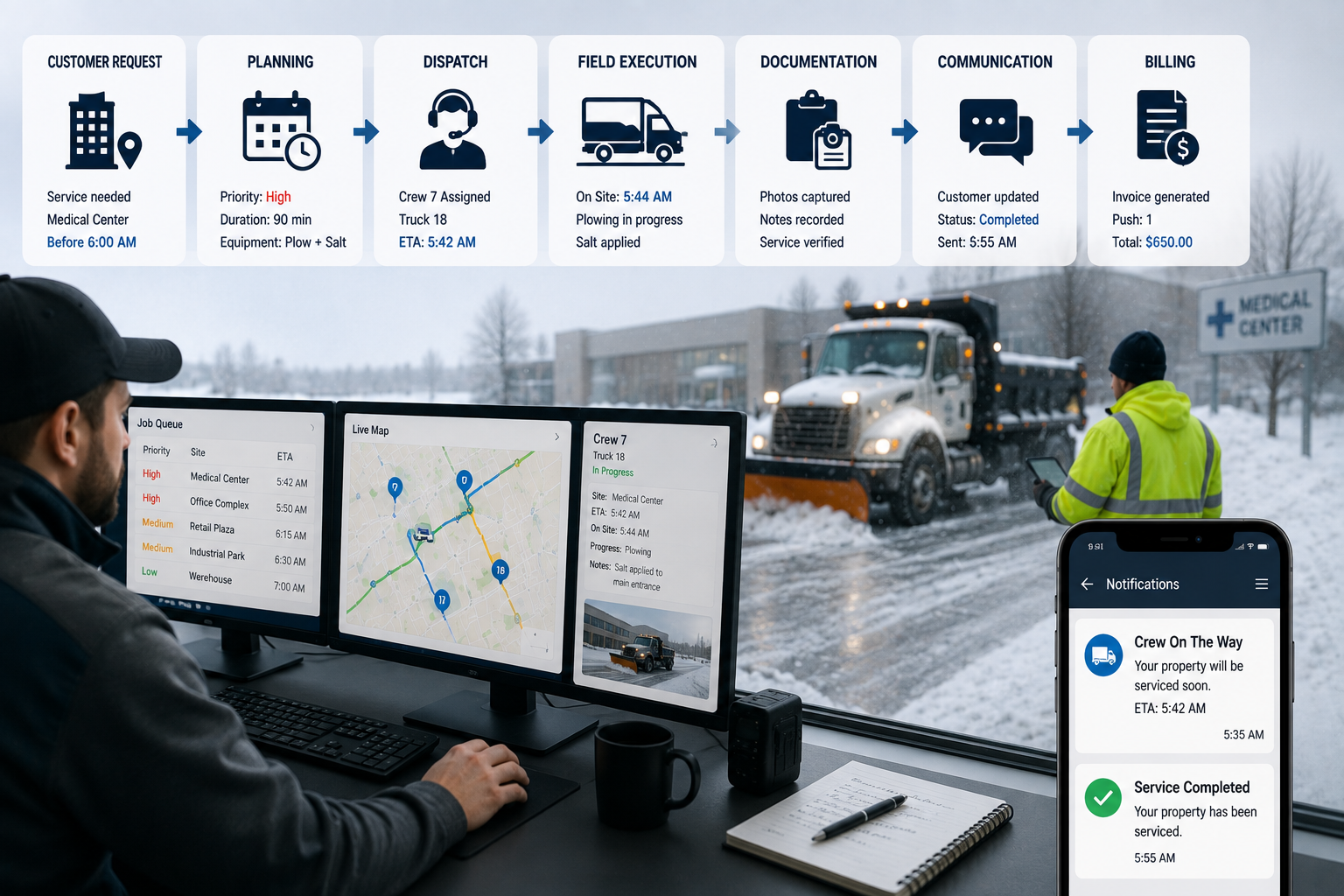
The Customer Never Sees Your Software Stack
At 4:50 a.m., a property manager does not care which routing app found the fastest path to the site.
They care whether the plow arrived.
At 7:15 a.m., they do not care that the contractor owns an excellent CRM. They want to know whether the loading area is complete and whether another visit is scheduled.
Two weeks later, they are not impressed by a sophisticated billing application if nobody can explain why an additional push appears on the invoice.
That is the problem with evaluating snow software feature by feature. Customers experience the operation as one continuous service, even when the contractor manages it through six different applications.
The challenge becomes more obvious with multi-property storm coverage planning. A commercial portfolio may involve different priorities, service windows, crews, equipment requirements, repeat visits, and billing rules. If each part of that information lives somewhere else, the contractor has to continually rebuild the full picture.
A collection of excellent apps can therefore produce an unexpectedly average customer experience.
Disconnected Apps Create Hidden Handoffs
Best-of-breed software has an appealing logic.
Choose the best CRM. Add the best route planner. Pick a specialized fleet tracker. Connect a field app. Use a separate accounting system. Add reporting software.
On paper, every individual decision can look correct.
The weakness appears between the applications.
A customer priority gets updated in the CRM but does not reach the current route. A dispatcher changes an assignment but the customer notification still reflects the original schedule. A field photo exists, yet accounting cannot easily associate it with the billable visit.
Someone eventually fixes these gaps.
Usually a person.
They copy information. Send a message. Update a spreadsheet. Ask a supervisor. Re-enter a note. Confirm something by phone.
That human integration layer rarely appears on a software invoice, but contractors pay for it every storm.
The relevant comparison is therefore not:
Which application has the most impressive feature?
It is:
How many times must information be translated, transferred, confirmed, or re-entered before a service event is finished?
The Best Tool Can Still Lose the Service Story
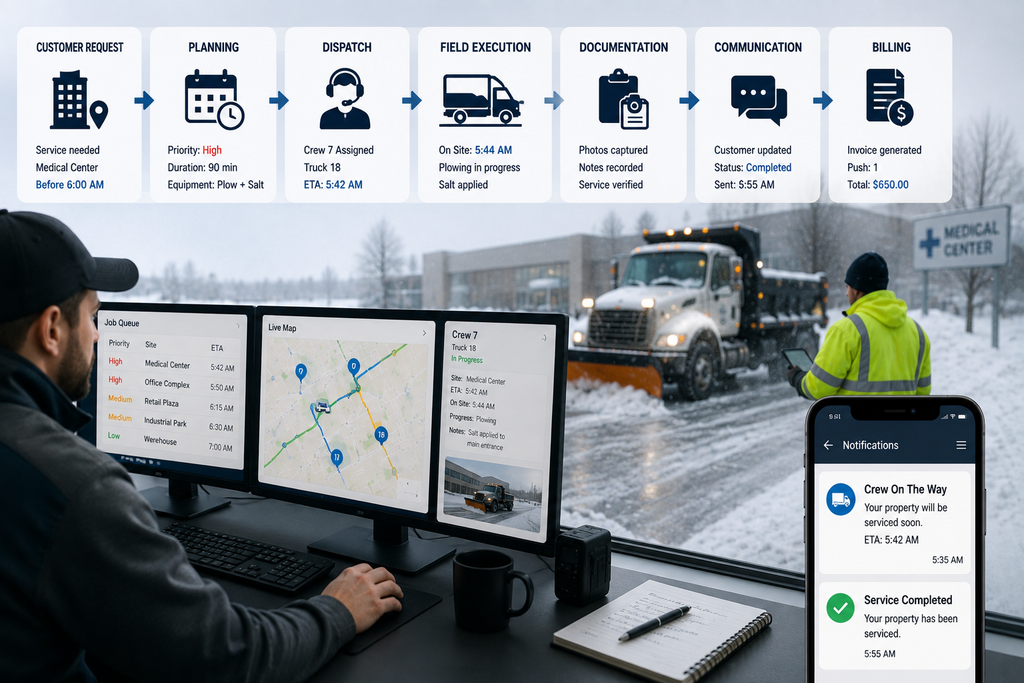
Snow work creates a chain of events. The customer request influences planning. Planning influences dispatch. Dispatch influences the field. Field activity creates documentation. Documentation supports communication and billing.
Break the chain and context begins disappearing.
Arrival Accuracy Starts Before Routing
Consider a contractor promising that a medical property will be serviced before 6:00 a.m.
Route optimization certainly matters.
But so do the customer commitment, property priority, expected service duration, equipment availability, current crew progress, and changing storm conditions.
If the routing tool sees addresses while another system holds the service promises, “optimized” may not mean “on time.”
Arrival accuracy is therefore not purely a routing outcome. It is the product of connected operational information.
Good Communication Requires Current Operations
Customer notifications have the same dependency.
An automated message saying a crew is “on the way” is useful only when it reflects the actual dispatch decision.
A completion notification is valuable only when the work really has been completed.
This is where Service Wand’s platform model becomes relevant. Its approach connects customer information, scheduling, dispatch, routing, field execution, documentation, billing, reporting, and automation on a shared operational foundation.
The important point is not simply having these features in one menu.
It is allowing the same service event to retain its context as it moves through the business.
What an All-in-One Platform Should Actually Connect
Consolidation should not mean buying a giant application simply because it claims to do everything.
A useful snow operations platform should connect the information that naturally belongs together.
For example:
- customer commitments should inform scheduling;
- property priorities should inform dispatch;
- current field status should inform route adjustments;
- completed visits should create service records;
- service records should support customer updates;
- additional work should retain authorization context;
- completed work should flow toward accurate billing;
- historical operations should feed reporting and future planning.
That distinction matters.
Putting ten modules under the same logo does not automatically eliminate fragmentation. If each module still maintains separate records and users repeatedly move information between them, the company has recreated its old app stack inside a larger interface.
Buyers should ask whether the platform shares an operational model, not merely whether it shares a login.
The Integration Tax Shows Up After the Storm
During an active storm, experienced teams can hide surprisingly weak systems.
They know which spreadsheet to check. The dispatcher remembers unusual accounts. Supervisors text the right people. Crews improvise.
The real cost often arrives afterward.
Documentation Becomes a Search Project
A customer questions a visit.
The GPS record is in one platform.
Photographs are somewhere else.
The customer instructions are in the CRM.
The route change happened in a group message.
The office now has all the pieces but not the story.
That distinction matters in snow management because proof of service becomes valuable precisely when somebody asks what happened.
A unified service record reduces the need to reconstruct yesterday from digital fragments.
Billing Exposes Every Broken Handoff
Invoices are another excellent stress test.
Suppose a property receives an additional push during an extended event. The dispatcher authorized it, a different operator performed it, and extra material was used.
Can accounting see that complete sequence?
If not, finance becomes an investigator.
One missing connection may cost only five minutes. Across dozens of properties and multiple storms, those minutes become substantial administrative work.
The biggest advantage of consolidation may therefore be surprisingly mundane: fewer conversations that begin with, “Does anyone know what happened at this property?”
How to Evaluate Platform Consolidation
The case for all-in-one software should not become an argument for software purity.
Some specialized applications deserve to remain. A company may have an accounting platform it cannot reasonably replace, specialized telematics, or another system with capabilities that genuinely justify integration.
The objective is not to eliminate every external tool.
It is to eliminate unnecessary operational fragmentation.
A practical evaluation can follow the Customer Outcome Chain:
Promise → Arrival → Communication → Proof → Invoice
Take one complicated property from last winter and follow it through that chain.
Where is the service promise stored?
Can dispatch see it?
Does field progress update the office?
Can the customer receive accurate information?
Does proof stay attached to the correct visit?
Can billing trace a charge back to what actually occurred?
Every manual bridge is a clue.
That is why a supposedly perfect collection of disconnected apps can lose to a broader platform whose individual features seem less exciting in isolation.
Snow operations are not a collection of isolated tasks. The customer does not experience a CRM, a routing app, a tracking tool, and an invoice system.
They experience one contractor.
Your software architecture should make it easier for the business to behave like one too.
