

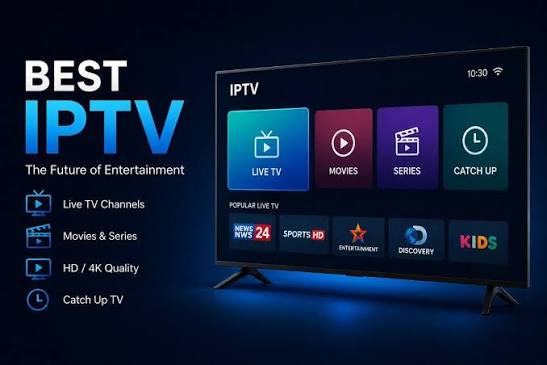
The way Americans watch television is changing faster than ever. Traditional cable and satellite television are now competing with streaming platforms, smart TVs and internet-based entertainment services. For viewers looking for greater flexibility, IPTV USA services represent another approach to accessing television entertainment through an internet connection.
Unlike traditional television delivery, an IPTV service can use internet infrastructure to deliver live television and digital video to compatible devices. This makes IPTV part of a much broader transformation in home entertainment, where viewers increasingly expect content to be accessible across televisions, streaming devices, smartphones, tablets and computers.
But IPTV is about more than simply replacing a cable box. It combines several technologies—including internet protocols, video compression, streaming infrastructure and connected devices—to create a more flexible television experience.
What Is IPTV?
IPTV stands for Internet Protocol Television. At its simplest, IPTV refers to television programming delivered through an IP network instead of relying exclusively on traditional terrestrial broadcasting, cable or satellite transmission.
The underlying technology is similar to the systems used to deliver other forms of internet video. Content is encoded, compressed and distributed through servers and networks before being received by a compatible application or device.
For the viewer, the process can appear straightforward. A user selects a channel or programme, the application requests the relevant stream, and the device receives and decodes the video.
Behind that simple interaction, however, there is a considerable amount of technology involved.
Why Internet Television Is Becoming More Important
The growth of broadband has changed what consumers expect from television.
In the past, television was largely associated with a fixed location and a fixed schedule. Viewers watched whatever was being broadcast at a particular time or recorded programmes for later viewing.
Streaming introduced a different model.
Consumers became accustomed to selecting content on demand, switching between devices and watching entertainment whenever it suited them.
IPTV fits into this evolution by bringing internet connectivity into the live television experience.
Instead of treating television and the internet as completely separate technologies, IPTV combines them.
IPTV and the Rise of Cord-Cutting
Cord-cutting has become one of the defining trends in modern television.
Rather than maintaining a traditional cable package simply because it is the default option, consumers are increasingly comparing different combinations of streaming and television services.
Some households may use subscription streaming platforms for movies and series while using other services for live television, news or sports.
Others may rely primarily on free ad-supported platforms.
IPTV sits within this larger ecosystem by providing another method of delivering television content through an internet connection.
The important point is that consumers now have more choices than they did when cable television dominated home entertainment.
The Technology Behind IPTV Streaming
A modern IPTV experience depends on several technologies working together.
Video Compression
Video contains enormous amounts of information. Sending uncompressed high-resolution video over the internet would require impractical amounts of bandwidth.
Video codecs reduce the amount of data needed to transmit content while attempting to preserve image quality.
Technologies such as H.264 and H.265/HEVC are examples of video compression standards used across digital video applications.
More efficient compression can make it easier to deliver high-quality video over available network connections.
Streaming Protocols
Streaming protocols determine how video data is delivered from servers to the viewer.
HTTP-based streaming technologies such as HLS and MPEG-DASH divide video into smaller segments that can be requested by the playback device.
This approach allows the player to manage playback dynamically rather than downloading an entire video file before viewing begins.
Content Delivery Infrastructure
Large audiences require significant infrastructure.
Content delivery networks can distribute video data across geographically distributed servers, reducing the distance between the content and the viewer.
For U.S. audiences spread across a large geographic area, network architecture can have an important impact on streaming performance.
Adaptive Bitrate Streaming
One of the most useful developments in internet video is adaptive bitrate streaming.
Instead of providing only one version of a video, a streaming system can make several versions available at different quality levels.
The player monitors the connection and chooses an appropriate version.
If network conditions deteriorate, the player may temporarily switch to a lower bitrate. If the connection improves, it can return to a higher-quality stream.
The goal is to reduce buffering while maintaining the best possible picture quality under the current network conditions.
This technology has become an important part of modern streaming because internet connections are rarely perfectly consistent.
IPTV and 4K Television
The popularity of 4K televisions has also influenced expectations around streaming quality.
A 4K display contains significantly more pixels than a Full HD screen, providing the potential for a sharper and more detailed picture.
However, 4K streaming requires more than simply owning a 4K television.
The content itself needs to be available in the appropriate resolution, the streaming infrastructure must support it, the playback device must be compatible and the internet connection needs enough bandwidth.
For viewers interested in 4K IPTV, all of these components should therefore be considered together.
A service advertising 4K content does not automatically mean that every channel or programme will be delivered in native 4K.
The Growing Importance of Smart TVs
Smart TVs have transformed the television into a connected computing device.
Instead of functioning only as displays for an external cable or satellite box, modern televisions can connect directly to the internet and run applications.
This has opened the door to a much wider range of entertainment services.
Depending on the provider and application, internet-based television can potentially be accessed through:
- Smart TVs
- Android TV devices
- Amazon Fire TV devices
- Streaming boxes
- Smartphones
- Tablets
- Windows PCs
- Mac computers
The ability to use multiple devices is particularly useful for households where different people have different viewing habits.
IPTV Players and IPTV Providers Are Not the Same Thing
An important distinction for consumers is the difference between an IPTV player and an IPTV provider.
An IPTV player is an application or software environment designed to play compatible video streams.
A provider is responsible for the underlying television service and the content it distributes.
This distinction matters because an IPTV player does not automatically determine where the content comes from.
When evaluating an IPTV provider, consumers should therefore look beyond the application itself and investigate the actual service, its reliability, supported devices, customer support and content rights.
What Makes a Good IPTV Experience?
The number of channels advertised by a provider is only one part of the equation.
Reliability
A large content catalogue is not useful if streams frequently stop or buffer.
Consistent infrastructure and a stable internet connection are important for a good viewing experience.
Device Compatibility
Consumers should verify that their preferred Smart TV, streaming device or mobile platform is supported.
Picture Quality
HD and 4K capabilities can be important for viewers with modern televisions, but actual quality depends on the source content, network and hardware.
Electronic Program Guides
An electronic programme guide can make navigating live television much easier by showing channels and upcoming programming in a familiar format.
Customer Support
Clear setup instructions and responsive support can be especially valuable when configuring applications or troubleshooting playback problems.
Transparent Terms
Consumers should understand exactly what they are purchasing, how long the subscription lasts and what is included.
Content Licensing
Perhaps the most important consideration is whether the service has the appropriate authorization to distribute the channels, movies, sports and other programming it offers.
Consumers should research providers carefully and choose services that operate transparently and respect applicable copyright and distribution laws.
IPTV and Live Sports
Sports remain one of the strongest reasons consumers continue to value live television.
American audiences follow football, basketball, baseball, hockey, soccer, motorsports and many other competitions.
Unlike on-demand movies or series, live sports are highly sensitive to buffering and interruptions.
This makes streaming reliability particularly important.
A strong internet connection, compatible hardware and stable streaming infrastructure can all contribute to a better live viewing experience.
At the same time, viewers should verify that any service they use has the appropriate rights to distribute the sports content it offers.
The Future of Television May Be More Flexible
The television industry is moving toward a model where consumers have greater control over how they watch.
Traditional broadcasting is not disappearing overnight. Cable, satellite, terrestrial television, subscription streaming and free ad-supported platforms continue to coexist.
But internet-based delivery has changed consumer expectations.
People increasingly expect television to be:
- Available across multiple devices
- Easy to navigate
- High quality
- Flexible
- Connected to the internet
- Accessible without unnecessary hardware
IPTV is one technology contributing to that evolution.
Choosing IPTV Responsibly
As the IPTV market grows, consumers should become more careful rather than simply choosing the service with the largest channel list or the lowest price.
A responsible evaluation should include the provider’s reputation, device compatibility, streaming reliability, customer support, pricing and—most importantly—the licensing and distribution rights associated with its content.
The technology itself is simply a delivery method. The legality and quality of a particular service depend on how that technology is used.
Conclusion
IPTV represents an important part of the continuing evolution of television.
By combining internet connectivity with digital video delivery, IPTV can give viewers more flexibility in how they access television and entertainment.
The technology behind the experience is becoming increasingly sophisticated, with adaptive bitrate streaming, efficient video codecs, content delivery networks and smart devices working together to improve the viewing experience.
For American consumers, the future of television is unlikely to be defined by one single technology. Instead, traditional broadcasting, streaming platforms, IPTV and other connected entertainment services will continue to coexist.
The biggest change is the growing expectation that viewers should have more control over what they watch, where they watch it and how they access it.
