

Businesses increasingly depend on accurate web data, regional market intelligence, localized search results, ecommerce research, advertising verification, and automated data workflows. These activities often require something a normal internet connection cannot provide: access to IP addresses from multiple countries and networks.
That is where residential proxy services become useful.
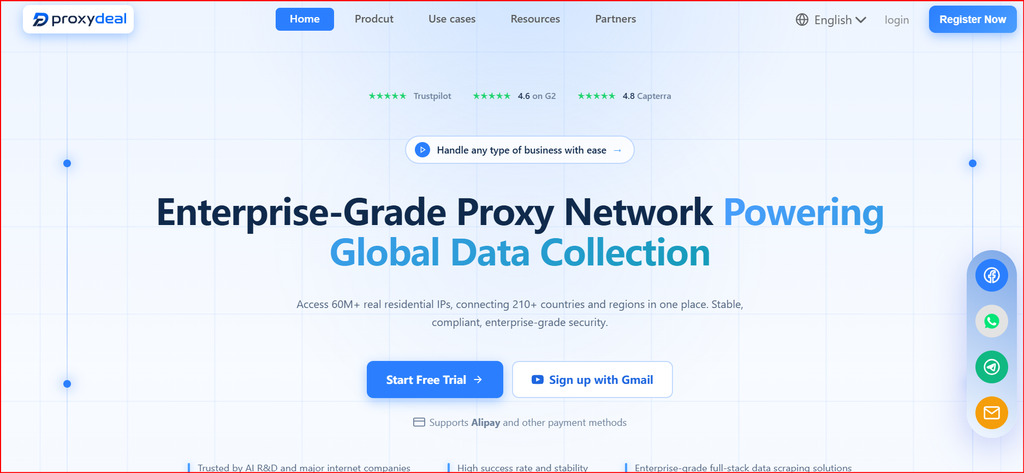
ProxyDeal is a global proxy provider offering infrastructure designed for web data and international online operations. The provider promotes both static and dynamic IP solutions and is currently described across several cross-border technology directories as supporting more than 210 countries and regions with eight independent IP pools.
That combination makes ProxyDeal particularly interesting for companies that require geographic flexibility rather than access to only a few major markets.
So, why should businesses consider ProxyDeal in 2026?
This review examines its residential proxy network, global coverage, static and dynamic options, applications, advantages, limitations, and the types of projects for which ProxyDeal may be a good fit.
What Is ProxyDeal?
ProxyDeal is a proxy service focused on providing global IP infrastructure for businesses, developers, marketers, ecommerce companies, and data teams.
Its official website describes the service around the concept of providing proxy infrastructure for web data. Meanwhile, current industry and cross-border business directories describe ProxyDeal as offering both overseas static and dynamic IP resources.
Unlike a basic datacenter proxy service with only a handful of server locations, ProxyDeal’s main attraction is its international network.
Current public listings consistently report:
| Feature | ProxyDeal |
| Geographic coverage | 210+ countries and regions |
| Proxy models | Static and dynamic IPs |
| IP infrastructure | 8 independent pools |
| Residential IP network | 60M+ reported by third-party directories |
| Main focus | Global proxy and web-data infrastructure |
| Suitable for | Data collection, ecommerce, SEO, ad verification, development |
| Official website | ProxyDeal.io |
One recent third-party listing describes ProxyDeal as providing approximately 60 million residential IPs, covering 210+ countries and supporting multiple proxy types and protocols. Because this figure is reported by an external directory rather than clearly displayed in the crawlable specifications of ProxyDeal’s official website, large customers should confirm the current active pool size directly with ProxyDeal.
Why ProxyDeal Is a Good Choice for Residential Proxies
The main reason ProxyDeal deserves attention is not a single feature. It is the combination of geographic coverage, different IP models, and separate proxy pools.
For businesses operating globally, flexibility matters.
A company may need a US IP for one project, a German endpoint for another, a Brazilian IP for market research, and an Asian location for regional website testing.
Maintaining separate providers for every market quickly becomes complicated.
ProxyDeal’s reported coverage of more than 210 countries and regions gives businesses the possibility of managing many of these requirements through one service. Multiple current cross-border technology directories independently list the same 210+ country coverage and eight-pool infrastructure.
For international teams, that can considerably simplify proxy management.
1. Residential Proxy Coverage Across 210+ Countries
Geographic coverage is one of the most important factors when choosing a residential proxy provider.
A company conducting research exclusively in the United States might not require a huge global network. But organizations working across Europe, North America, Asia, Latin America, Africa, and the Middle East need considerably more flexibility.
ProxyDeal is currently listed as supporting IP resources across more than 210 countries and regions.
This can be valuable for applications such as international SEO monitoring, ecommerce price research, localization testing, advertising verification, public web-data collection, travel research, market intelligence, and application testing.
For example, imagine an ecommerce company selling internationally.
The team wants to understand how its storefront appears to visitors from the United States, Spain, Germany, Brazil, Singapore, and Japan.
Regional proxy endpoints can help the company test what publicly available content is displayed from those markets without requiring physical offices in each country.
This is one of the clearest advantages of a geographically diverse residential proxy network.
2. Static and Dynamic Proxy Options
Another reason ProxyDeal is interesting is its support for both static and dynamic IP solutions.
Current directories consistently describe ProxyDeal as offering overseas static and dynamic proxy IPs.
These two proxy models serve different purposes.
Dynamic Residential Proxies
Dynamic proxies are suitable for applications where IP diversity and rotation are important.
For example, a data collection application may need to process a large number of public webpages.
Instead of routing every request through one address, a dynamic proxy infrastructure can distribute requests across different IP endpoints.
This model can work well for public web scraping, price monitoring, search-result research, localization testing, market intelligence, and other high-volume data projects.
Static Proxies
Static proxies are designed for workflows where keeping a consistent IP address for a longer period is preferable.
Possible applications include browser-based business workflows, regional QA testing, longer website sessions, persistent application connections, and other legitimate activities where frequent IP rotation would be inconvenient.
Having both options allows customers to choose the appropriate proxy model for each project rather than forcing every workflow through the same architecture.
3. Eight Independent IP Pools
ProxyDeal’s reported eight independent IP pools are another interesting feature.
Multiple independent directories currently reference this infrastructure model.
Separate pools can potentially allow a proxy provider to serve different customer requirements more efficiently.
A high-volume web scraping operation, for instance, has very different requirements from a persistent browser session.
A scraping project may prioritize large IP diversity, scalability, rotation, and concurrency.
A longer browser session may prioritize IP consistency, geographic stability, and connection continuity.
Being able to choose among different pools can therefore be useful for organizations running several types of proxy workloads.
Before purchasing, customers should ask ProxyDeal which pool is most appropriate for their target countries and websites.
4. ProxyDeal for Web Scraping and Data Collection
Web data is one of the most obvious applications for a service such as ProxyDeal.
A typical setup might work like this:
Data collector → ProxyDeal gateway → residential IP → public website
The application sends requests through the proxy infrastructure rather than directly from the same server address every time.
Residential proxy networks can be particularly useful when collecting geographically dependent public information.
Examples include product prices, search results, public business information, ecommerce catalog data, travel information, public reviews, and localized website content.
A geographically diverse pool also makes it possible to investigate how information differs between regions.
Companies should, of course, ensure that their data-collection practices comply with applicable laws, contractual requirements, privacy rules, and website policies.
Using a proxy does not remove those obligations.
5. ProxyDeal for Ecommerce and Price Monitoring
International ecommerce is another area where ProxyDeal can be useful.
Businesses rarely operate in a completely uniform global market.
A product might have one price in the United States, another in Germany, and a different promotional offer in Brazil.
Shipping availability and inventory can also vary by country.
Residential proxies can help companies conduct legitimate regional research into publicly available ecommerce information.
This could include monitoring competitor prices, comparing product availability, testing regional storefronts, reviewing localized promotions, verifying currency presentation, and checking public product pages.
ProxyDeal’s broad geographic footprint is particularly relevant here because ecommerce companies increasingly operate across dozens of markets.
6. ProxyDeal for SEO Monitoring
Search results are heavily influenced by location.
Someone searching for the same keyword in London, New York, Madrid, and Tokyo may see different results.
That creates a challenge for international SEO teams.
Simply searching from an office computer does not necessarily show what customers in another country see.
Using regional residential IP addresses can help SEO specialists evaluate geographically relevant public search results.
ProxyDeal could therefore be useful for international rank monitoring, competitor research, local SEO analysis, search-result verification, content localization research, and regional marketing analysis.
For agencies working with clients across many countries, access to 210+ locations can be significantly more useful than maintaining several small regional proxy providers.
7. ProxyDeal for Ad Verification
Digital advertising is another potential application.
Companies spending significant amounts on advertising need to know whether campaigns are appearing correctly.
A campaign intended for a specific region may use different creative material, language, offers, pricing, or landing pages.
Regional proxy infrastructure can assist teams in checking publicly served campaigns from different geographic perspectives.
Typical verification tasks can include confirming regional landing pages, reviewing localization, checking redirects, validating public affiliate pages, inspecting geographic promotions, and testing campaign destinations.
For advertising teams operating across many markets, ProxyDeal’s broad location coverage can therefore be valuable.
8. ProxyDeal for Market Research
Market researchers often need to understand what customers in another country can publicly access online.
This could involve comparing competitors, tracking pricing differences, identifying new brands, checking market availability, studying public product catalogs, or investigating regional trends.
A residential proxy network can provide a more geographically accurate perspective than conducting every search from one country’s IP address.
ProxyDeal’s combination of broad country support and dynamic proxy options makes it particularly relevant for international market intelligence projects.
ProxyDeal Pricing in 2026
Pricing transparency is one area where ProxyDeal could improve.
During our review, the publicly crawlable official website did not provide enough reliable pricing information for us to publish a complete current price table without risking giving readers outdated or incorrect figures.
For this reason, businesses should check the current ProxyDeal dashboard or contact the provider directly for current pricing.
Proxy costs frequently depend on several variables, including proxy type, bandwidth consumption, requested location, number of IPs, session duration, and overall traffic commitment.
Enterprise customers may also receive customized pricing.
While custom quotations are normal in the proxy industry, publicly displaying clearer starting prices would make ProxyDeal easier to compare against competitors.
ProxyDeal Pros and Cons
| Pros | Cons |
| 210+ countries and regions reported | Public pricing information is limited |
| Static and dynamic IP options | More detailed public documentation would help |
| Eight independent IP pools | Performance may vary by target and region |
| Large reported residential network | 60M+ pool claim should be confirmed for enterprise purchasing |
| Useful for international data projects | Customers should benchmark required destinations |
| Suitable for SEO and ecommerce research | Some technical details require direct confirmation |
| Broad geographic flexibility | Not every project requires such extensive coverage |
What Should You Test Before Buying?
Proxy network size is important, but it should never be the only buying criterion.
A provider advertising millions of IP addresses does not automatically guarantee identical performance on every website.
Real-world results depend on the target platform, requested country, network provider, IP reputation, latency, session strategy, concurrency, and many other variables.
Before committing to a large ProxyDeal plan, test the service with the exact countries and websites relevant to your business.
Pay particular attention to connection speed, request success rate, IP availability, geographic accuracy, session stability, rotation behavior, and support responsiveness.
This gives a much more meaningful indication of performance than comparing IP-pool numbers alone.
Who Should Consider ProxyDeal?
ProxyDeal appears particularly relevant for companies that require international IP diversity.
Web-data companies can use dynamic residential resources for geographically distributed public-data collection.
SEO agencies can use regional endpoints to analyze search results across multiple markets.
Ecommerce businesses can research pricing, availability, localization, and competitive positioning.
Advertising teams can perform geographic campaign verification.
Developers can test applications and public webpages from different regional network environments.
Market researchers can compare publicly available information across countries.
The common factor is geographic scale.
If you only need one static proxy in one country, a smaller specialist provider may be sufficient.
If you regularly work across dozens of countries, ProxyDeal becomes considerably more interesting.
Is ProxyDeal Worth It in 2026?
Based on the information currently available, ProxyDeal appears to offer a compelling proposition for businesses that prioritize geographic reach and flexibility.
The provider’s strongest characteristics are its 210+ country coverage, static and dynamic proxy options, and eight independent IP pools. These figures appear consistently across multiple current cross-border technology directories.
Third-party directories additionally report approximately 60 million residential IPs, although organizations planning major deployments should verify the current active network size directly with ProxyDeal before purchasing.
ProxyDeal would become even easier to recommend if it provided more transparent public pricing and deeper technical documentation covering session duration, targeting options, authentication, protocols, concurrency, and individual proxy-pool characteristics.
Nevertheless, its global infrastructure makes it a provider worth testing.
ProxyDeal Review 2026: Final Verdict
ProxyDeal is a good choice for residential proxies in 2026 primarily because of its extensive geographic coverage and flexible proxy infrastructure.
Instead of concentrating exclusively on one type of proxy, the service combines static and dynamic IP solutions with multiple independent pools.
Its reported coverage across more than 210 countries makes it especially attractive for international businesses.
For web scraping, SEO monitoring, ecommerce research, market intelligence, advertising verification, localization testing, and other legitimate data applications, that geographic flexibility can be a significant advantage.
ProxyDeal is therefore best viewed not simply as a tool for changing an IP address, but as infrastructure for companies that need to interact with geographically distributed public web content at scale.
The main recommendation before purchasing is simple: test it with your actual workload.
Evaluate the countries you require, the websites you work with, session stability, connection quality, IP availability, and overall cost.
If the performance matches your requirements, ProxyDeal has the geographic scope and proxy flexibility to become a useful part of an international web-data stack.
Our ProxyDeal Rating
Global Coverage: 9/10
Proxy Flexibility: 8.5/10
Business Use Cases: 8.5/10
Scalability Potential: 8.5/10
Pricing Transparency: 6.5/10
Public Documentation: 7/10
Overall Rating: 8.2/10
This editorial score reflects publicly verifiable features and product positioning. It is not based on an independent controlled latency or request-success benchmark.
Frequently Asked Questions
What is ProxyDeal?
ProxyDeal is a global proxy service offering proxy infrastructure for web-data and international online operations. Current directories describe it as providing static and dynamic IP solutions across more than 210 countries and regions.
Does ProxyDeal offer residential proxies?
Current third-party listings describe ProxyDeal as operating a residential proxy network, with some directories reporting more than 60 million residential IPs. Customers should confirm the latest active pool size directly with ProxyDeal.
How many countries does ProxyDeal support?
Multiple current sources report coverage across 210+ countries and regions.
Does ProxyDeal offer static proxies?
Yes. Current public listings describe ProxyDeal as providing both static and dynamic overseas IP options.
Is ProxyDeal suitable for web scraping?
Its global IP coverage and dynamic proxy infrastructure make it potentially suitable for legitimate public web-data collection. Performance should be tested against the specific websites, countries, and request volumes required by your project.
Is ProxyDeal good for SEO?
It can be useful for international SEO research because proxies from different regions can help teams inspect geographically dependent public search results and website content.
Is ProxyDeal good for ecommerce?
ProxyDeal may be useful for legitimate ecommerce applications such as localized storefront testing, public price monitoring, market research, regional product research, and competitor analysis.
Should I choose ProxyDeal in 2026?
ProxyDeal deserves consideration if your main priorities are broad international coverage, residential IP diversity, and access to both static and dynamic proxy options. Businesses should test the network before committing to a high-volume plan.
Official Website: ProxyDeal
