


A Data Science Course is a great tool for training people using projects based on business problems related to data, tools, documentation, and measurable results. Rather than studying separate skills like Python, SQL, statistics, and machine learning, people learn how to apply them through tasks similar to those assigned at work.
Data Science Projects training is useful for portfolio creation, decision making, explanation of technical solutions, and interviews preparation. It allows fresh graduates, experienced employees, career changers, analysts, developers, and non-technical people to acquire practical skills during training.
The article describes how classroom projects operate, what products are created during training, how projects help to prepare for placement, and what should be considered when choosing a Data Science Course in India.
What does project-based Data Science Training look like?
Project-based Data Science Training involves the use of realistic data and business cases for training the full analytical cycle. Students are not asked to just write the code but have to interpret the data, determine the validity of the model used, and provide recommendations.
In a classroom, there could be an introduction of a principle like classification, followed by its application in a customer churn situation. In such a situation, students can define the target variable, cleanse customer data, create features, train different models, compare metrics, and describe the customers who would require retention services.
The above process captures how data scientists create value. Data scientists employ analysis and other techniques for interpreting insights from data, as per the U.S. Bureau of Labor Statistics. This occupation usually needs at least a bachelor’s degree in a relevant field, although requirements vary from employer to employer.
The classroom project workflow
A well-designed project usually follows these stages:
- Define the business problem. Students convert a broad request into a measurable question, such as “Which customers are at risk of leaving within 30 days?”
- Understand the data. Students inspect data types, missing values, duplicates, outliers, class imbalance, and possible leakage.
- Prepare the dataset. Students clean, transform, join, and document the data using Python and SQL.
- Explore patterns. Students use statistics and visualizations to identify trends, relationships, and anomalies.
- Build a baseline. Students create a simple benchmark before testing more complex approaches.
- Train and evaluate models. Students choose suitable metrics and validate performance on unseen data.
- Translate findings into action. Students explain what a business team should do and why.
- Present the result. Students create a report, dashboard, presentation, or deployable demonstration.
It does matter because workplace data science is not often a problem of modelling. Even a technically perfect model will not be successful if there is a poor problem definition, the data is biased, or the results cannot support a decision.

How does a classroom project become a portfolio project?
What makes a project portfolio worthy is its ability to show a complete and repeatable process of decision making, rather than presenting a well-designed chart or a mere model. The best projects will discuss the problem, data, methodology, result, limitations, and recommendation on how to proceed from here.
Students should normally produce:
- A concise project brief.
- A data dictionary.
- A reproducible notebook or code repository.
- SQL queries where relevant.
- Exploratory visualizations.
- A baseline and improved model.
- Evaluation metrics selected for the business problem.
- A dashboard or presentation.
- A limitations and ethics section.
- A short executive summary.
In the case of retail sales project, the result of “Sales have increased in December” is too superficial to be presented in a portfolio. Instead, one could add more information to this result, such as the types of products that were responsible for the growth or if there was any effect after subtracting discounts.
What makes a project credible?
The authenticity of a project reveals the way the student managed uncertainty. The project does not conceal missing values, poor assumptions, data imbalance, data leakage, and lack of a good sample size.
A useful project review asks:
- Is the business problem specific?
- Is the target variable clearly defined?
- Are the data sources and assumptions documented?
- Is the train-test split appropriate?
- Are the evaluation metrics relevant?
- Does the analysis distinguish correlation from causation?
- Can another person reproduce the result?
- Does the final recommendation follow from the evidence?
Such considerations will generate quality questions for the interview process. An interviewer can learn much more about a candidate based on their imperfect project than the perfect one.
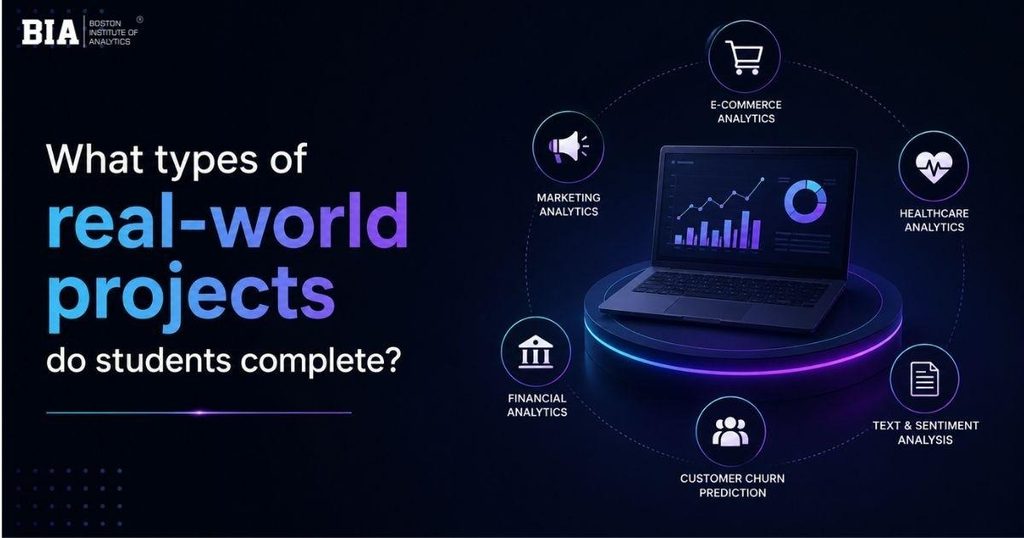
What types of real-world projects do students complete?
A Practical Data Science Course should include projects from analytics, machine learning, visualization, and deployment areas. This will allow students to experience all the duties that are involved in an entry-level data science position.
| Project type | Typical question | Skills demonstrated |
|---|---|---|
| Customer churn | Which customers may leave? | Classification, feature engineering, recall, business recommendations |
| Sales forecasting | What may demand look like next month? | Time-series analysis, seasonality, validation, forecasting |
| Credit risk | Which applications require additional review? | Classification, probability, precision-recall trade-offs |
| Marketing analytics | Which campaigns generate qualified leads? | SQL, funnel analysis, segmentation, dashboards |
| Recommendation system | Which products or content should be suggested? | Similarity, ranking, evaluation, personalization |
| Fraud detection | Which transactions appear unusual? | Imbalanced data, anomaly detection, threshold selection |
| Operations analytics | Where are delays or capacity constraints occurring? | Root-cause analysis, visualization, process metrics |
| Natural-language analysis | What themes appear in customer feedback? | Text preprocessing, sentiment analysis, topic modelling |
Project selection must be appropriate based on the targeted job function. A future data analyst can use more projects on SQL programming, dashboard building, and business analysis. A future machine learning engineer can use more modelling, software engineering, deployment, and monitoring projects.
Example: a customer-churn project
A customer-churn project can be started using a dataset which has information on subscription history, usage pattern, complaints, duration and payments. Students may find missing cancelation dates or customer identification numbers in this dataset.
The project then becomes more realistic:
- SQL joins customer and transaction tables.
- Python handles cleaning and exploratory analysis.
- Feature engineering creates tenure bands and recent-usage indicators.
- A baseline model establishes initial performance.
- Students compare logistic regression, decision trees, and ensemble models.
- Recall and precision are discussed because missed churners and unnecessary retention offers have different costs.
- A dashboard communicates risk segments to a non-technical audience.
The final output is not simply a model. It is a business approval supported by analysis.
How do projects prepare students for data science jobs?
Practical projects help students prepare themselves for future jobs through building technical skills, business acumen, communications, and interviews’ proof. An employer may evaluate all these factors, particularly when the candidate does not have much job experience.
A project-based Data Science Program supports job readiness in five ways:
- It builds tool fluency. Students repeatedly use Python, SQL, pandas, NumPy, scikit-learn, notebooks, visualization tools, and version-control workflows.
- It improves problem decomposition. Students learn to turn vague requests into measurable objectives.
- It develops communication. Students practise explaining findings to managers, clients, and technical reviewers.
- It creates interview examples. Students can discuss trade-offs, failures, metrics, and improvements using specific evidence.
- It produces portfolio assets. Students can show repositories, dashboards, reports, and presentations during applications.
The worldwide demand for professionals with data skills does not eliminate the need for evidence of skills. According to NASSCOM, the demand for specialists in artificial intelligence and big data analytics in India was higher than the supply in its quoted 2021 assessment, underlining the relevance of bridging the gap between employability and upskilling.
Nevertheless, career prospects depend on the number of factors, including prior education, quality of one’s portfolio, interviewing skills, geographic location, choice of the position, etc. While practical projects may help prove skills, Data Science Certification itself does not secure employment.
How projects support interview preparation?
A candidate should be able to answer:
- What business problem did the project address?
- How did you identify and fix data-quality issues?
- Why did you select that model?
- Which metric mattered most?
- What did the model get wrong?
- How would the solution work in production?
- What would you do with more time or better data?
- How did your recommendation create business value?
A classroom should inspire students to answer these questions through the project. Interview preparation should not begin only after the final assignment.

Can beginners and career switchers learn through projects?
Beginners and career shifters can be trained through projects provided that the Data Science Course adopts a gradual approach as opposed to providing students with difficult assignments right away.
A practical progression looks like this:
Stage 1: Guided exercises
Students go through systematic samples in terms of Python syntax, SQL query, data cleaning, descriptive statistics, and simple visualization. The main objective is to develop familiarity with the tools.
Stage 2: Structured projects
Students get the problem statement, data set, methodology, and outputs expected. The mentors’ role would be to point out mistakes in methodology and explain the significance of each step.
Stage 3: Semi-independent projects
Students make their own choices regarding features, models, measures, and visualizations in an outlined project scope. Critique will emphasize logical justification as opposed to code implementation.
Stage 4: Capstone projects
Students will have lesser instructions and will present their findings as if they were addressing a business executive.
Such design allows for making a Data Science Course for beginners in India easier without compromising quality. Non-technical learners might require extra help in programming, math, and data-related vocabulary. IT professionals and developers might progress faster in coding concepts but will need more practice in statistics, experimentation, and business understanding.
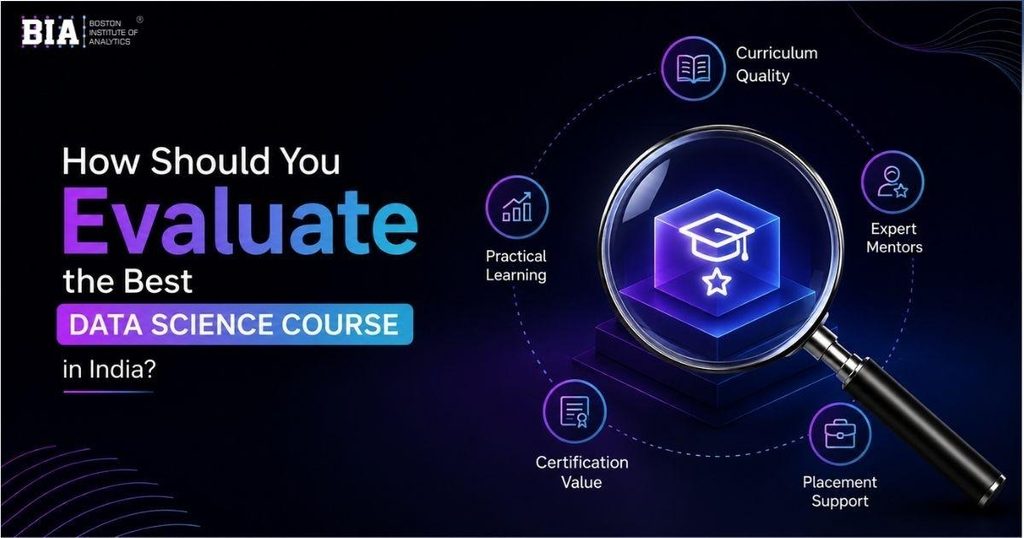
How should you evaluate the best data science course in India?
The best data science course in India must be judged on the basis of practical depth of the curriculum, quality of projects, access to mentors, criteria of assessment, and clear career guidance rather than on the basis of the language of certification. A course must demonstrate its output in the form of learner’s work and the process of assessment of that work.
Use this checklist before enrolling:
| Evaluation factor | What to look for | Warning sign |
|---|---|---|
| Curriculum | Python, SQL, statistics, visualization, machine learning, and deployment basics | Tool lists without learning outcomes |
| Projects | Multiple projects using realistic and imperfect datasets | One small guided exercise presented as a capstone |
| Mentorship | Code reviews, project feedback, and doubt-clearing sessions | Recorded videos with no meaningful feedback |
| Assessment | Rubrics, checkpoints, presentations, and revisions | Attendance treated as the main measure |
| Portfolio | GitHub, dashboards, documentation, and business summaries | Certificate offered without demonstrable work |
| Industry relevance | Problems connected to retail, finance, healthcare, marketing, or operations | Purely academic examples |
| Career support | Resume reviews, mock interviews, applications, and role guidance | Unclear “100% placement” claims |
| Format | Schedule and delivery suited to your work or study commitments | No explanation of attendance or support |
| Location | Relevant options in Mumbai, Bengaluru, Chennai, Delhi, Thane, Hyderabad, or Pune | Location pages with no local delivery details |
According to Google, the recommended people-first content should showcase the expert status and provide users with enough information for achieving their goals. The same can be used while evaluating the Data Science Institute based on the actual evidence of learners’ actions, assessment of work, and support.
Does a Data Science Certification prove practical ability?
A Data Science Certification is proof of completing a course or an assessment conducted by the issuing body; however, a Data Science Certification will not be sufficient to demonstrate professional competence in the workplace.
Certification can still be useful when it accompanies:
- Assessed assignments.
- Mentor feedback.
- A credible curriculum.
- A verifiable issuing institution.
- Portfolio projects.
- Interview and career preparation.
Treat the certificate as one signal among quite a few. Do not treat it as a substitute for evidence.
What should a Data Science Course with placement assistance include?
Placement assistance in an Indian Data Science course will offer career guidance in an organized manner; however, placement assistance does not necessarily guarantee a job. Career guidance really means preparing the candidates for the application process.
Useful placement support may include:
- A skills-gap assessment.
- Resume and LinkedIn reviews.
- Portfolio and GitHub feedback.
- Mock technical interviews.
- SQL, Python, statistics, and case-study practice.
- Communication and presentation coaching.
- Role mapping for analyst, data scientist, or machine-learning positions.
- Job-search strategy and application guidance.
- Interview feedback after unsuccessful attempts.
- Access to relevant employer or hiring networks, where available.
Request that the provider give you a written definition of “placement assistance”. Be clear on eligibility criteria, support periods, job targets, job locations, and outcome reporting by cohorts.
In the case of a Data Science Course with Job Placement, also request if the job targets advertised are commensurate with your level of experience. Your first job title might not be that of “Data Scientist”, but “Data Analyst”, “Reporting Analyst”, “Business Analyst” or even “Junior Data Scientist”.

How does Boston Institute of Analytics support this learning approach?
BIA’s Data Science can be marketed based on the relationship between structured learning, real-life projects, and professional readiness. It is recommended to check the specific curriculum, delivery mode, project list, eligibility criteria, and support conditions for job placements on the respective programme webpage or with an admissions consultant.
Prospective learners should ask:
- Which projects are included in the curriculum?
- Are the datasets realistic and sufficiently varied?
- How often do mentors review project work?
- Will students present projects to a panel or stakeholder?
- What portfolio materials can students retain?
- Which tools and technologies are taught?
- How are beginners supported?
- What does career and placement support include?
- Are classroom options available in Mumbai, Bengaluru, Chennai, Delhi, Thane, Hyderabad, or Pune?
- What are the attendance, assessment, and completion requirements?
This dialogue allows aligning the programme with your qualifications. An experienced analyst requires a higher level of machine learning and application knowledge. A non-technical graduate requires more solid foundations and gradual learning process. A software engineer requires business context, statistical analysis, and model assessment.
How should you start a Data Science Program?
To begin with, choose your target position, review the project process within the course, and ensure that the program aligns with your current skill set. It is easier to decide by comparing facts rather than listening to the course’s description.
Use this four-step process:
- Choose a role target. Decide whether you are preparing for data analyst, data scientist, machine-learning, business-analytics, or another related role.
- Audit the curriculum. Check whether the course teaches the tools and concepts required for that role.
- Inspect project deliverables. Look for realistic data, documented assumptions, mentor feedback, presentations, and portfolio outputs.
- Discuss career support. Ask for specific details about assessments, interviews, applications, and placement assistance.
If the program is right for you, contact a career specialist from the Boston Institute of Analytics.
FAQ Section
What is a project-based Data Science Course?
In the Project-Based Data Science Course, the students learn the concepts through practical analytical problem-solving and deliverable completion. Students learn programming, statistics, SQL, machine learning, visualization, and communication within a single process.
Is project-based data science training suitable for beginners?
It is okay to have the project-based data science training for beginners as long as the learning starts from the guided exercises towards the capstone project. A beginner must make sure that the program covers the fundamentals, mentorship, and feedback before proceeding with advanced projects.
How many projects should a data science student complete?
The student should focus on making sure he has a few well-documented projects rather than making several notebooks. He should make sure that he creates a balanced portfolio that can contain an analytics project, machine-learning project, and a business-facing dashboard or capstone.
Does a Data Science Certification guarantee a job?
A Data Science Certification does not promise job assurance. The job opportunity will depend on skills, portfolio, interview, experience, fit, and market.
What does placement assistance mean in a data science course?
Placement assistance refers to structured assistance such as resume review, mock interview, portfolio review, job search advice, and hiring opportunities. Placement assistance doesn’t necessarily promise jobs.
Is a Data Science Course in India with placement assistance worth it?
A Data Science Course in India with placement assistance can prove to be of great worth if the placement support is properly explained and the course curriculum involves practical projects. Consider factors like quality of projects, availability of mentors, career support, requirements, fees, and overall schedule before opting for the course.
Can non-technical graduates learn data science?
Students who have graduated without a technical background can master data science through proper training in programming, mathematics, statistics, and problem-solving. They must expect regular practice from the course chosen by them and must find one that clearly states the pre-requisites.
Which cities offer data science course options in India?
There are data science courses available in all the big centres of education and technology in India, such as Mumbai, Bangalore, Chennai, Delhi, Thane, Hyderabad, and Pune.
Final Thoughts
Real-life projects make all the difference between a theoretical training in data science and the real professional preparation. As a result of using real datasets, students get an idea of how to formulate business problems, process data, create machine learning models, and make analysis.
The best course projects for data science not only deliver a piece of code. These projects allow the learner to create a portfolio, explain decision-making in technical interviews, get familiar with business limitations, and show useful skills for assessment by future employers. Beginners, professionals, and career changers will all get benefits from projects that evolve from being guided exercises into capstone projects.
When choosing a data science course, take into consideration the quality of projects offered, mentoring, tooling, evaluation, portfolios creation, and placement help. Certificate might show your completion of the course, but project work is the proof of practice.
