

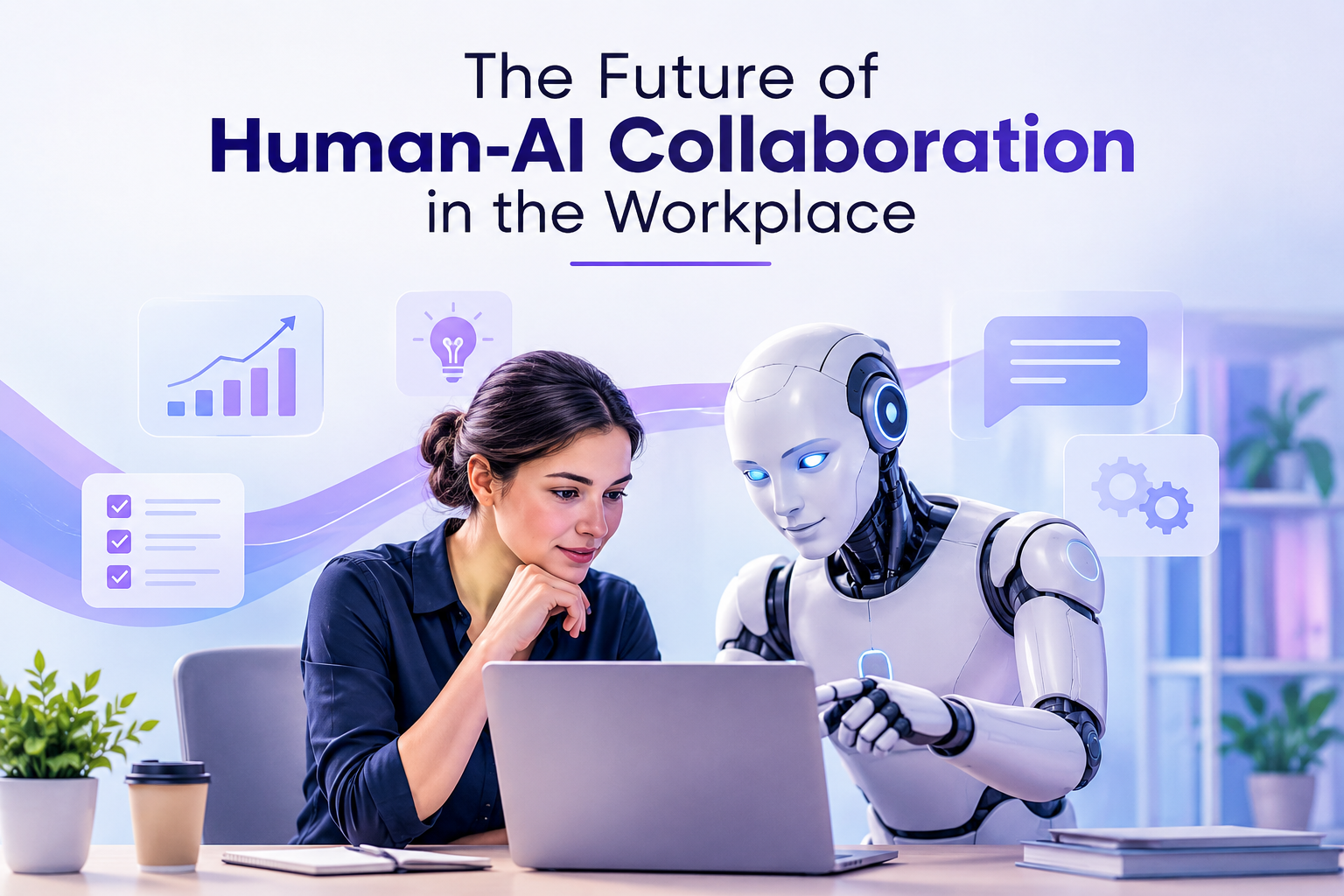
AI has outgrown its old job as a simple automation tool. These days it’s woven into how people draft messages, research topics, dig through data, generate content, and make calls on business decisions. As those abilities keep improving, human-AI collaboration in the workplace has turned into a real, working model for businesses that want to pair human judgment with machine speed.
The idea was not to give every chore to the machine. The whole idea revolves around how to determine whether the machine would be better at the job, or whether human decision-making takes precedence in such situations. This understanding has already led to changes in teamwork, job profiles, and productivity itself.
For employees, the shift can be a big one. AI can chew through repetitive work and mountains of information, then hand back recommendations freeing people up to focus on strategy, creative thinking, relationships, and the kinds of decisions that need real context.
Why Human and AI Collaboration Matters
Older workplace automation was built for predictable, repetitive tasks with clear rules. Today’s AI can handle messier, less structured input: text, images, documents, customer conversations, raw business data.
That opens the door to human and AI collaboration in almost every corner of a company.
Take a marketing team. AI can spot patterns buried in campaign data, toss out content ideas, boil down customer feedback, and even help write a first draft. But it’s still the marketer who decides which of those ideas actually fits the brand, the audience, and where the business is headed.
The same pattern shows up in software development, healthcare, finance, admin, sales, customer service, and operations. AI brings the computing muscle; people bring the judgment and the domain know-how.
That’s a big reason AI in the workplace is now talked about less like a piece of automation tech and more like a productivity tool.
AI Will Change Jobs, Not Just Eliminate Tasks
A lot of the conversation around the future of work and AI boils down to one anxious question: will machines take people’s jobs? Fair question but it misses most of the story.
Most jobs aren’t one task; they’re dozens of small ones stitched together. Some of those can be fully automated. Others can be assisted by AI. And plenty still need a human hand.
Think about a customer service rep who spends half their shift hunting for information, summarizing calls, and writing up case notes. AI can strip out a lot of that busywork, leaving the rep more time to actually dig into the customer’s real problem.
That’s a shift from replacing tasks to redesigning them. More and more, people will find themselves working next to AI systems acting like research assistants, writing partners, data analysts, or coding helpers. It’s a different flavor of AI-human collaboration, one where the technology takes on certain kinds of cognitive grunt work, while people keep hold of context and accountability.
Where AI-Assisted Work Can Deliver the Most Value
The best use cases for AI-assisted work usually aren’t the flashiest ones. More often, the real payoff comes from ordinary, everyday processes that quietly eat up huge chunks of employee time.
Some places worth exploring:
- Research: Synthesis of information from reports, documents, market research and company data.
- Communication: Creating emails, proposals, memos, and general correspondence.
- Data analysis: Spotting patterns, anomalies, and correlations in big data sets.
- Customer service: Guiding customer service agents to extract information and craft a response.
- Software development: Supporting programmers through coding, testing, and documentation.
- Operations: Automating repetitive workflows and routing tasks to the right people.
- Knowledge management: Making internal information easier to find and use.
The real value here is time giving people back the hours that experience and human reasoning are actually good for. Organizations are increasingly judging AI investments by measurable business results rather than treating them as an ongoing experiment.
AI and Employee Productivity Need the Right Measurement
It’s easy to assume that dropping AI into a workflow automatically boosts AI and employee productivity. It doesn’t work that way.
If an employee gets a new AI tool but spends most of their time double-checking wrong outputs, that’s not a productivity win, it’s just a different kind of work. And automating one step in a badly designed process can just push the bottleneck somewhere else.
Better to track things like:
- Time saved per task
- Error and rework rates
- Customer response times
- Employee workload
- Quality of finished work
- Revenue or cost impact
- How well employees are actually adopting the tools, and how satisfied they are with them
Productivity is something to measure at the workflow level not by counting how many AI tools someone happens to have open.
Building Effective Human-AI Teamwork
Good human-AI teamwork depends on clear lines. People need to know exactly what the AI can do, where it tends to slip up, and when a human absolutely has to check the work before it goes anywhere.
One useful way to split the work:
AI-led tasks
Work that’s repetitive and predictable enough that AI can run with minimal oversight.
AI-assisted tasks
AI produces the draft, the summary, the recommendation and a person reviews it before acting.
Human-led tasks
Strategic calls, sensitive situations, ethical judgment calls, leadership, negotiation anything where accountability can’t be handed off to a machine. This kind of structure keeps workplace AI technology useful without ever treating it as gospel.
Trust and Governance Will Become More Important
As artificial intelligence in the workplace gets woven deeper into daily operations, governance stops being a side conversation and becomes central.
Individuals must be assured that they are well-informed about how the company’s data is used by the AI system, its output validation, and liability issues. There should be actual policies on privacy, security, intellectual property, bias, and appropriate use.
An employee should know, for instance, whether it’s okay to paste confidential client details into an outside AI tool. And a recommendation an AI spits out shouldn’t automatically turn into a business decision without someone actually looking it over.
The tech can be as advanced as it wants; good governance is what keeps people accountable at the end of the day.
For more background on how AI has developed and where it’s being applied, a good starting point is Wikipedia’s overview of artificial intelligence.
What an AI-Powered Workplace Could Look Like
The AI-powered workplace of the future probably won’t look like rows of people babysitting machines. AI is more likely to just quietly become part of the software and workflows people already use.
Think of a person waking up to find their AI assistant has done all the analysis of key messages, highlighted urgent issues, written meeting reports, and gathered relevant business data. Then during a project, the same assistant comes to help them by analyzing data, identifying potential threats, and keeping documentation in place. The person’s still steering the ship. AI just clears away the friction of finding and processing information.
That points to a bigger future of human-AI interaction, one where working with intelligent systems feels as natural as using a search engine, opening a spreadsheet, or messaging a colleague.
Preparing for AI Workplace Transformation
Nobody needs to automate everything overnight. A smarter approach is to zero in on the processes where AI can solve a real, specific business problem.
A workable AI workplace transformation strategy might start like this:
- Find the bottlenecks. Look for processes where people are sinking a lot of time into low-value work.
- Check AI’s fit. Figure out whether AI can reliably take on or support those tasks.
- Start small. Test AI where the risks are manageable, and the results are easy to measure.
- Keep people in the loop. Set up review steps for important decisions and sensitive data.
- Train the team. Teach people how to use the tools well and how to spot when AI gets it wrong.
- Track results. Watch productivity, quality, cost, adoption, and overall business impact.
- Grow gradually. Roll successful pilots out to other departments only once they’ve proven themselves.
Companies that need extra hands can also look into AI integration services to connect AI tools with the systems and workflows they already rely on.
The Workplace Will Become More Collaborative
The next chapter of workplace technology won’t be about humans versus machines; it’ll come down to how well the two actually work together.
AI is fast at processing information, spotting patterns, automating the routine stuff, and supporting complicated workflows. People bring judgment, creativity, empathy, leadership, and the ability to be accountable for outcomes.
Put those together and human-AI collaboration in the workplace stops being just another tech trend; it becomes a genuinely new way of organizing work.
Companies that go into this with clear goals, solid governance, real employee training, and measurable outcomes will be the ones who actually benefit. The workplace of the future won’t just be more automated it’ll be more collaborative, with smart systems supporting people while humans stay firmly in charge of the decisions that matter most.
