

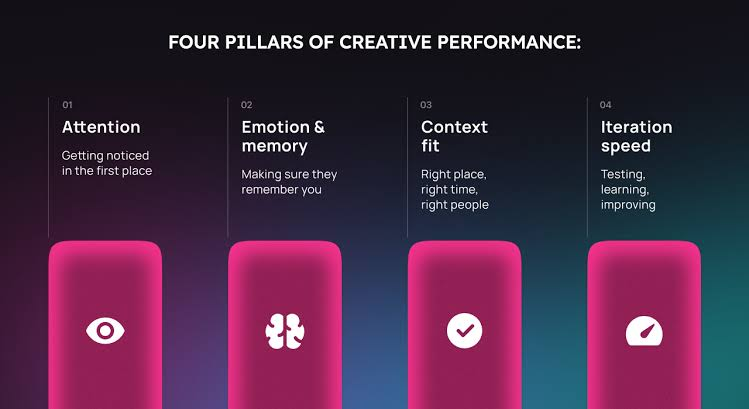
Virtually every performance marketer shares a familiar frustration: a high-performing campaign suddenly hits a wall, leaving everyone searching for answers. With budgets and targeting remaining constant, the creative element becomes the primary variable. Consequently, creative performance insights have emerged as a critical focus for founders, marketing teams, and growth agencies navigating paid advertising in 2026.
Historically, performance tools prioritized bidding strategies, audience segmentation, and campaign structure. Creative assets were often treated as secondary deliverables, passed from designers to marketers with the hope of success. However, that model is no longer viable. Rising advertising costs and shrinking consumer attention spans have elevated ad creative into one of the most vital levers for business growth.
The Trend Behind Marketing Performance Insights in 2026
If you follow the marketing space closely, you have probably noticed a pattern. Conversations that used to center on “which platform performs better?” have shifted toward “how do we actually understand what our ads are doing?” This shift is why marketing performance insights have become a category of their own, separate from basic reporting dashboards.
The reason is simple. Google Ads reports its own version of success, and Meta reports a different one. Neither platform talks to your actual store data, your returns, or your true cost of goods. Without a unified view of performance, businesses end up making decisions based on incomplete or misleading numbers. Founders exploring new channels, agencies managing multiple client accounts, and in-house teams juggling several platforms all face the same problem: fragmented data that hides the real story.
Why This Matters for Growing Brands and Agencies
This isn’t just a technical inconvenience, it has real financial consequences. The budget gets wasted on channels that only look profitable because the reporting is incomplete. Creative teams keep producing variations of an ad that has already peaked simply because nobody flagged the decline in time. For anyone genuinely interested in scaling a business, whether a solo founder testing a first campaign or an agency running dozens of accounts, closing this visibility gap is no longer optional.
How AI Performance Insights Are Reshaping Decision-Making
This is where artificial intelligence has changed the equation. Manually cross-referencing spreadsheets from several platforms used to take hours every week. Today, AI performance insights can process that same volume of data in seconds, flagging shifts in engagement or conversion patterns a human analyst might miss until it’s too late.
What makes this technology genuinely useful is not just speed, its context. A good AI-driven system doesn’t just show a number going down, it connects that number to a cause, whether that’s an ad losing relevance, a segment reaching saturation, or a mismatch between the ad’s promise and the landing page.
The most valuable applications currently fall into a few clear categories:
- Creative fatigue detection, which flags ads before their declining performance quietly drains the budget
- Cross-channel comparison, showing how the same creative performs differently on Google versus Meta versus TikTok
- Pattern recognition across top performers, identifying which formats, hooks, or visuals consistently drive results
- True ROAS calculation, blending ad platform data with actual ecommerce revenue and returns
The next evolution isn’t just detecting problems, it’s recommending solutions. Instead of a dashboard full of numbers, teams increasingly want a system that tells them what to test next based on what has already worked, and that direction is exactly where the entire category is heading.
Turning Insights Into a Repeatable Creative Process
Understanding that creativity drives performance is one thing. Building a repeatable process around it is another. Brands that treat this analysis as a one-time report rather than an ongoing system tend to fall back into old habits within a few weeks.
A Simple Framework to Follow
A sustainable process generally includes a few consistent steps:
- Continuously track every active creative across every connected channel, not just the top spenders
- Score each creative against account-specific benchmarks instead of generic industry averages
- Set automatic alerts for fatigue signals so refresh decisions happen before performance collapses
- Feed the patterns from top performers directly into the next creative brief
Entrepreneurs launching their first paid campaigns and established marketing teams managing multi-brand portfolios both benefit from this structure. It removes guesswork from a part of the funnel that has traditionally relied on intuition and turns creative analysis into a genuine competitive advantage rather than a report nobody reads.
About Meerkads: Turn Your Data Into Your Next Winning Ad
This is exactly the gap Meerkads was built to close. Meerkads is an AI-powered performance marketing platform that connects Google Ads, Meta, TikTok, and your ecommerce store into a single system, giving founders, in-house teams, and agencies a unified view of what is actually working.
Instead of jumping between disconnected dashboards, Meerkads delivers creative performance insights, ai performance insights, and marketing performance insights in one place. It scores every active creative, detects fatigue before it hurts your ROAS, and surfaces the patterns behind your best-performing ads so your next brief is backed by data instead of guesswork.
If you’re ready to stop guessing which creative is actually driving results, start your free trial at meerkads.com and see your true performance picture in minutes, not hours.
