

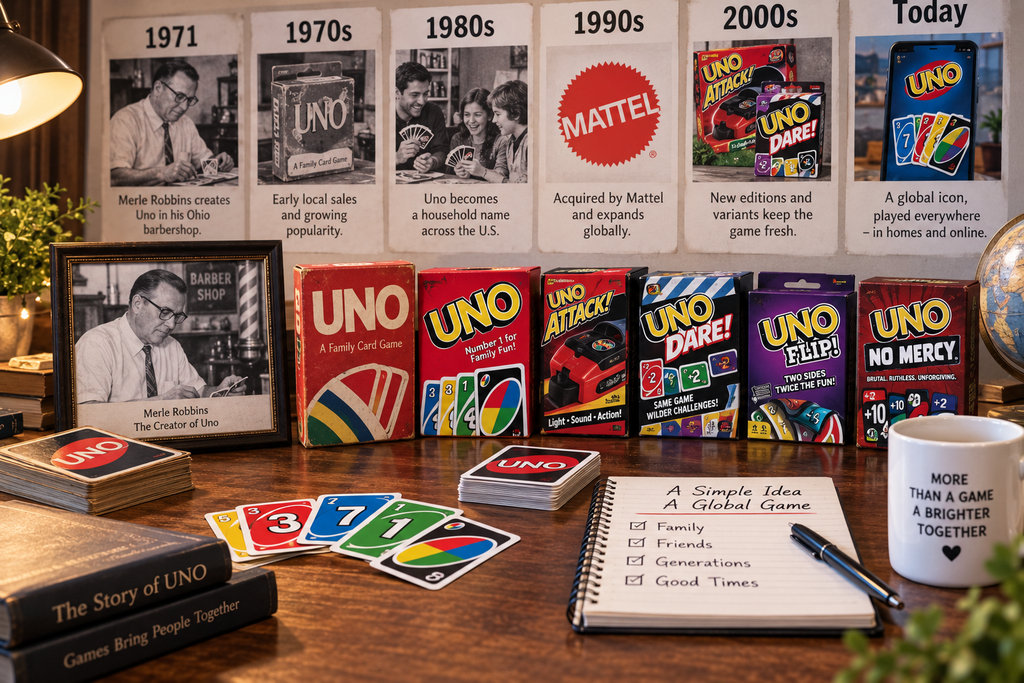
It is easy to take Uno for granted. The bright box sits in nearly every household’s game closet, the rules feel almost second nature by the time most people are adults, and it rarely occurs to anyone to ask where the game actually came from. Yet Uno has a genuinely interesting origin story, one that starts in a small Ohio barbershop and eventually grows into one of the best-selling card games in the world.
This article traces that journey from the beginning, looking at how Uno was created, how it grew into a household name, the variants that have kept it feeling fresh over the decades, and where the game stands today after more than fifty years in circulation.
Origins in 1971
Uno’s story begins with Merle Robbins, a barber living in Reading, Ohio. Robbins and his family had spent years playing Crazy Eights, a classic matching game played with a standard deck of playing cards. At some point, Robbins decided the family favorite could be improved with its own dedicated deck and a slightly refined set of rules, rather than relying on a regular deck that most households already had lying around for other purposes.
He designed the first version of the game himself in 1971, printing an initial batch of decks and selling them locally out of his barbershop. It was a modest, homegrown start for a game that had no idea it was about to become a cultural fixture. According to Wikipedia’s history of Uno, Robbins invested a few thousand dollars of his own money into that first print run, a relatively small gamble that ended up paying off in ways nobody involved could have predicted at the time.
The game’s early growth stayed fairly local for a while, spreading mostly through word of mouth among friends and family in the area. That changed when Robert Tezak, a family friend who ran a funeral home business, saw potential in the game and purchased the rights from Robbins for a relatively small sum plus a share of future royalties. Tezak formed a company specifically to manufacture and distribute the game on a larger scale, marking the real turning point where Uno stopped being a homemade family project and started becoming a commercial product.
Rise to Popularity
Once Tezak’s company began producing Uno at scale, the game spread steadily across the United States throughout the 1970s. Its appeal was straightforward. The rules took only a few minutes to explain, the colorful deck felt distinct from anything else on the market, and it worked equally well for a quiet family evening or a livelier gathering with a full table of players.
By the late 1970s and into the 1980s, Uno had become a recognizable name well beyond its original Ohio roots, eventually catching the attention of larger toy and game companies. The brand changed ownership a few times over the following decades, eventually landing with Mattel, one of the largest toy companies in the world, which continues to manage the brand today.
That path from a small independent company to a subsidiary of a major toy manufacturer is fairly typical for successful game brands from that era, but Uno’s transition happened with relatively little disruption to the actual product itself. Unlike some acquired games that get significantly redesigned or repackaged after changing hands, Uno’s core rules and card design remained largely consistent through each ownership change, which likely helped preserve the brand loyalty it had already built among early fans and their growing families.
Mattel’s resources helped push Uno into international markets and expanded its presence well beyond the United States. The game’s simplicity translated easily across languages and cultures, since it relies on color and number matching rather than text heavy instructions, which made it an easy fit for global distribution without needing extensive localization for every new market it entered.
This international expansion also introduced regional variations and house rules that persist informally to this day, with different countries and communities developing their own preferred tweaks to stacking rules, challenge mechanics, and other small details even though the officially printed rules remained the same everywhere. That kind of organic, community driven variation is often a sign of a game that has genuinely embedded itself into everyday culture rather than remaining a niche product confined to its country of origin.
According to coverage from Smithsonian Magazine’s retrospective on the game’s history, Uno’s rise coincided with a broader boom in accessible, family-friendly tabletop games during the same era, positioning it well to capture a growing market of households looking for simple, affordable entertainment options that did not require significant investment in equipment or setup.
Modern Variants
As Uno settled into its status as a household staple, the brand began experimenting with variants designed to keep the core experience feeling fresh for both longtime fans and newer players. Uno Attack introduced a card launching device that randomly shoots out cards, adding an unpredictable physical element to the traditional card-based penalties.
Uno Dare combined the classic card game with dare-based challenges, appealing to a slightly older, party-oriented crowd looking for something a bit more social and interactive than the standard rule set offers on its own. Uno Flip, released more recently, introduced a genuinely clever twist by printing two complete rule sets on either side of every card, letting players flip the entire game into a tougher, faster paced mode mid round.
Uno No Mercy pushed the difficulty even further, adding harsher penalty cards and new mechanics specifically designed for players who wanted a more aggressive, less forgiving version of the classic gameplay. Themed editions have also become a regular fixture, tying the game’s branding to popular movies, sports teams, and other pop culture properties, which has helped keep Uno visible and relevant to new generations of players who might associate it with a favorite franchise rather than the original barbershop origin story.
These themed and mechanical variants have generally been well received precisely because they respect the original formula rather than trying to replace it outright. A new player can still sit down with a themed deck and recognize the same fundamental matching gameplay they already know, even if the artwork or a handful of specialty cards look unfamiliar at first glance. That consistency has arguably done more for the brand’s long term health than any single flashy variant could accomplish on its own, since it keeps the barrier to entry low no matter which version ends up on the table.
Uno Today
More than fifty years after Robbins first printed those early decks, Uno remains one of the most recognizable card games in the world. It continues to sell strongly across physical retail and digital platforms alike, and Mattel has leaned into that digital shift by supporting official mobile apps and online versions that let players enjoy the game without needing a physical deck at all.
The official Mattel corporate site lists Uno among its most enduring and globally recognized brands, a status few card games from the same era have managed to maintain with the same level of consistency. Its continued presence in pop culture, from social media trends built around dramatic Draw Four moments to its frequent appearance in movies and television as shorthand for a casual family game, keeps it firmly embedded in everyday life well beyond its original physical product.
For anyone curious about experiencing the modern version of the game without needing to track down a physical deck, you can experience modern Uno online through unopeli.fi, which offers a quick way to play or brush up on the rules whenever the mood strikes.
Final Thoughts
Uno’s journey from a small barbershop in Ohio to one of the most widely recognized games on the planet is a genuinely remarkable story, and one that a lot of players never think to ask about while they are busy arguing over whether a Draw Four was played fairly. Its staying power comes down to a combination of simplicity, adaptability, and a willingness from its various owners over the decades to keep experimenting with new variants without ever losing sight of what made the original design work so well in the first place.
More than fifty years later, the game Merle Robbins created for his own family has become a fixture in households around the world, proving that sometimes the simplest ideas end up having the longest staying power of all.
