

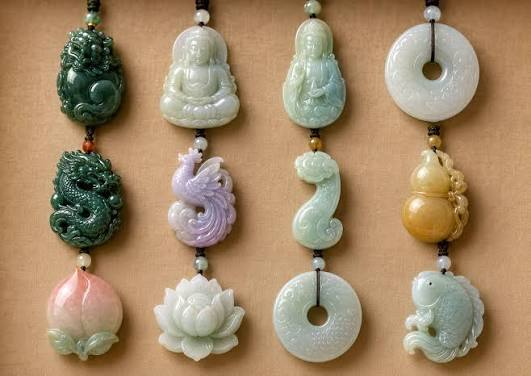
You’ve decided on a jade pendant. Now you’re looking at a page of them — a winged lion, a laughing Buddha, a robed figure, a dragon, a peach, a plain ring with a hole in the middle — and every listing promises good fortune of one kind or another. None of them tells you which one belongs on the person you’re buying for.
Here’s the short answer, and it’s a real one: if you’re not sure, buy a Ping An Kou (平安扣), the peace buckle. It’s a flat circular ring with a central hole, it carries a wish for safety and smooth passage, and it has no wrong recipient and no wrong occasion. It’s the everyday jade of Chinese families — worn by newborns, students, grandmothers, travelers, everyone. Buy that and you will not have made a mistake.
The rest of this is for when you want to get closer than “not a mistake.”
Two Ways to Actually Get This Wrong
Most gift guides put the warnings at the end, by which point the reader has already chosen. These two are worth knowing first, because they’re the only ones that cause real awkwardness.
Religious figures deserve a deliberate choice. Jade Buddha and Guan Yin pendants are the two most popular carvings in the category, and both are religious figures in Chinese Buddhism — Maitreya, the future Buddha, and Avalokiteshvara, the Bodhisattva of Compassion. Giving one to someone with a connection to that tradition, or an interest in it, is thoughtful. Giving one to someone who has neither, because it was the prettiest carving on the page, is less thoughtful than the peace buckle would have been.
Nobody will confront you about it. It’s a question of whether the gift reads as considered.
Jade is given, not lent. In Chinese practice a jade piece handed to someone becomes theirs, and the tradition doesn’t anticipate it coming back. This matters if you were thinking of letting a relative wear a family piece “for a while” — that’s not a loan in the way you might mean it. Either give it or don’t.
With those out of the way, the useful part. If you want the full symbolic background on any carving below, a carving-by-carving gifting guide covers all twelve traditional motifs and the principles behind them.
By Recipient
For a newborn or young child, the traditional choices are a Ping An Kou, a longevity lock, or the child’s zodiac animal. The longevity lock (长命锁, cháng mìng suǒ) is shaped like a padlock, and the idea is exactly what it looks like: the child is locked to life. Along with the peace buckle it’s the most common jade given to infants in Chinese families, which makes it a safe and recognizably traditional choice for a baby gift.
For a student, three carvings work and they say slightly different things. Bamboo (竹) is the strongest: it grows straight, hollow, and in segments, and the phrase attached to it is 节节高升 — rising node by node. It’s the classic gift for someone climbing, whether through school or a career. A Ruyi (如意), the curved scepter shape, means “as you wish” and suits someone with one specific goal in view, an exam or an application. A carp is the third option, from the legend of the fish that leaps the Dragon Gate and becomes a dragon — the standard Chinese metaphor for clearing a hard threshold.
For an elder, especially a milestone birthday, the answer is the peach (寿桃, shòu táo). It comes from the Daoist legend of Xiwangmu, the Queen Mother of the West, whose heavenly peaches ripened once every three thousand years and were eaten by the Eight Immortals at her birthday banquet. Chinese families still serve peach-shaped buns at sixtieth, seventieth and eightieth birthdays, so the jade version reads immediately to anyone who grew up with it.
One distinction to get right: the peach fruit means longevity, the peach blossom means romance. They are different carvings with different meanings, and they don’t substitute for each other. Check that the piece you’re buying is the fruit — round below, narrow at the top, usually with a leaf at the stem.
For a couple getting married, the Dragon-and-Phoenix (龙凤呈祥) is the single most important pairing in Chinese symbolism: dragon as yang, phoenix as yin, the two in harmony. It can be carved into one piece or given as two pendants, one to each partner, which is the version that works best as a wedding gift because it’s the only jade gift that’s structurally about two people.
For a mother, Guan Yin, with the caveat about religious figures above. She’s the Bodhisattva of Compassion and, in Chinese practice, protector of mothers and children specifically. For a woman who doesn’t have a connection to the tradition, a lotus carries a related register — grace, renewal — with no religious content.
For a man in business, three carvings dominate: the Buddha, the Pixiu, and Guan Gong. The Pixiu (貔貅) is the one worth understanding, because it’s the most popular wealth carving in Chinese jade and its logic is unusual. It’s a winged lion-dragon hybrid with an appetite for gold and, in the legend, no way to release what it swallows. That makes it a symbol of wealth acquired and retained, which is why it’s favored by business owners rather than by people who simply want more money. Traditional practice faces the Pixiu outward so it can see fortune to draw in.
For someone ill or recovering, the gourd (葫芦, hú lu). Its name sounds like 福禄, blessing and prosperity, and its hollow double-bulb form is the vessel that holds the elixir of life in Daoist stories — Li Tieguai of the Eight Immortals carries one full of medicines. It’s the traditional health carving, and it reads as a wish for recovery rather than as a comment on the illness, which matters when you’re choosing a gift for someone unwell.
For someone traveling or moving away, the Ping An Kou again. This is its classic use: the piece you give before a journey. The unbroken ring is wholeness, the central hole is passage without obstruction, and the name means, roughly, peace, fastened.
For someone going through something hard — grief, divorce, a bad year — the lotus. It grows out of mud and opens clean above the water, and the mud doesn’t stain it. That meaning needs no cultural background to land, which makes the lotus the carving that travels best to a Western recipient. Zhou Dunyi’s Song-dynasty essay made it the flower of the gentleman in Confucian thought; in Buddhism it’s the seat of the Buddha. Either way, it says the same thing.
Three Things That Matter as Much as the Carving
Color should agree with the carving’s register. Deep green and black for the weighty motifs — dragon, Pixiu, Guan Gong. Lavender and white for the gentler ones — Guan Yin, phoenix, lotus. Icy and white for the ones about clarity, like the peace buckle. Warm tones — yellow, honey, apple green — for joy and longevity, so Buddha, peach, gourd. These are conventions rather than rules, but a recipient who knows the tradition will notice when they line up.
Size depends on how it will be worn. Around 3 to 4 cm suits a piece worn daily under clothing. A pendant meant to be seen wants 5 to 7 cm. Check the chain length separately, and check whether a chain is even included, because plenty of sellers price the pendant alone.
Material disclosure matters more on carved pieces than on plain ones. For jadeite, you want the listing to say Type A, meaning untreated: no acid bleaching, no polymer resin, no dye. The reason this matters more for carvings is physical — carving creates grooves and undercuts, and those are exactly where dye pools and where treated material shows its damage first. A plain cabochon can hide a lot that a carved dragon can’t.
Before You Order
Three steps, in this order.
First, pick the person, not the carving. Find the recipient in the section above and start from the one or two carvings listed there. Choosing by which one looks nicest is how people end up giving a business owner’s wealth charm to a retired schoolteacher.
Second, ask the seller four questions. Is it jadeite or nephrite? For jadeite, is it Type A, and is there a report number you can verify? What are the pendant’s dimensions? Is a chain included, and what metal is it? A seller who answers all four plainly is one you can buy from.
Third, ask for a backlit photograph before you pay. Hold the image up and look into the carved grooves. On treated material, dye concentrates in exactly those recesses and shows as color that’s stronger in the crevices than on the flat surfaces. It’s the one check that’s worth more on a carved pendant than on anything else in jade.
And if you get through all three and still can’t decide between two carvings, the peace buckle is sitting right where you left it at the top of this page.
