

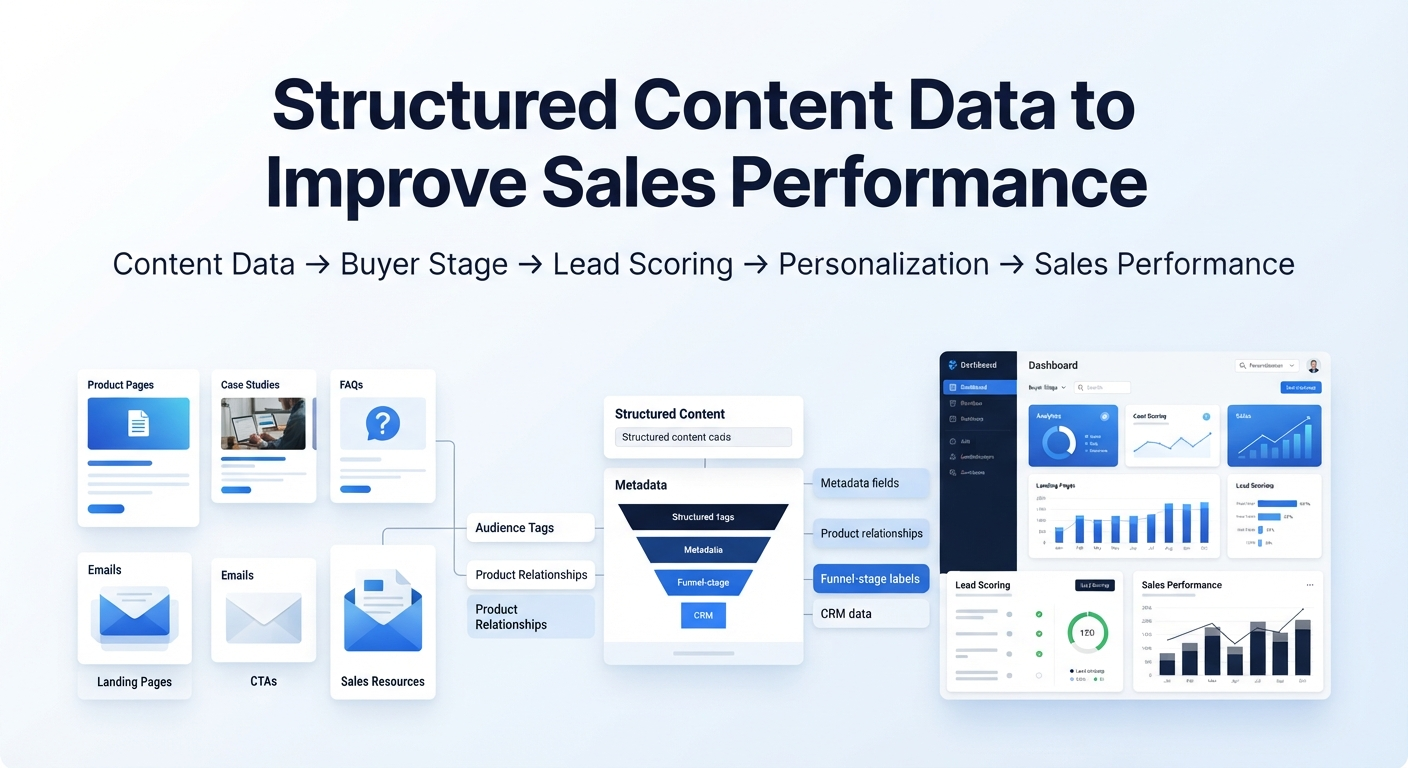
Sales performance depends on how well a business can guide buyers from interest to action. Buyers need clear product information, relevant proof, helpful resources, strong calls-to-action, and consistent messaging across every touchpoint. However, many sales teams struggle to understand which content actually helps buyers move forward. They may have landing pages, case studies, emails, product pages, FAQs, and sales materials, but without structure, it can be difficult to know what is working and what needs improvement.
Structured content data helps businesses make sales content more useful, measurable, and connected to performance outcomes. By organizing content with clear fields, metadata, buyer-stage labels, audience tags, product relationships, and channel information, teams can better understand how content supports the sales journey. This allows sales and marketing teams to improve messaging, personalize experiences, prioritize content investments, and make better decisions based on real buyer behavior.
Creating a Strong Foundation for Sales Content Data
Structured content data begins with a strong foundation. If content is managed as isolated pages, files, or documents, it becomes difficult to measure and improve. A case study may perform well, but teams may not know which product, industry, funnel stage, or buyer segment it supports. Read more about how structured content data can provide clearer insights into performance and buyer engagement. A landing page may generate leads, but without structured data, it can be hard to understand which content elements influenced the result.
A structured system gives every content asset a clear identity. Product pages, guides, FAQs, CTAs, emails, sales resources, and case studies can be organized with useful fields and labels. This creates a more reliable content foundation for sales teams and marketers. When content is structured properly, performance data becomes easier to interpret. Teams can stop guessing which resources matter and start connecting content activity to sales performance more clearly.
Turning Content Into Measurable Sales Assets
Sales content should not only exist as information; it should function as a measurable asset. Every guide, product page, case study, comparison resource, and FAQ can influence how a buyer thinks and what action they take next. However, if content is not structured, teams may only see surface-level metrics such as page views or downloads. These numbers can be useful, but they do not always explain sales impact.
Structured content data makes each asset easier to evaluate. Content can be tagged by topic, product, audience, funnel stage, format, and purpose. This allows teams to compare performance across content types and understand which assets support lead generation, qualification, opportunity creation, or conversion. When content becomes measurable, businesses can invest more confidently in the resources that actually support sales outcomes.
Connecting Content to Funnel Stages
Different content supports different parts of the sales funnel. Awareness-stage content may educate buyers and attract new leads. Consideration-stage content may help buyers compare options and understand product value. Decision-stage content may provide reassurance through case studies, pricing explanations, implementation details, or strong calls-to-action. If content is not connected to funnel stages, it becomes harder to understand where it contributes.
Structured content data allows teams to label each asset by its role in the funnel. This makes it easier to see whether the sales journey has enough support at every stage. A business may discover that it has many awareness articles but not enough decision-stage resources. It may also learn that comparison content performs strongly in moving leads toward sales conversations. Funnel-stage data helps teams improve sales performance by placing the right content where buyers need it most.
Improving Lead Scoring With Content Engagement
Lead scoring becomes more accurate when content engagement is properly understood. Not every content interaction signals the same level of intent. A visitor reading a general educational article may be at an early stage, while someone viewing pricing pages, product comparisons, or implementation FAQs may be much closer to a buying decision. Without structured data, these differences can be difficult to evaluate.
Structured content data helps businesses assign meaning to content engagement. Assets can be tagged by intent level, funnel stage, product interest, and buyer need. Marketing automation and CRM systems can then use this information to score leads more intelligently. A lead who interacts with several decision-stage resources can be prioritized differently from a lead who only reads introductory content. Better lead scoring helps sales teams focus on prospects who are more likely to move forward.
Personalizing Sales Experiences With Better Data
Personalization improves sales performance when it helps buyers find information that matches their needs. A buyer from one industry may need different proof points than a buyer from another. A returning lead may need comparison content rather than beginner education. An existing customer may need upgrade or renewal information instead of introductory product messaging. Structured content data makes these personalized experiences easier to deliver.
By tagging content according to audience, industry, region, buyer stage, product interest, and intent, businesses can create more relevant sales journeys. A website, email sequence, or customer portal can recommend content based on what the buyer has already viewed or shared. This reduces friction because buyers do not have to search through irrelevant information. Personalized content helps buyers feel understood, which can increase engagement and support stronger conversion rates.
Optimizing Product Messaging Based on Performance
Product messaging has a direct impact on sales performance. Buyers need to understand what a product does, why it matters, and how it solves their specific challenge. If product messaging is unclear or poorly aligned with buyer needs, even strong traffic may not turn into sales opportunities. Structured content data helps teams understand which product messages are actually working.
Product content can be broken into structured fields such as value proposition, feature explanation, benefit statement, use case, proof point, and CTA. Teams can then analyze which messages perform best across pages, campaigns, regions, and buyer segments. If one benefit statement drives more demo requests, it can be reused more strategically. If another message underperforms, it can be refined. This turns product messaging into a measurable and improvable part of the sales engine.
Supporting Sales Enablement With Structured Insights
Sales teams need content that helps them answer questions, handle objections, and guide buyers toward decisions. However, sales enablement content often becomes difficult to manage when resources are scattered or poorly categorized. Representatives may not know which case study, FAQ, comparison guide, or product sheet fits a specific buyer conversation. Structured content data makes enablement more practical and useful.
Each sales resource can be tagged by buyer stage, product, industry, objection, region, and use case. This helps representatives quickly find relevant materials before or after sales conversations. It also helps sales leaders understand which content is being used most often and which resources may need improvement. When enablement content is structured and measurable, sales teams can work more efficiently and deliver more relevant follow-ups to buyers.
Identifying High-Performing Content Assets
Not all content contributes equally to sales performance. Some assets may attract traffic but fail to influence conversion. Others may receive fewer views but play an important role in moving qualified buyers forward. Structured content data helps teams identify which assets are truly valuable. This creates a better basis for deciding what to update, promote, reuse, or expand.
By analyzing content based on metadata, teams can compare performance across topics, formats, products, audiences, and funnel stages. A business may find that industry-specific case studies support late-stage opportunities, while comparison guides help move leads into sales conversations. These insights allow teams to focus on high-impact content instead of simply producing more assets. Understanding what performs well helps improve both content strategy and sales outcomes.
Revealing Gaps in the Sales Content Library
Structured content data can also show what is missing. A sales content library may look large, but it may not support every buyer need. There may be many awareness articles but few decision-stage FAQs. There may be strong product pages but not enough industry-specific proof. There may be localized landing pages but limited regional sales resources. These gaps can slow buyers down and reduce conversion opportunities.
When content is organized by funnel stage, product, audience, industry, and region, gaps become easier to see. Teams can identify where the sales journey lacks support and prioritize new content accordingly. This helps businesses create content with a clear purpose. Instead of creating resources based on assumptions, teams can build assets that solve real sales problems and help buyers move forward.
Improving Campaign Performance Through Content Data
Campaign performance depends heavily on content relevance. A campaign may bring visitors to a landing page, but the page still needs the right message, proof, CTA, and supporting resources to convert. Structured content data helps teams understand which campaign elements are working and which need improvement. Without structure, campaign analysis may only show basic conversion numbers without explaining why results changed.
Structured content allows landing page modules, CTAs, testimonials, product highlights, and FAQs to be tagged and measured. Teams can analyze whether certain benefit blocks perform better for specific audiences or whether case studies improve form submissions. This makes campaign optimization more precise. Instead of changing entire pages without direction, teams can improve specific content elements that influence buyer behavior. Better campaign content data leads to stronger digital sales performance.
Aligning Sales and Marketing Around Shared Data
Sales and marketing teams often look at content from different perspectives. Marketing may focus on engagement and lead generation, while sales focuses on buyer conversations and closed opportunities. Structured content data gives both teams a shared language for understanding performance. Instead of debating content value based on opinion, teams can look at how resources support the buyer journey.
When content is tagged consistently, marketing can see which assets generate interest, and sales can see which resources help opportunities progress. Both teams can identify which topics, objections, and buyer stages need better support. This alignment improves collaboration because content planning becomes connected to real sales needs. Sales and marketing can work together to refine resources, update messaging, and prioritize content that improves outcomes.
Supporting Localized Sales Performance
For businesses selling across multiple markets, structured content data is especially valuable. Different regions may respond to different messages, proof points, CTAs, or content formats. Without structured data, teams may not know which localized content performs well or where regional gaps exist. This can make global sales performance harder to improve.
Structured content allows localized assets to be tagged by language, region, product, market, and buyer stage. Teams can compare performance across markets and identify what needs adjustment. A case study may work well in one region, while another market may need different proof or examples. Localized performance insights help teams adapt without losing global consistency. This makes international sales content more effective and easier to manage over time.
Making Content Updates More Strategic
Content updates should be guided by performance, not only by internal requests. Teams may often revise pages, rewrite copy, or create new resources without knowing whether those changes will improve sales outcomes. Structured content data helps make updates more strategic because teams can see what is working, what is outdated, and what creates friction.
If a decision-stage FAQ receives high engagement but low follow-through, the answer may need to be clearer. If a product page receives traffic but few conversions, the messaging or CTA may need refinement. If a case study is frequently shared by sales but rarely updated, it may deserve review. Structured data helps teams prioritize updates that matter most. This makes content management more focused and sales-driven.
Conclusion
Using structured content data to improve sales performance gives businesses a clearer way to understand how content supports the buyer journey. Sales content is not only a collection of pages, guides, emails, and resources. It is a system that can influence awareness, consideration, decision-making, lead quality, sales conversations, and customer conversion. Without structure, it is difficult to know which content truly matters.
By organizing content with metadata, funnel-stage labels, product relationships, audience tags, localization fields, and performance data, businesses can make better sales decisions. Teams can improve lead scoring, personalize content, identify gaps, optimize campaigns, support sales enablement, and connect content engagement with CRM insights. This helps sales and marketing work more effectively together while giving buyers clearer and more relevant experiences. As digital sales journeys become more complex, structured content data will remain essential for improving performance and driving stronger outcomes.
