

As businesses move more of their operations, data, and customer interactions online, cybersecurity has become an essential part of modern technology. Companies need professionals who can identify vulnerabilities, monitor networks, investigate incidents, protect sensitive information, and respond to cyber threats.
This growing need has also made cybersecurity an attractive career option for students, IT professionals, and people looking to transition into technology. But getting started can be confusing. There are university programs, professional certifications, short-term courses, and online cybersecurity training programs, each designed for different experience levels.
The right course should therefore do more than provide a certificate. It should help you develop practical security skills and understand how cybersecurity is applied in real-world environments.
This guide covers some of the best online cybersecurity courses with certification in 2026, along with what they teach, who they are suitable for, and how to choose the right option.
Best Online Cybersecurity Courses With Certification in 2026
| Course / Certification | Provider | Best For | Key Areas |
| Cyber Security Course | Intellipaat | Beginners and working professionals | Network Security, Ethical Hacking, Linux, IAM, Cryptography |
| Google Cybersecurity Professional Certificate | Beginners | Linux, SQL, Python, SIEM, Threats and Vulnerabilities | |
| CompTIA Security+ | CompTIA | Entry-level cybersecurity professionals | Security Fundamentals, Threats, Risk, Network Security |
| IBM Cybersecurity Analyst Professional Certificate | IBM | Beginners and aspiring security analysts | Security Operations, Network Security, SIEM, Incident Response |
| Certified Ethical Hacker (CEH) | EC-Council | Ethical hacking professionals | Penetration Testing, Vulnerability Assessment, Ethical Hacking |
| Certified in Cybersecurity (CC) | ISC2 | Cybersecurity beginners | Security Principles, Network Security, Risk, Incident Response |
The best option depends on your current technical knowledge and the cybersecurity role you want to pursue.
1. Intellipaat Cyber Security Course
For learners looking for a structured cybersecurity course online with certification and hands-on training, Intellipaat offers a comprehensive program covering cybersecurity fundamentals as well as practical security techniques.
The current program lists 168 hours of live classes over seven months, 60+ live sessions, and 25+ real-world cybersecurity projects. It also includes training from IIT faculty and EC-Council-certified experts. The program currently lists certifications from iHUB IIT Roorkee and EC-Council.
The curriculum covers areas including network security, cryptography, risk analysis, SQL injection, identity and access management, Linux, and ethical hacking. The program also provides exposure to tools and technologies used in practical cybersecurity environments.
Key areas covered
- Cybersecurity fundamentals
- Linux foundations
- Network security
- Cryptography
- Ethical hacking
- Vulnerability assessment
- SQL injection
- Identity and access management
- Risk analysis
- Security operations
- Generative AI in cybersecurity
- Practical cybersecurity projects
The combination of instructor-led training and hands-on projects makes this type of program useful for learners who prefer structured guidance instead of relying entirely on self-paced resources.
Best for: Students, beginners, IT professionals, and career changers who want structured cybersecurity training with practical projects.
2. Google Cybersecurity Professional Certificate
The Google Cybersecurity Professional Certificate is designed for people who want to enter cybersecurity without previous professional experience.
Google states that no relevant experience is required and that the program is fully online and practice-based. Its curriculum covers areas such as Linux, SQL, Python, security risks, threats and vulnerabilities, detection and response, and cybersecurity tools.
The program also helps learners prepare for the CompTIA Security+ examination, making it a possible starting point for people who want to progress toward an industry certification.
What you can learn
- Cybersecurity fundamentals
- Linux
- SQL
- Python
- Threat identification
- Vulnerability management
- Security monitoring
- Incident response
- Security information and event management
- Security automation
Best for: Beginners who want a guided introduction to cybersecurity.
3. CompTIA Security+
CompTIA Security+ is one of the better-known entry-level cybersecurity certifications. Unlike a professional certificate program that primarily focuses on guided coursework, Security+ is an assessment-based certification.
It is designed to validate foundational cybersecurity knowledge across areas such as threats, vulnerabilities, security architecture, risk management, and incident response.
The current certification is particularly useful for learners who already have some basic IT or networking knowledge and want a recognized cybersecurity credential.
Best for: IT professionals, aspiring security analysts, and candidates preparing for entry-level cybersecurity positions.
4. IBM Cybersecurity Analyst Professional Certificate
The IBM Cybersecurity Analyst Professional Certificate provides another beginner-friendly route into cybersecurity.
The program focuses on practical security concepts and can help learners understand areas such as network security, endpoint protection, incident response, and security operations.
Compared with a certification that focuses primarily on examination objectives, a professional certificate program can provide a more structured learning experience for someone who is still developing foundational skills.
Best for: Beginners and learners interested in security analyst or SOC-related career paths.
5. Certified Ethical Hacker (CEH)
The Certified Ethical Hacker (CEH) certification from EC-Council focuses on ethical hacking and offensive security concepts.
Rather than concentrating only on defensive cybersecurity, ethical hacking training helps learners understand how attackers identify weaknesses and how security professionals can assess and address those weaknesses.
Common areas include:
- Reconnaissance
- Scanning
- Vulnerability analysis
- System security
- Web application security
- Wireless security
- Social engineering
- Penetration testing concepts
Best for: IT professionals and cybersecurity learners interested in ethical hacking and penetration testing.
6. ISC2 Certified in Cybersecurity (CC)
The ISC2 Certified in Cybersecurity (CC) is another option for people entering the cybersecurity field.
It focuses on foundational security knowledge and can provide a starting point for learners who are not yet ready for more specialized certifications.
The certification can be particularly useful for people who want to establish their cybersecurity fundamentals before progressing toward more advanced credentials.
Best for: Students, career changers, and beginners entering cybersecurity.
What Should a Cybersecurity Course Cover?
Choosing a cybersecurity course simply because it offers a certificate can be a mistake. A useful program should teach skills that correspond to actual security work.
Here are some important areas to look for.
1. Cybersecurity Fundamentals
Start with the basics:
- CIA triad
- Authentication
- Authorization
- Access control
- Security policies
- Risk management
- Common cyber threats
These concepts provide the foundation for more advanced cybersecurity topics.
2. Networking and Network Security
A cybersecurity professional needs to understand how networks work before learning how to secure them.
A good course should introduce:
- TCP/IP
- DNS
- HTTP/HTTPS
- Firewalls
- VPNs
- Network monitoring
- Network attacks
- Intrusion detection
3. Linux
Linux is widely used in cybersecurity environments. Learning basic Linux commands, permissions, processes, networking, and system administration can be particularly useful.
4. Ethical Hacking
Ethical hacking helps security professionals understand how vulnerabilities can be discovered and exploited in authorized environments.
Topics may include:
- Reconnaissance
- Vulnerability scanning
- Web security
- Network attacks
- Password security
- Exploitation fundamentals
- Penetration testing
5. Security Operations
Security Operations Center professionals monitor systems and investigate suspicious activity.
A practical cybersecurity course should introduce concepts such as:
- SIEM
- Log analysis
- Threat detection
- Incident response
- Security monitoring
- Alert investigation
6. Cloud Security
As organizations increasingly use cloud infrastructure, cybersecurity professionals also need to understand cloud security concepts.
Look for introductory coverage of:
- Identity and access management
- Cloud permissions
- Data protection
- Network security
- Cloud monitoring
- Shared responsibility
7. Identity and Access Management
IAM controls who can access systems, applications, and data.
Important concepts include:
- Authentication
- Authorization
- Role-based access
- Privileged access
- Multi-factor authentication
- Identity governance
8. Hands-On Labs and Projects
Cybersecurity is a practical discipline. Reading about vulnerabilities is useful, but working through security labs gives learners a much better understanding of how attacks and defenses work.
Look for courses that include:
- Virtual labs
- Capture-the-flag exercises
- Vulnerability assessments
- Network analysis
- Security investigations
- Incident-response exercises
- Real-world case studies
How to Choose the Best Online Cybersecurity Course
With so many options available, compare programs using a few practical criteria.
Check the syllabus
Make sure the course covers the skills relevant to your target role.
For example, someone targeting a SOC analyst position may need more SIEM and incident-response training, while someone interested in ethical hacking should prioritize penetration testing and vulnerability assessment.
Look for practical training
A course that includes labs and projects can help you build a portfolio and gain confidence with cybersecurity tools.
Check the certification
Understand what type of credential you receive.
There is an important difference between:
Course completion certificate → confirms that you completed a training program.
Professional certification → generally involves a formal examination or assessment of your knowledge.
Both can have value, but they serve different purposes.
Consider your experience level
A beginner should not immediately choose an advanced penetration-testing certification without understanding networking and operating systems.
A better approach is to progress gradually.
Compare learning formats
Online cybersecurity programs can include:
- Self-paced courses
- Live instructor-led classes
- Weekend programs
- University-backed programs
- Certification preparation
- Blended learning
Choose the format that fits your schedule and learning style.
Cybersecurity Course for Beginners: Where Should You Start?
If you have no IT background, don’t feel pressured to start with advanced ethical hacking.
A practical learning sequence could be:
Computer Fundamentals → Networking → Linux → Cybersecurity Fundamentals → Security Tools → Ethical Hacking/SOC → Specialization
Once you understand the basics, you can choose a specialization such as:
- Ethical hacking
- SOC operations
- Cloud security
- Application security
- Digital forensics
- Incident response
- Identity and access management
This approach gives you a stronger foundation than trying to learn advanced tools without understanding the systems behind them.
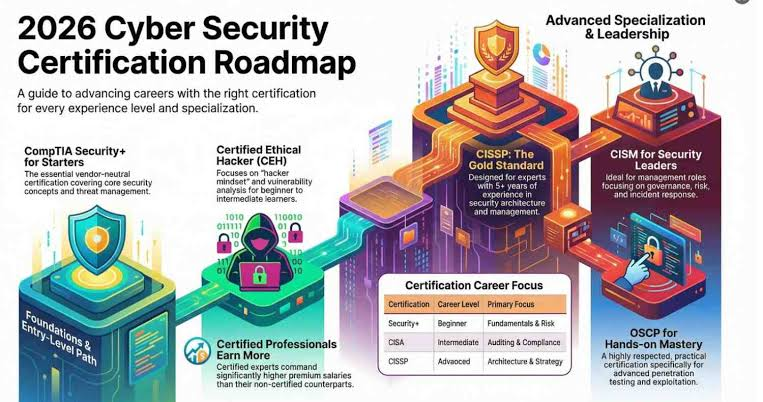
Cybersecurity Certifications to Consider in 2026
The right certification depends on your career stage.
For beginners
Consider foundational options such as:
- Google Cybersecurity Professional Certificate
- ISC2 Certified in Cybersecurity
For entry-level IT and security professionals
Consider:
- CompTIA Security+
- Relevant vendor-specific security certifications
For ethical hacking
Consider:
- Certified Ethical Hacker
- Practical penetration-testing certifications
For experienced professionals
Advanced credentials such as CISSP can become relevant once you meet the required professional experience and want to move toward senior or management-level cybersecurity roles.
The key point is to choose certifications according to your career stage rather than collecting credentials without a clear objective.
Career Opportunities After a Cybersecurity Course
Cybersecurity offers several career paths. Depending on your skills and specialization, you could work toward roles such as:
- Cybersecurity Analyst
- Security Analyst
- SOC Analyst
- Information Security Analyst
- Security Engineer
- Network Security Engineer
- Ethical Hacker
- Penetration Tester
- Incident Response Analyst
- Cloud Security Engineer
- Application Security Analyst
- Security Consultant
The Google Cybersecurity Certificate, for example, specifically identifies roles such as cybersecurity analyst, SOC analyst, information security analyst, IT security analyst, and cyber defense analyst as potential career paths.
Is an Online Cybersecurity Certification Worth It in 2026?
Yes, but a certification should be treated as one part of your career preparation.
Cybersecurity employers need people who can understand systems, identify threats, investigate incidents, and apply security controls. A certificate without practical knowledge may not be enough to demonstrate those abilities.
A stronger approach is:
Certification + Hands-On Labs + Projects + Networking Knowledge + Interview Preparation
For example, instead of only studying security concepts, build a small home lab, analyze network traffic, investigate sample logs, practice vulnerability assessment in authorized environments, and document what you learned.
That gives you practical examples to discuss during interviews.
What Skills Should You Learn for a Cybersecurity Career?
A strong cybersecurity foundation can include:
Technical skills
- Networking
- Linux
- Windows security
- Python
- SQL
- Cryptography
- Network security
- Vulnerability assessment
- Ethical hacking
- SIEM
- Incident response
- Cloud security
- IAM
- Security automation
Professional skills
Technical knowledge is only part of the job. Security professionals also need:
- Problem-solving
- Analytical thinking
- Attention to detail
- Communication
- Documentation
- Incident reporting
- Risk assessment
- Continuous learning
Cybersecurity changes constantly, so the ability to keep learning is particularly important.
Online Cybersecurity Course vs Certification: What’s the Difference?
These terms are often used interchangeably, but they are not always the same.
| Online Course | Professional Certification |
| Primarily designed for learning | Primarily validates knowledge |
| May include videos and labs | Usually involves an assessment or examination |
| Can be beginner-friendly | Often has defined objectives |
| May provide a completion certificate | Provides a professional credential |
| Focus can vary widely | Usually follows a standardized exam blueprint |
You don’t necessarily have to choose one or the other. A structured course can help you learn the material, while a recognized certification can validate your knowledge.
Frequently Asked Questions
Which is the best online cybersecurity course in 2026?
There is no single best course for everyone. Beginners may benefit from Google Cybersecurity or ISC2 CC, while learners looking for structured, project-based training can consider comprehensive programs such as Intellipaat’s Cyber Security Course. More experienced professionals may prefer specialized certifications such as Security+ or CEH.
Which cybersecurity certification is best for beginners?
Google’s Cybersecurity Professional Certificate and ISC2 Certified in Cybersecurity are beginner-friendly starting points. CompTIA Security+ can be a strong next step for learners who have developed basic IT and networking knowledge.
Can I learn cybersecurity online?
Yes. Many cybersecurity programs are completely online and include video lessons, live classes, virtual labs, projects, assessments, and certification preparation.
Can I learn cybersecurity without a technical background?
Yes, but you should start with fundamentals. Learning basic networking, operating systems, Linux, and security concepts before moving into advanced ethical hacking can make the learning process much easier.
Is cybersecurity a good career in 2026?
Cybersecurity remains an important technology function because organizations need to protect systems, applications, networks, and data. However, entering the field requires more than earning a certificate. Practical skills, projects, and a strong understanding of IT fundamentals can improve your career prospects.
What programming language should I learn for cybersecurity?
Python is a useful starting point because it can be used for automation, scripting, data processing, and security tools. SQL is also valuable for working with databases and investigating security-related data.
Do I need to learn ethical hacking to work in cybersecurity?
No. Ethical hacking is only one area of cybersecurity. You can specialize in SOC operations, cloud security, incident response, application security, IAM, governance, risk, and compliance.
How long does it take to learn cybersecurity?
The timeline depends on your starting point and career goal. A beginner may need several months to develop networking, Linux, security, and hands-on skills. Advanced specializations require additional experience and continuous practice.
Is a cybersecurity certification enough to get a job?
No certification can guarantee employment. Certifications can demonstrate knowledge and commitment, but employers may also evaluate practical skills, projects, experience, communication, and problem-solving ability.
Final Thoughts
The best online cybersecurity courses with certification in 2026 are those that combine structured learning with practical experience.
If you’re starting from scratch, begin with networking, Linux, operating systems, and cybersecurity fundamentals. Once you have that foundation, you can move toward ethical hacking, SOC operations, cloud security, incident response, or another specialization.
Choose certifications based on your career stage instead of collecting as many credentials as possible. More importantly, practice what you learn through labs and projects.
A certificate can strengthen your resume, but practical cybersecurity skills are what help turn that credential into a career opportunity.
